

- Best Picks at a Glance
- Detailed Reviews
- Purina Pro Plan FortiFlora (Enterococcus faecium SF68)
- Nutramax Proviable-DC (cat formulation)
- Vetri-Science Probiotic Everyday Feline
- Zesty Paws Probiotic Bites (cat)
- Plain unsweetened kefir (human food)
- 🏆 Editor's Pick
- Practical Buying Advice
- FAQ
- Choosing the Right One for Your Cat
Walk down the pet supplement aisle and you’ll see the same word slapped on a dozen different tubs: “probiotic.” Most of it is marketing dressed up as science. The bacterial strains in the majority of cat probiotics were never tested in cats at all — they were pulled from human research or dairy fermentation cultures because they’re cheap and easy to source, not because anyone proved they do anything once they hit a cat’s gut.
That doesn’t mean probiotics are useless for cats. It means you need to know which ones actually have research behind them before you spend money on a “50 billion CFU” tub that’s essentially a guess.
“If you’re short on time: FortiFlora (Enterococcus faecium SF68) is the only cat probiotic with real published feline research behind it, which is why vets reach for it first — especially after antibiotics or during a bout of diarrhea. For everyday maintenance, a multi-strain option like Vetri-Science or Nutramax Proviable is reasonable, even without the same depth of evidence. Skip anything selling you on CFU count alone; the strain matters far more than the number on the label.”
Best Picks at a Glance
Purina Pro Plan FortiFlora (Enterococcus faecium SF68) – 9.4/10 The clear pick for post-antibiotic recovery or active diarrhea, backed by more published feline research than any competitor on this list — this is the one vets actually reach for.
Nutramax Proviable-DC (cat formulation) – 8.2/10 A solid multi-strain option with a real veterinary track record, especially for cats with IBD or chronic loose stool who need more flexible dosing formats.
Vetri-Science Probiotic Everyday Feline – 7.6/10 A reasonable daily-maintenance choice with FOS prebiotic fiber included, though most of its individual strains lack feline-specific studies.
Zesty Paws Probiotic Bites (cat) – 6.4/10 Best reserved for cats who flatly refuse powders — palatability is the whole selling point here, not evidence.
Plain unsweetened kefir – 6.0/10 A genuinely low-cost option for cost-conscious owners, but it’s food, not a controlled clinical product, and comes with zero cat-specific strain data.
Detailed Reviews
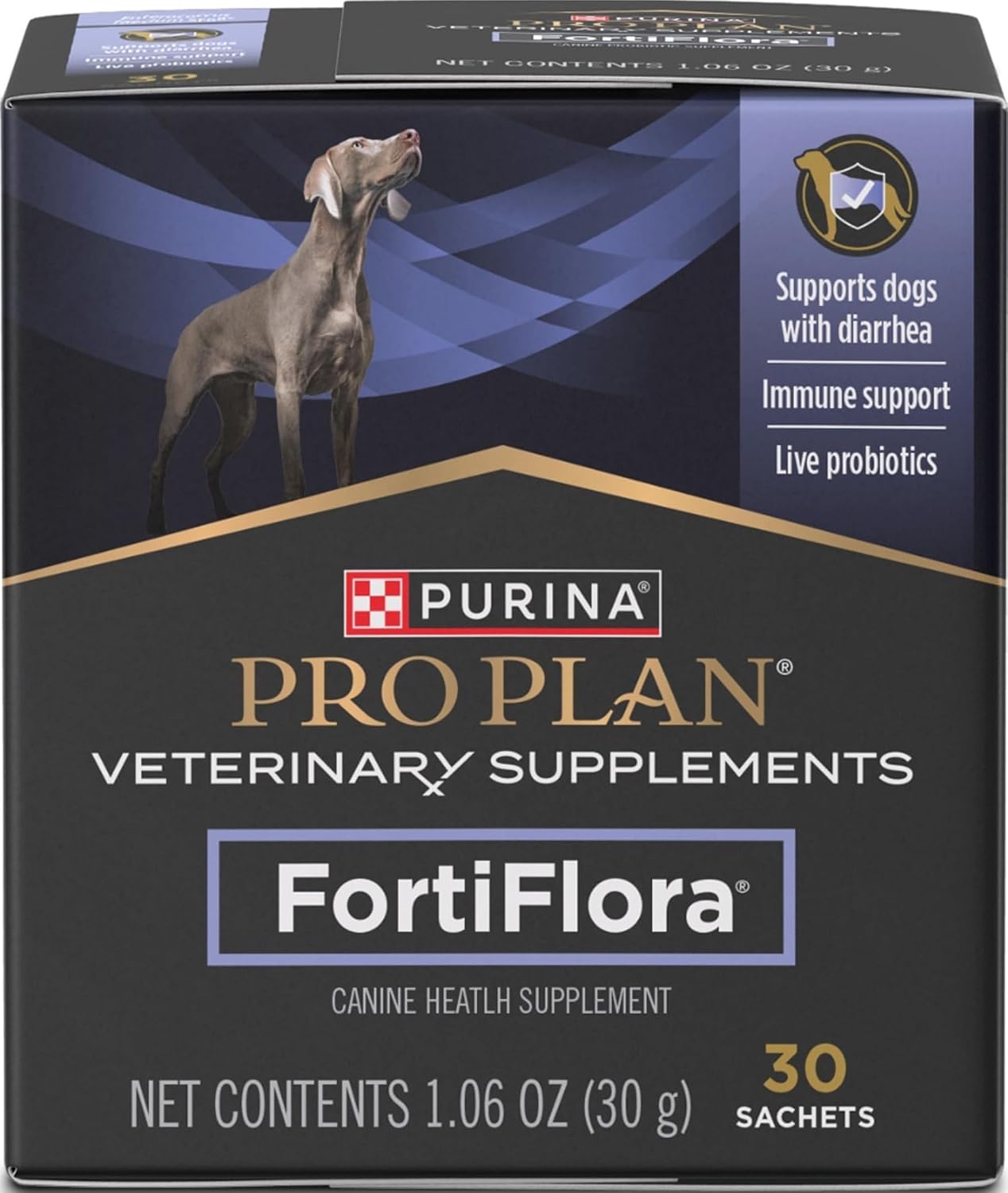
Purina Pro Plan FortiFlora (Enterococcus faecium SF68)
Rating: 9.4/10
FortiFlora is the odd one out on this list, and not because of clever marketing. It’s built around Enterococcus faecium SF68, the only bacterial strain with published clinical research specifically conducted in cats. That single fact explains why it’s been a go-to vet recommendation for longer than most competing brands have existed.
Pros
- The most published feline-specific probiotic research of any product on the market
- The #1 vet-recommended cat probiotic
- Single-serving sachets make dosing consistent and simple
- Cats generally accept it readily, likely helped by the chicken liver flavoring
Cons
- Single-strain formula — no multi-strain diversity
- No prebiotic fiber included
- Costs more per dose than bulk powder alternatives
- Designed for short-course use (post-antibiotic, acute diarrhea) rather than indefinite daily maintenance
Where FortiFlora earns its reputation is in clinical situations: a cat coming off antibiotics, a sudden bout of loose stool, or a vet-directed digestive protocol. If you’re supplementing for a specific reason rather than general wellness, this is the product with actual evidence attached to it — not just a confident label.
Nutramax Proviable-DC (cat formulation)

Rating: 8.2/10
Proviable-DC shows up constantly in veterinary practice, particularly for cats managing IBD or persistent loose stool. It’s a multi-strain formula, and while it doesn’t carry the same depth of published research as FortiFlora, it has a longer track record in clinical settings than most over-the-counter competitors.
Pros
- Widely used in veterinary practice for clinical digestive disturbance
- Available in both paste and capsule form, which helps with dosing flexibility
- Reasonable evidence base relative to non-vet-channel products
Cons
- Not as specifically researched as FortiFlora
- The multi-strain approach is logical in theory, but it’s unclear whether it outperforms a single well-studied strain in cats specifically
Best for: cats already under veterinary care for chronic digestive issues where a vet has recommended a multi-strain approach, or owners who want a paste/capsule option instead of a powder.
Vetri-Science Probiotic Everyday Feline

Rating: 7.6/10
This one is built for daily maintenance rather than acute problems. It combines several Lactobacillus and Bifidobacterium strains with FOS prebiotic fiber — the idea being that you’re feeding the bacteria you’re introducing, not just dumping them in and hoping.
Pros
- Multi-strain formulation with a broader bacterial profile
- Includes FOS prebiotic fiber, giving the bacteria something to feed on
- Reasonably palatable for daily use
Cons
- Most included strains have little to no feline-specific research behind them
- The “more strains is better” logic is unproven in cats specifically, even if it sounds reasonable
Setup tip: if you’re using this for long-term maintenance rather than a clinical issue, it’s worth periodically checking whether your cat’s digestion actually changes with and without it — daily supplements are easy to keep buying out of habit rather than results.
Zesty Paws Probiotic Bites (cat)

Rating: 6.4/10
The entire pitch here is palatability. It’s a soft chew, and some cats will eat it voluntarily where they’d refuse a powder mixed into food — which matters more than people expect, because a probiotic your cat won’t eat does nothing.
Pros
- Soft chew format some cats accept without a fight
- Flavor specifically designed for cats, not adapted from a human product
- Convenient, no mixing required
Cons
- Lower researched strain content compared to vet-channel options
- CFU marketing on the label doesn’t reflect what’s actually clinically relevant
- Higher cost relative to the evidence backing it
Best for: picky cats where compliance is the real obstacle — not owners chasing the strongest evidence base.
Plain unsweetened kefir (human food)

Rating: 6.0/10
Kefir isn’t a “cat probiotic” in the commercial sense — it’s fermented dairy that happens to contain live Lactobacillus and Lactococcus cultures. Most cats tolerate it better than plain milk because it’s lower in lactose, and it costs a fraction of any commercial supplement.
Pros
- Naturally contains multiple live bacterial cultures
- Generally better tolerated than milk due to lower lactose content
- Very low cost compared to any commercial product
Cons
- No feline-specific strain data at all
- Some cats still react to dairy, lactose content or not
- Not a controlled, dosed clinical product — you’re guessing at quantity
Best for: budget-conscious owners doing general maintenance, not cats with an active clinical issue that needs a known, dosed intervention.
🏆 Editor’s Pick
FortiFlora wins this comparison, and it’s not close. The reason isn’t brand loyalty or shelf presence — it’s that Enterococcus faecium SF68 is the only strain in this entire category with published research conducted specifically in cats, including data on reducing diarrhea duration. Every other product on this list is either extrapolating from human/dairy research or leaning on general veterinary use rather than strain-specific evidence.
If your cat has a clinical reason for supplementation — post-antibiotic recovery, acute diarrhea, a stressful transition — FortiFlora is the product backed by the most evidence. If you’re supplementing purely for general daily wellness with no specific issue to address, a multi-strain product like Proviable-DC or Vetri-Science is a reasonable, lower-cost alternative, just with a thinner evidence base behind the individual strains.
Practical Buying Advice
Ignore the CFU number on the front of the label. CFU (colony-forming units) tells you how many live bacteria were present at manufacture — not how many survive shipping, storage, and time on a shelf, and not whether the strain does anything in a cat. Five billion CFUs of a studied strain can outperform fifty billion CFUs of one that’s never been tested in cats.
Match the product to the reason you’re buying it. Post-antibiotic recovery, acute diarrhea, and vet-directed IBD support all call for a strain with actual research behind it. General daily maintenance is more forgiving — the stakes of an unstudied strain doing nothing are lower when there’s no active problem to solve.
Check storage instructions before you buy. Live bacteria are sensitive to heat and moisture. Some products are shelf-stable by design; others require refrigeration to keep bacteria viable through their expiration date. A probiotic left in a warm pantry for months may deliver far less than what’s printed on the label, regardless of the strain.
Don’t assume more strains means more benefit. Multi-strain formulas make intuitive sense, but “intuitive” and “proven in cats” aren’t the same thing. A single well-researched strain isn’t automatically inferior to a blend of five unresearched ones.
Reassess periodically if you’re using a maintenance product long-term. If your cat’s digestion looks the same with or without the supplement after a few weeks, it may not be doing much for that particular cat — and that’s fine to find out.
FAQ
What probiotic is best for cats with diarrhea? FortiFlora (Enterococcus faecium SF68) is the option with published research specifically on reducing diarrhea duration in cats. Typical use is one sachet daily mixed into food. If diarrhea persists beyond 3–5 days, lasts longer than expected, or comes with blood, lethargy, or vomiting, that’s a signal to get a vet involved rather than continuing to manage it at home.
Can cats take human probiotics? They generally won’t be harmed by them, but human probiotics are usually built around Lactobacillus and Bifidobacterium strains with little to no feline-specific research. FortiFlora’s E. faecium SF68 strain is actually studied in cats, which is why cat-specific, vet-channel products are the better choice — especially for a cat with a genuine clinical issue rather than general upkeep.
How long should I give my cat probiotics? For post-antibiotic gut restoration: continue for 2–4 weeks after the antibiotic course ends. For acute diarrhea: 7–14 days, or until it resolves. For daily maintenance: it can be ongoing, but taking periodic breaks to see whether anything actually changes without it is a reasonable way to confirm it’s doing something.
Do probiotics help cats with IBD? Only as an adjunct, not as primary treatment. Feline IBD requires veterinary diagnosis — often via biopsy — along with dietary management (hydrolyzed or novel protein diets) and, in many cases, immunosuppressive medication. Probiotics may help reduce the frequency of digestive flares and are generally safe to add on top of a vet-directed plan, but they don’t address the underlying inflammation on their own.
My cat won’t eat the probiotic powder — what do I do? Try mixing a small amount into a strongly flavored food like tuna, sardines, or meat baby food (no onion or garlic). Some cats will detect any additive regardless of quantity. If powder is consistently refused, a paste option like Nutramax Proviable or a soft chew may work better — FortiFlora’s chicken liver flavoring in particular tends to go over well even with picky eaters when mixed into just a spoonful of wet food rather than a full meal.
Choosing the Right One for Your Cat
There’s no single “best” probiotic here — there’s a best probiotic for what your cat actually needs. A cat coming off antibiotics or dealing with active diarrhea benefits from the one product with real feline-specific research: FortiFlora. A cat with no acute issue, just an owner wanting general digestive support, can reasonably use a multi-strain daily option without needing the same depth of evidence behind it.
What matters most is reading past the CFU number on the front of the label and looking at what strain is actually inside — and being honest with yourself about whether it’s making a measurable difference after a few weeks of use