
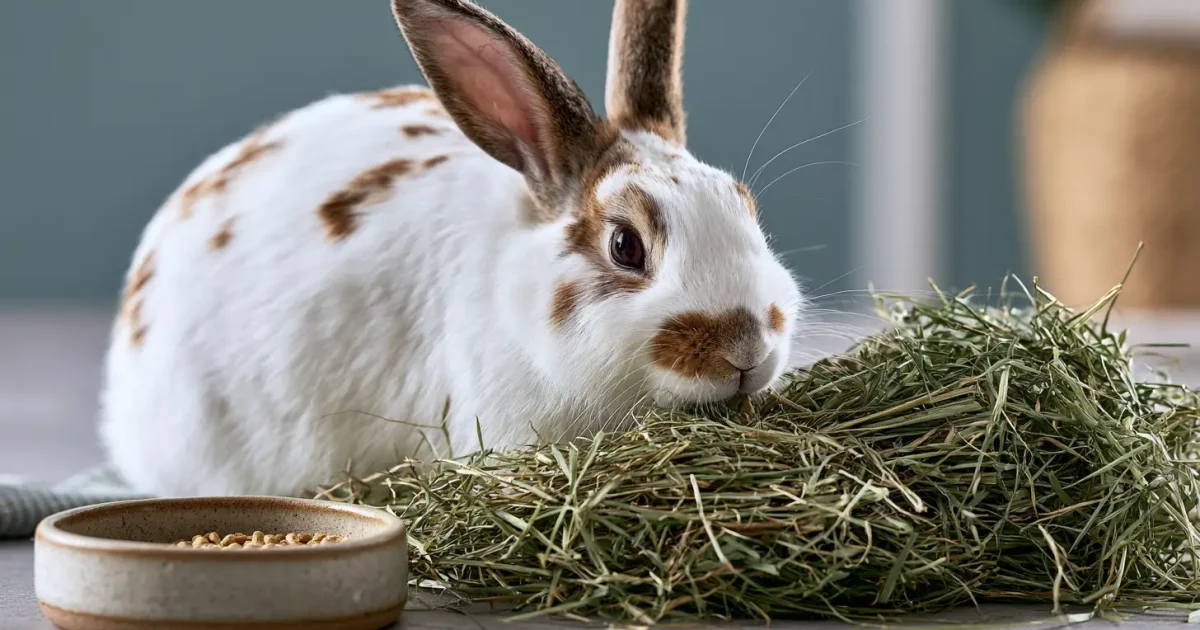

- Best Picks at a Glance
- The Hay Hierarchy: This Is the Main Event
- Pellets: The Supplement, Not the Main Course
- Oxbow Essentials Adult Rabbit: The Standard Recommendation
- Kaytee Timothy Complete: The Budget Option
- Small Pet Select Timothy Pellets
- Oxbow Western Timothy Hay (loose): The Most Important Purchase
- Small Pet Select 2nd Cut Timothy Hay
- Oxbow Garden Select Adult Rabbit
- 🏆 Editor's Pick
- Fresh Greens: The Third Component
- Treats: How Much Is Too Much
- Water
- FAQ
- Bottom Line
Every case of rabbit dental disease, GI stasis, or obesity I’ve heard a rabbit vet describe traces back to the same root cause: not enough hay. Hay isn’t bedding, and it isn’t an accessory sitting in the corner of the enclosure — it’s the primary food a rabbit’s teeth and digestive system evolved to run on. A rabbit eating unlimited hay every day, with a small amount of pellets and some fresh greens, is eating a diet that matches its biology. A rabbit eating pellets as the main event, with hay “available sometimes,” is on a slow path toward chronic health problems.
“If you’re short on time: hay should be unlimited and is the actual foundation of a rabbit’s diet — Oxbow Western Timothy Hay is the best primary choice. Pellets are a small daily supplement, not a meal, and Oxbow Essentials Adult Rabbit is the standard vet-recommended option. Add 1–2 cups of fresh leafy greens daily, and treat fruit like candy — rare and small.”
Best Picks at a Glance
Oxbow Western Timothy Hay (loose) – 9.4/10 The single most important purchase on this list. Consistent quality, low dust, and available in both first-cut and second-cut — this is what your rabbit’s diet should actually be built around.
Oxbow Essentials Adult Rabbit – 9.0/10 The standard pellet recommendation from most exotic vets, and for good reason: timothy hay as the first ingredient, high fiber, and no seeds or nuts padding out the bag.
Small Pet Select Timothy Pellets – 8.7/10 A quality-first alternative to Oxbow with a simple ingredient list and strong fiber content, best suited to owners comfortable buying online.
Small Pet Select 2nd Cut Timothy Hay – 8.8/10 Softer and leafier than first-cut, and often the better choice for older or pickier rabbits — just not the right sole hay for a rabbit that needs to lose weight.
Oxbow Garden Select Adult Rabbit – 8.5/10 A soy-free, wheat-free pellet with a broader mix of botanical ingredients, aimed at rabbits with sensitive digestion — at a premium price to match.
Kaytee Timothy Complete – 7.8/10 The reasonable budget pick. Timothy-based and fortified, but higher in starch than Oxbow, so it needs closer portion monitoring.
The Hay Hierarchy: This Is the Main Event

Timothy hay is the gold standard for an adult rabbit’s diet. It has the fiber-to-protein ratio rabbits actually need: high fiber, moderate protein, low calcium. First-cut timothy has more stalk, more fiber, and a coarser texture — better for dental wear and higher in fiber overall. Second-cut has more leaf, a softer texture, and slightly more fat, which is part of why many rabbits simply prefer the taste.
Most adult rabbits do best with first-cut timothy as the everyday hay, with second-cut mixed in occasionally for variety. For rabbits that reject first-cut outright, second-cut is a reasonable fallback rather than a compromise to feel bad about.
Orchard grass is a popular mix-in and alternative, with a nutritional profile similar to timothy. Rabbits that turn their nose up at timothy will often eat orchard grass without hesitation — the smell and taste are different enough to register as something new. Keeping two hay types on hand also protects you if one ever becomes hard to source.
Oat hay is high in fiber and often very palatable, making it a solid mix-in or even a primary hay for rabbits that reject both timothy and orchard grass. It runs slightly lower in calcium than some alternatives, and it’s worth keeping around purely for variety.
Alfalfa hay belongs to young rabbits under seven months, and to nursing or pregnant does — not adults. Alfalfa is high in calcium and protein, which suits the higher nutritional demands of growth or reproduction. In adult rabbits, that same calcium load gets excreted through the urinary tract and can contribute to bladder sludge and urinary issues over time. Adult rabbits should not be eating alfalfa as a primary hay, full stop.
One rule that overrides all of the above: hay access should be unlimited, meaning it never runs out. If you find yourself managing or rationing how much hay your rabbit gets, something about the setup needs to change — this is the one part of the diet where more is simply correct.
Pellets: The Supplement, Not the Main Course
Adult rabbits need roughly 1/4 cup of quality pellets per 5 pounds of body weight, per day. A 5-pound rabbit gets about 1/4 cup. A 10-pound rabbit gets about 1/2 cup. That’s the whole allotment — this is a supplement, not a meal, and it’s easy to overfeed by treating it like one.
The role pellets actually play in a modern rabbit diet is closer to nutritional insurance: they fill in anything hay and greens might miss, and they add a bit of palatability variety. It’s worth knowing where the format came from — pellets were originally developed for commercial rabbit production, where animals were raised quickly for meat and calorie density was the goal. Pet rabbits live long-term, so what a good pellet should prioritize looks completely different.
A quality rabbit pellet has a few consistent traits:
High fiber content. Look for 18%+ crude fiber — a lot of cheaper pellets fall below this line. Higher-fiber pellets slow glucose absorption and support gut motility better than low-fiber versions do.
Timothy hay as the first ingredient, not corn, soy, or grain byproducts. The first ingredient on the label tells you what actually makes up the bulk of the product by weight.
No seeds, nuts, or dried fruit. The colorful “gourmet” mixes with dried vegetables, seeds, and fruit pieces are built to catch a shopper’s eye, not to meet a rabbit’s nutritional needs. Seeds and nuts are high-fat and shouldn’t be a regular part of the diet — and a rabbit that picks out the fun bits and ignores the actual pellets ends up with an imbalanced diet by default.
No unnecessary artificial dyes or preservatives. Colored pellets look appealing on a shelf and do nothing nutritionally.
Oxbow Essentials Adult Rabbit: The Standard Recommendation

Rating: 9.0/10
Oxbow is the brand most exotic vets point to when asked what pellet to buy — and it’s not because Oxbow is paying for the recommendation. It’s because the formulation actually holds up. Essentials Adult lists timothy grass meal as the first ingredient, runs 25–29% crude fiber, skips the seeds and nuts entirely, and keeps the ingredient list free of unnecessary additives. It’s also sold at most general pet retailers, not locked behind specialty stores, and sits at a mid-range price — pricier than Kaytee, cheaper than Small Pet Select.
Pros
- Timothy grass meal as first ingredient
- 25–29% crude fiber
- No seeds, nuts, or unnecessary additives
- Widely available at general pet retailers
Cons
- Still only appropriate as a small daily supplement, never a main food source
- Mid-range price is a step up from budget options like Kaytee
The one thing worth understanding clearly: Oxbow doesn’t change the fundamental structure of the diet just by being a better pellet. A rabbit eating premium Oxbow as its primary food source is still worse off than a rabbit eating unlimited generic timothy hay with no pellets at all. The hay is the thing. The pellet is just the best version of a supporting player.
Kaytee Timothy Complete: The Budget Option

Rating: 7.8/10
For owners managing cost, Kaytee Timothy Complete is the sensible budget pick over other economy pellets. It’s built on a timothy hay base, includes vitamin and mineral fortification, and is sold almost everywhere, which matters if you don’t want to rely on online ordering.
Pros
- Timothy hay base with vitamin and mineral fortification
- Widely available, including in general grocery and big-box stores
- Lowest price tier among the pellets on this list
Cons
- Higher in starch than Oxbow’s formulations
- Requires closer portion monitoring, especially for rabbits prone to soft cecotropes
The legitimate criticism here is starch content — it runs higher than Oxbow’s pellets, which matters for rabbits prone to cecotrope issues. Cecotropes are the special droppings rabbits produce and re-eat directly; healthy ones are a normal part of digestion, but overproduction or softness often points to too many carbohydrates in the diet. If you’re using Kaytee, measure the portion carefully and keep an eye on cecotrope consistency. Soft cecotropes sticking to fur or building up in the enclosure is your signal to cut back on pellets and lean harder into hay.
Small Pet Select Timothy Pellets

Rating: 8.7/10
This is the pellet for owners who’ve already decided quality matters more than convenience of purchase. It’s high in fiber, built on a simple ingredient list, free of artificial additives, and known for consistent quality control between bags.
Pros
- High fiber content
- Simple, clean ingredient list
- Strong, consistent quality control
Cons
- Sold online only — no walk-in retail option
- More expensive per pound than Oxbow Essentials or Kaytee
Best for: owners who are already comfortable ordering pet supplies online and want a pellet that matches Oxbow’s quality bar, potentially with an even simpler ingredient list, without needing to find it on a store shelf.
Oxbow Western Timothy Hay (loose): The Most Important Purchase

Rating: 9.4/10
If there’s one line item on this whole list worth spending a little more on, it’s this one. Oxbow’s loose Western Timothy Hay is consistently low in dust, consistent bag to bag, and available in both first-cut and second-cut depending on what your rabbit prefers or needs.
Pros
- Consistent quality between bags
- Low dust, which matters for both rabbit and owner respiratory comfort
- Available in first-cut and second-cut
Cons
- Priced above some competing hay brands
- Needs to be stored dry to maintain quality and prevent mold
Setup tip: buy this in bulk if your rabbit takes to it well — hay is the highest-volume item in the diet by far, and the per-pound cost drops meaningfully at larger bag sizes. Just make sure storage stays dry; damp hay molds fast and becomes unusable.
Small Pet Select 2nd Cut Timothy Hay

Rating: 8.8/10
Second-cut hay is softer and leafier than first-cut, and a lot of rabbits simply prefer the taste and texture — particularly older rabbits or ones with dental sensitivity who find first-cut’s coarser stalks harder to manage.
Pros
- Softer, leafier texture than first-cut
- Well-suited to older rabbits or picky eaters
- Often higher palatability, meaning better overall intake
Cons
- Higher fat content than first-cut
- Not ideal as the sole hay for an overweight rabbit
Who should avoid it as a sole hay: rabbits that need to lose weight. The slightly higher fat content is a minor issue for most healthy adult rabbits, but it’s worth mixing in first-cut alongside it if weight management is already a concern.
Oxbow Garden Select Adult Rabbit

Rating: 8.5/10
This is Oxbow’s premium tier, aimed specifically at rabbits with sensitive digestion or owners who want more botanical variety in the pellet itself. It’s soy-free, wheat-free, and built with multiple botanical ingredients rather than a single grain-heavy base, with no added sugars.
Pros
- Soy-free and wheat-free formulation
- Multiple botanical ingredients for variety
- No added sugars
Cons
- More expensive than standard Oxbow Essentials
- Still limited to the same small daily quantity as any other pellet
Best for: rabbits who’ve shown sensitivity to standard formulations, or owners who simply want the more premium option in the Oxbow lineup. It’s not a requirement for most healthy adult rabbits, but it’s a reasonable upgrade if digestion has been an issue.
🏆 Editor’s Pick
The fountain-and-pellet instinct in most rabbit owners is to focus the search on the pellet bag — but the real winner here is the Oxbow Western Timothy Hay. It’s not flashy, and it doesn’t come with a feature list. What it does is form the actual foundation of a correct rabbit diet in a way no pellet, however well-formulated, can substitute for.
Rabbit teeth grow continuously, and it’s the grinding motion of chewing long hay fiber — not soft pellets — that wears them down at the right rate. Skip enough of that wear and you’re looking at dental malocclusion, a genuinely common and painful problem in pet rabbits raised without enough hay. Gut motility runs on the same fuel: a rabbit’s digestive system needs constant fiber to keep moving, and a slowdown — GI stasis — can turn fatal within 24 to 48 hours. Unlimited hay is what keeps that system running; pellets, however good, don’t replicate the same effect.
If you’re only going to get one thing right in a rabbit’s diet, make it unlimited access to good hay. Everything else is genuinely secondary.
Fresh Greens: The Third Component
Fresh leafy greens belong in an adult rabbit’s daily diet — roughly 1–2 cups per day for a 5-pound rabbit, scaled up for larger rabbits.
Good choices include romaine lettuce, green leaf lettuce, red leaf lettuce, cilantro, flat-leaf parsley, basil, dill, and carrot tops. These add hydration, variety, and enrichment on top of their nutritional value.
Foods to avoid or limit: iceberg lettuce (mostly water, minimal nutrition, and can cause loose cecotropes), kale and spinach in large quantities (high oxalates that add to urinary issues over time, though occasional small amounts are fine), and rhubarb, avocado, onion, and garlic, which shouldn’t be fed at all.
Introduce any new green gradually — one at a time over one to two weeks — to catch individual sensitivities early. Some rabbits develop soft cecotropes or general GI upset from sudden changes, even between foods that are individually fine.
Fresh greens are the variety and enrichment layer of the diet. They’re not the staple — hay still is.
Treats: How Much Is Too Much
Fruit is a treat, not a diet component. Rabbits respond to fruit sugar roughly the way humans respond to candy — enthusiastically, and with zero ability to self-regulate. A blueberry, a small slice of strawberry, or half a grape once or twice a week is a reasonable occasional enrichment item.
Commercial rabbit treats — yogurt drops, seed sticks, fruit-flavored chews — are almost universally a bad idea. Yogurt drops contain dairy, and rabbits are lactose intolerant. Seed sticks are high-fat. Fruit chews are high-sugar. None of these are formulated with rabbit health in mind; they’re formulated to catch an owner’s eye on a shelf.
Water
It’s easy to leave water out of a food discussion, but it belongs here. Fresh water should always be available, and most rabbits actually prefer a bowl over a bottle — bowls allow a higher flow rate and a more natural drinking posture, though some rabbits do learn to use bottles well. A heavy ceramic bowl that can’t be tipped over is the practical choice for most setups.
Change the water daily, and in warm weather, check it more than once a day — rabbits drink noticeably more when it’s hot.
FAQ
How much hay should a rabbit eat per day? Unlimited — a continuous supply that never runs out. A commonly cited rule of thumb is a pile of hay roughly the same size as the rabbit itself, per day. In practice, keep a hay rack or holder full at all times and refill before it ever empties completely. There’s no such thing as too much hay in a rabbit’s diet.
Are pellets necessary for rabbits? For adult rabbits eating unlimited quality hay and daily fresh greens, pellets are a supplement rather than a strict necessity. A rabbit with unlimited timothy hay, daily leafy greens, and fresh water already has the foundation of a correct diet — pellets add a layer of nutritional insurance on top. Many rabbit welfare organizations now recommend feeding fewer pellets than was standard advice in the past, as the nutrition science has moved forward.
My rabbit only wants to eat pellets and ignores hay. What do I do? Cut pellets dramatically — down to about a tablespoon a day temporarily — while keeping hay unlimited. A rabbit that isn’t filling up on pellets will typically eat more hay out of appetite. Make the change gradually, reassess after about a week at the reduced amount, and double check the hay itself is fresh and not dusty. Some rabbits are surprisingly picky about hay texture — try orchard grass or oat hay if timothy specifically is being ignored.
Can rabbits eat carrots every day? No. Carrots are high in sugar and should be an occasional treat — a few thin slices, a few times a week at most. The cultural pairing of rabbits and carrots is one of the more harmful misconceptions in pet rabbit care; fed daily, carrots contribute to both obesity and dental problems.
Is Oxbow worth the extra cost over Kaytee? For the pellet portion of the diet — which should already be a small daily amount — the quality gap between Oxbow and Kaytee is noticeable and generally worth paying for. Oxbow’s simpler ingredient list and higher fiber content line up better with what a rabbit pellet is actually supposed to do. If budget makes Kaytee the more realistic option, it’s an acceptable choice — just measure portions carefully and watch for soft cecotrope issues.
Bottom Line
Get the hay right and almost everything else falls into place. Unlimited timothy or a timothy-family hay is what your rabbit’s teeth and gut are actually built around — everything else in this guide, from Oxbow’s pellet formulation to fresh greens to the occasional grape, is support for that foundation, not a replacement for it. If you only change one thing after reading this, make it the size and freshness of the hay pile, not the brand of pellet in the bowl.
