
- Why Your Treat Pouch Is Actually a Training Tool
- The Best Treat Pouches for Dog Training, Ranked
- What Closure Type Actually Does to Your Dog's Learning
- What to Look for in a Dog Training Treat Bag
- The Argument for Not Using a Bag at All
- Hands-Free Treat Pouch Options: Which Setups Actually Stay Put
- The One Pouch Feature Most People Overlook
- FAQ
My first training class, I showed up with treats stuffed in my coat pocket. By the third sit-cue, my Golden had her nose in my jacket and I was fishing around in old receipts trying to find a piece of chicken. The trainer watched me for about ten seconds and said, “Get a pouch.”
I’ve been using a dog training treat bag ever since — and I’ve gone through enough of them to have opinions.
This isn’t a list of everything on Amazon. It’s a breakdown of what actually matters when you’re in the middle of a training session and need a treat in your hand in under a second.
Why Your Treat Pouch Is Actually a Training Tool
Most people shop for a treat pouch the way they’d shop for a phone case. They look at color and price.
But the pouch you clip to your waist affects your timing — and timing is everything in dog training. The gap between the moment your dog does the right thing and the moment the treat hits their mouth is the window where learning happens. Miss it by two seconds and your dog isn’t sure what they got rewarded for.
A pouch that’s slow to open costs you that window.
Drawstring bags are the main offender. I’ve seen people at training classes yanking on a drawstring while their dog sits there wondering what’s happening. By the time the treat comes out, the dog has shifted position. You’ve now accidentally rewarded “sit, then shuffle.”
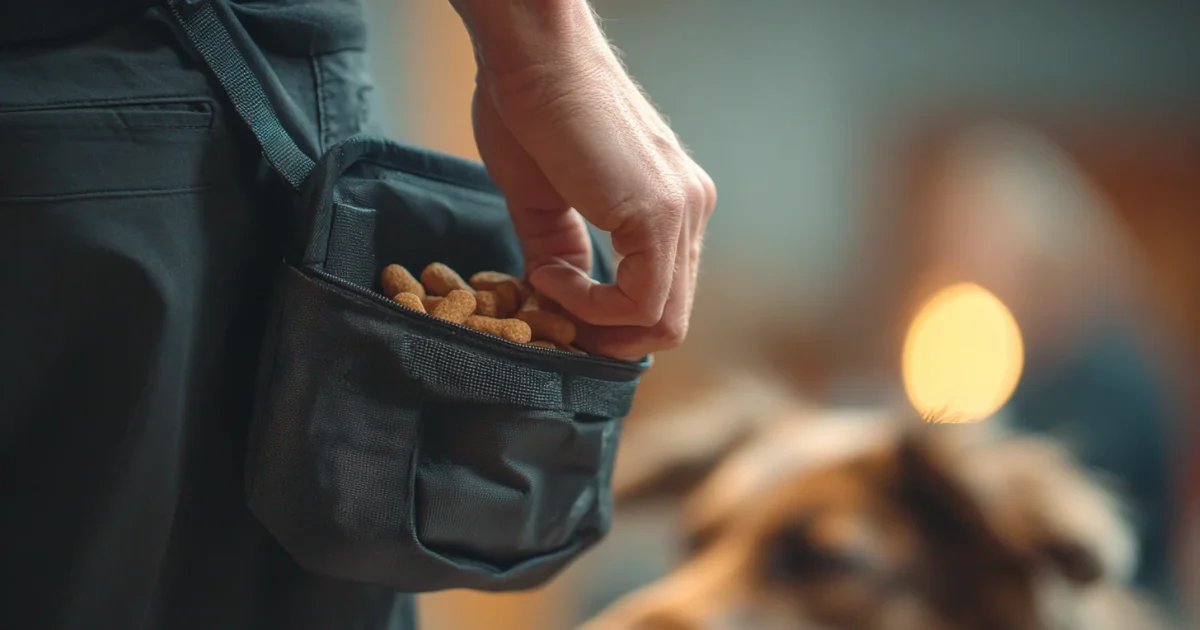
Magnetic closures win for pure training speed. The bag opens with one hand. You reach in, treat out, done. You never break eye contact with your dog.
The Best Treat Pouches for Dog Training, Ranked
Here’s what I’d actually recommend based on how they hold up during real training sessions — not just how they look in product photos.
1. Wilderdog Dog Training Treat Pouch — Best Overall
The Wilderdog is the one I use now and have used for two years. It has both a magnetic closure and a zipper, which sounds redundant until you realize the magnet is for during training (fast) and the zipper is for when you’re hiking or in the car (secure).
It clips with a carabiner or wears on an adjustable waist strap. The strap goes up to 48 inches, so it fits most body types without buying an extender.
Two things I actually care about: it washes in the washing machine on a gentle cycle, and the buckle is big enough to fasten with one hand. At around $36, it lasts for years. That’s not a bad deal.
One honest note: the magnetic opening takes a small amount of deliberate wrist action to open one-handed cleanly. It’s fast, but it’s not instant. First day with it, practice the motion before you use it with your dog.
2. PetSafe Treat Pouch Sport — Best for Two-Value Training
This is the one if you do a lot of training where you use both high-value and low-value rewards in the same session.
It has two inner compartments. Kibble in one side, small pieces of hot dog in the other. One side for basic behavior, the other when you’re working on something harder — like a solid recall around distractions. Having both accessible without swapping pouches mid-session is a bigger deal than it sounds.
The opening mechanism holds itself open, which means you can reach in quickly without pressing anything. A bit more bulk than the Wilderdog, but if you’re doing structured training sessions in a yard or class, that tradeoff makes sense.
3. Doggone Good Rapid Reward Bag — Best for Trainer-Style Use
Professional trainers tend to gravitate toward this one, and it’s not hard to see why. It opens wide. Really wide. You can grab treats without looking down, which keeps your attention on your dog.
The belt attachment is solid. It doesn’t swing or bounce when you move, which matters more than people realize — a pouch banging around near your dog’s face is distracting.
No poop bag dispenser. No extra pockets. If you want a stripped-down bag that does one thing well, this is it.
4. PetAmi Dog Fanny Pack — Best for Walks and Hiking
This one crosses the line from “training pouch” into “walk bag,” and that’s exactly the point. It has room for your phone, keys, waste bags, a collapsible bowl, and a water bottle holder.
For active training on trail walks or when you’re out for an hour-plus, carrying everything in one bag is genuinely convenient. The trade-off is that it’s bulkier and slower to access than a purpose-built training pouch.
If most of your training happens at home or in class, skip this one. If training happens during everyday walks, it’s worth looking at.
5. RoyalCare Silicone Treat Pouch — Best Budget Pick
Silicone pouches have one advantage: they’re easy to rinse out. If you use wet treats — chicken, hot dog, cheese — fabric pouches get gross fast. A silicone pouch wipes clean in thirty seconds.
The RoyalCare is small, clips to a belt or leash handle, and costs under $10. It’s not going to replace a proper training pouch for long sessions. But it’s a solid backup, a travel option, or a first pouch for someone just starting out.
Fair warning: a few people have had the clip break after a few months. It’s a budget pick. Buy it knowing that.
What Closure Type Actually Does to Your Dog’s Learning
This is the part most reviews skip.
In positive reinforcement training, your dog learns by connecting a behavior to a reward. That connection is strongest when the reward comes within about two seconds of the behavior. After that, it gets fuzzy. After five seconds, your dog is guessing.
So when you’re fumbling with a drawstring at second three, four, five — you’re muddying the signal.
Here’s how closure types stack up in real training conditions:
- Magnetic closure: One hand, one motion, under a second. Best for rapid repetition.
- Drawstring: Two hands, or one slow hand. Fine for casual walks, rough in active training.
- Zipper: Good for security, slow for speed. Better for transit than training.
- Self-opening (spring-loaded top): Sits open the whole session. Fast — but treats can spill if you move around a lot.
The self-opening style works well if you’re standing still doing focused attention work. Move around, do loose-leash work, and you’ll be picking treats off the sidewalk.
What to Look for in a Dog Training Treat Bag
If you want to evaluate pouches yourself rather than just take my word for it, here’s what I’d check:
How does it attach? Belt clips that only clip to the waistband fall off. A proper waist strap with a buckle stays put. For some body types, a crossbody strap is more comfortable.
Can you open it with one hand? Test this at home. With your dominant hand. With your non-dominant hand if you hold the leash in your dominant.
Can it handle soft treats? Small fabric pouches with rough seams get absolutely coated in soft treat residue. Either go silicone or find one with a removable liner. [INTERNAL LINK: best small training treats for dogs]
Does it smell? All treat pouches smell eventually. The question is whether the smell transfers to your clothes. Dense nylon bags tend to hold odors more than silicone or canvas.
Size matters — but not always bigger. A huge pouch sounds good until it swings into your dog’s face when you bend down to reward them at nose level. For small breeds, a smaller pouch at a lower position makes more sense.
The Argument for Not Using a Bag at All
This is the nuanced part.
Some trainers prefer that dogs don’t associate the pouch with rewards. The idea is that if your dog tracks the bag, they may start responding only when the bag is visible — a problem if you want behavior that holds up when you’re not geared up.
One approach: use the pouch for treat storage, but deliver rewards from a different location — your front pocket, the opposite hand, somewhere unexpected. This keeps the dog guessing where the reward comes from, which some trainers argue builds stronger, more generalized responses.
I don’t fully know if this makes a measurable difference for the average pet owner training basic manners. It probably matters more if you’re training for competition or working on proofing behaviors under distraction. For a puppy class in your kitchen? Probably fine either way.
But it’s worth knowing the debate exists.
Hands-Free Treat Pouch Options: Which Setups Actually Stay Put
“Hands free” is printed on basically every pouch box, but there’s a spectrum.
A belt clip pouch is hands-free in the loose sense — you’re not holding it. But clip-only designs shift around. On a run or during an active training session, they end up behind your hip or sideways.
A waist strap with a real buckle is genuinely hands-free. It sits at your hip, doesn’t bounce, and you can access it without looking at it after a bit of practice.
Crossbody straps work well for some people, especially if you’re wearing workout pants without belt loops. The bag sits at your side or front. Heavier bags start to swing when you move, though.
If you train during runs or hikes, look specifically for pouches with a sternum strap option or those designed to sit against your body rather than hang from it.
The One Pouch Feature Most People Overlook
The poop bag dispenser.
Almost every training pouch has one built in now, and it sounds like a minor add-on. But when you’re on a walk, training as you go, the last thing you want is to stop, unclip the pouch, put it down somewhere, deal with cleanup, then reload everything. A bag dispenser keeps one hand free the whole time.
The dispenser matters less if you’re training in a yard. It matters a lot if all your training happens on leash during walks — which, for many people, it does.
FAQ
Do I really need a treat pouch or can I just use my pocket? Your pocket works. Until you use wet treats, or your pants don’t have deep pockets, or you try to reward quickly and end up touching every item in your pocket before finding a treat. A pouch eliminates all of that. It’s not required gear, but once you use one you won’t go back.
What’s the best treat pouch for someone with small hands? The RoyalCare silicone pouch is compact and easy to grip. The PetSafe Mini (a smaller version of the Sport) also works well for smaller hands. Avoid oversized pouches — the wider the opening, the more hand span it takes to close quickly.
Can I put a wet treat like chicken in any pouch? Not really. Fabric pouches hold moisture and develop a specific smell fast. Silicone pouches are better for wet treats because they wipe clean. Some fabric pouches have a removable silicone liner — look for that if you want fabric but use wet treats often.
My dog stares at my pouch instead of focusing on me. What do I do? This is a real training issue and it’s not the pouch’s fault — it’s a management problem. Try putting treats in your front pocket or a different location and using the pouch only for storage. Reward from unpredictable spots. Some trainers also work on “watch me” as a separate skill so attention is the default behavior, not treat-scanning.
How do I clean a treat pouch? Most fabric pouches with a waist strap can go in the washing machine on a gentle cycle — hang dry only. Silicone pouches rinse under warm water. The Wilderdog is machine washable. Check before buying if easy cleaning is important to you, because some pouches absolutely cannot go in the wash and you’ll hate them within two weeks of using soft treats.
The right best treat pouch for dog training isn’t the one with the most features. It’s the one you’ll actually reach into fast, without thinking, at the right moment. Buy for speed first. Everything else is secondary.