
- Best Beginner Saltwater Tank Kit
- Saltwater Kit vs Reef Kit
- Best Overall Nano Kit: Fluval Sea Evo 13.5
- Best Classic Beginner Reef: Coralife BioCube 32
- Best Modern Display: Waterbox Cube 20
- Best Upgrade Path: Innovative Marine Nuvo Fusion 20
- Best Budget Fish-Only Setup: Aqueon 20-Gallon Long
- Best Premium Starter: Red Sea Max Nano
- What Beginner Saltwater Kits Do Not Include
- Best Beginner Livestock for Saltwater Kits
- Nano Reef Mistakes I Would Avoid
- My Picks by Goal
- FAQ
- What is the best saltwater aquarium kit for beginners?
- Is a nano reef good for beginners?
- Can I start a saltwater tank with tap water?
- What fish should I put in a beginner saltwater tank?
- Do all-in-one reef kits include everything?
Saltwater tanks are not hard because the fish are fancy. They are hard because the water is honest.
Freshwater mistakes can sometimes give you a warning. Saltwater mistakes can show up fast, especially in tiny tanks with coral. The best saltwater aquarium kit for a beginner is not the smallest shiny cube. It is the kit that gives you stable water, clear access, enough filtration space, and room to learn without turning every top-off into a chemistry event.
Best Beginner Saltwater Tank Kit
For most beginners, the Fluval Sea Evo 13.5 is the best starter saltwater kit if you want a small all-in-one reef-style tank. If you have the space and budget, a Waterbox Cube 20 or Innovative Marine Nuvo Fusion 20 is easier long term because more water gives you more stability. For a classic compact reef look, the Coralife BioCube 32 is still a strong pick.
| Product & Model | Best For | The Big Win | The Catch | Price Tier |
|---|---|---|---|---|
| Fluval Sea Evo 13.5 | First nano reef | True starter kit | Small water volume | Mid-Range |
| Coralife BioCube 32 | Classic beginner reef | More stable size | Bulky hood design | Premium |
| Waterbox Cube 20 | Clean modern setup | Great display quality | Gear adds cost | Premium |
| Innovative Marine Nuvo Fusion 20 | Upgrade-minded beginners | Strong rear chamber | Light often extra | Premium |
| Aqueon 20-Gallon Long Setup | Fish-only marine | Cheap flexible base | Not all-in-one | Budget |
| Red Sea Max Nano | Polished reef start | Premium integrated gear | High upfront cost | Ultra-Premium |
Saltwater Kit vs Reef Kit
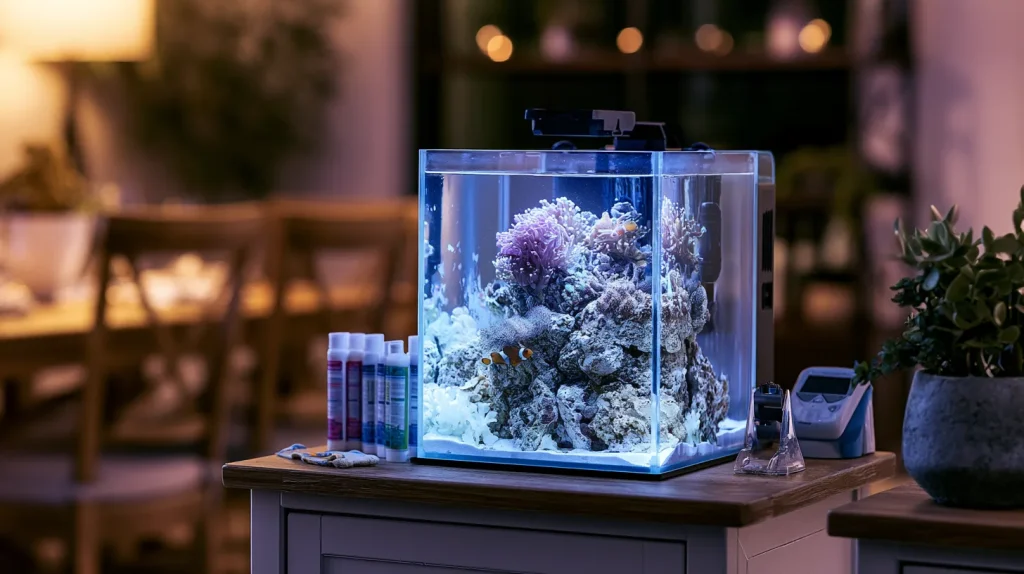
Not every saltwater tank is a reef tank.
A fish-only saltwater tank keeps marine fish, rock, and maybe cleanup crew animals. A reef tank keeps coral too. Coral changes the gear needs. Lighting matters more. Flow matters more. Water testing gets more detailed.
This is where beginner buying gets messy.
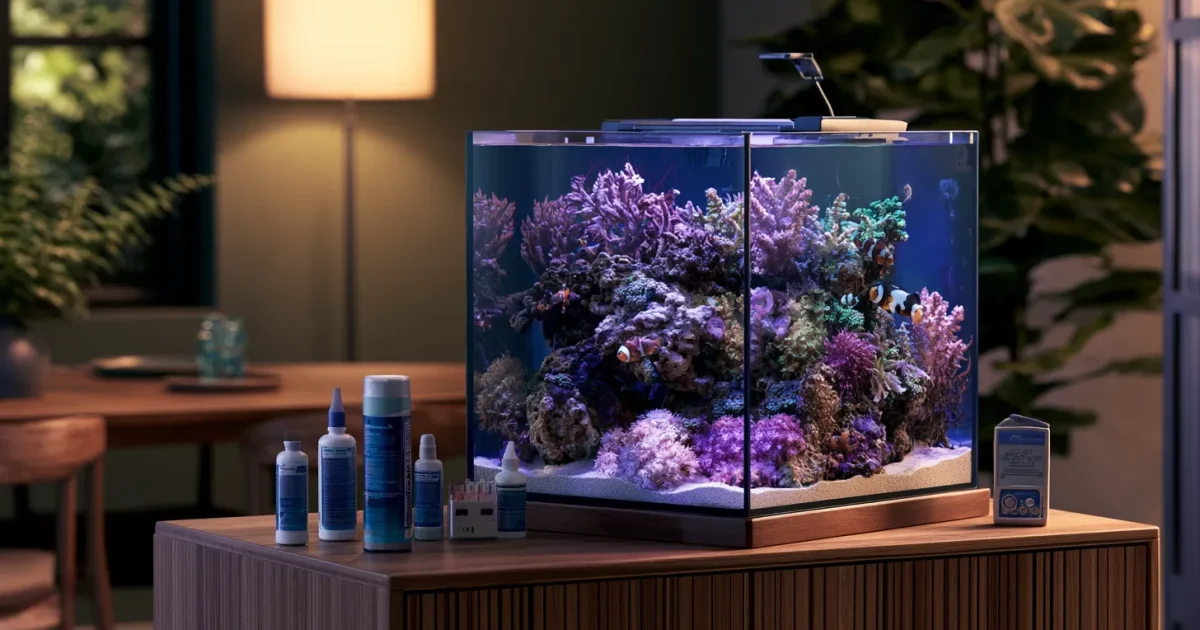
Many kits are sold with reef-style photos. Clownfish, coral, blue glow, clean white sand. Lovely. But the kit may still need upgrades before it can handle a mixed reef well.
A beginner saltwater tank needs:
- Stable water volume
- Heater
- Filtration
- Saltwater test kit
- Refractometer or salinity checker
- Powerhead or enough flow
- Live rock or dry rock
- Marine salt
- Dechlorinated or RO/DI water
RO/DI means water filtered by reverse osmosis and deionization. In plain language, it is very clean water. It helps avoid algae and mystery tap-water issues.
I would rather see a beginner spend less on coral at first and more on testing and water quality.
That is not exciting. It works.
Best Overall Nano Kit: Fluval Sea Evo 13.5
The Fluval Sea Evo 13.5 is popular because it gives beginners a real all-in-one saltwater start without taking over a room.
It includes the tank, rear filtration, hood, and reef-capable style lighting for soft corals and beginner livestock. The footprint fits apartments, bedrooms, and offices. It also looks tidy, which matters when a tank lives where people can see the gear.
For a beginner who wants two clownfish and maybe easy corals later, it makes sense.
The catch is water volume.
Thirteen and a half gallons is small. Evaporation changes salinity faster. Overfeeding shows up faster. A dead snail matters more than it would in a larger tank.
You can succeed with it, but you need routine.
Use an auto top-off if budget allows. Top-off means replacing evaporated freshwater, not saltwater. Salt stays behind when water evaporates, so salinity rises unless you add fresh water.
Good fit:
- One or two small fish
- Soft corals
- Beginner nano reef
- Small spaces
- Owners who will test water
Bad fit:
- Impulse coral buying
- Large fish
- Heavy feeding
- People who travel often
I like the Evo, but I would not call it effortless. No nano reef is.
Best Classic Beginner Reef: Coralife BioCube 32
The Coralife BioCube 32 gives beginners something the smaller kits lack: more water.
Thirty-two gallons is still compact, but it is far more forgiving than a tiny desktop cube. Temperature changes slower. Salinity swings slower. Nitrate rises slower. You have more room for rock and fish behavior.
The BioCube also has a long history in the reef hobby. That means lots of upgrade parts, forum advice, media baskets, light upgrades, and examples from other owners.
That community knowledge is useful.
The hood design is the catch. Some people like the clean covered look. Others feel boxed in by it, especially if they want stronger lights or easier open-top access. Heat can also be a concern depending on room temperature and gear.
For a beginner, though, the BioCube 32 is a strong reef tank starter kit because it gives enough size to learn.
I would choose it over a tiny pico reef for most new saltwater owners.
Tiny reefs look cute. They are not easier.
Best Modern Display: Waterbox Cube 20
The Waterbox Cube 20 is for the beginner who wants a cleaner, more modern tank and does not mind buying some gear separately.
The glass looks good. The rear filtration layout is neat. The display feels more polished than many old starter kits.
I like 20 gallons as a beginner nano size. It is still small, but not as twitchy as a 5 or 10-gallon saltwater setup. You get enough room for rockwork, a pair of clowns or other small fish, and beginner corals if lighting and flow are right.
The catch is total cost.
The tank may not include everything you need. Light, heater, pump upgrades, media, lid, and auto top-off can add up. The kit price is not the final price.
That is true with most saltwater gear, but it feels extra obvious here.
Buy this if you care about display quality and want to build the setup properly from the start.
Do not buy it if you expect the box to contain a finished reef.
Best Upgrade Path: Innovative Marine Nuvo Fusion 20
Innovative Marine all-in-one tanks are popular because the rear chambers are practical and the display shape works well.
The Nuvo Fusion 20 is a good size for a beginner who wants a serious nano reef path. It gives enough room for better media, pumps, and flow upgrades without jumping straight to a sump system.
A sump is an extra filtration tank usually placed below the display. It adds volume and hides gear. Great tool. More plumbing. Not always beginner-simple.
The Nuvo Fusion avoids that while still feeling like a hobbyist-grade tank.
The catch is that lights and accessories can raise the real cost. But if you already know you want coral, I would rather see you buy a strong base tank than replace a weak kit six months later.
Use it for:
- Clownfish pair
- Goby and pistol shrimp setup
- Soft corals
- LPS corals with proper light
- Clean modern reef display
LPS means large polyp stony coral. It has a hard skeleton and fleshy polyps. It needs more stable water than the easiest soft corals.
Best Budget Fish-Only Setup: Aqueon 20-Gallon Long
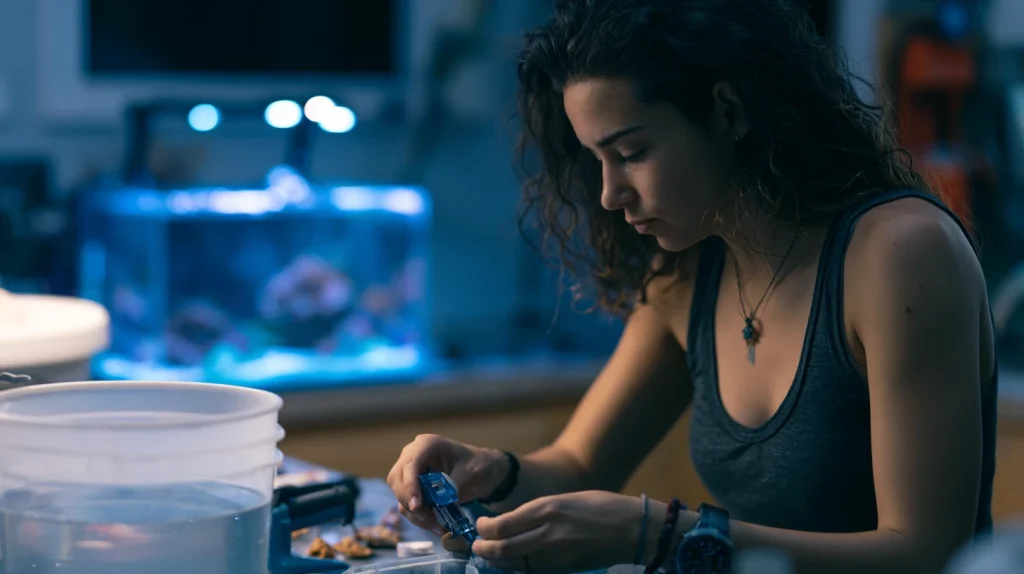
Not every beginner needs an all-in-one reef cube.
If you want a simple fish-only saltwater tank, a standard 20-gallon long can work well. It gives horizontal swimming room, easy access, and cheap replacement parts.
You will need to build the setup:
- Tank
- Lid
- Heater
- Filter
- Powerhead
- Light
- Rock
- Sand if wanted
- Salt mix
- Salinity tool
- Test kit
That list looks long because saltwater is honest. A kit hides the list, but it does not remove it.
The upside is flexibility. You can choose a simple hang-on-back filter, add rock, and keep hardy fish without paying for reef lighting right away.
This is a good route for someone who wants clownfish, a goby, or other small marine fish but is not ready for coral.
Do not treat it like freshwater with salt added. Cycling, salinity, and stocking still matter.
Best Premium Starter: Red Sea Max Nano
The Red Sea Max Nano is the polished path.
It gives you a more integrated reef setup with higher-end design and gear planning. The tank, filtration, and lighting feel more like a reef system than a general aquarium kit.
For a beginner with budget, it can reduce guesswork.
The catch is price. You can spend a lot before adding rock, salt, test kits, livestock, and maintenance gear.
Would I recommend it to every beginner? No.
Would I choose it for someone who wants a sleek reef tank, has the budget, and is willing to go slowly? Yes.
Premium gear does not remove patience. It just makes some parts nicer.
That is true across the whole reef hobby.
What Beginner Saltwater Kits Do Not Include
This is the part product photos skip.
Most kits do not include every tool you need for long-term success.
Plan to buy:
- Refractometer or digital salinity checker
- Marine salt mix
- RO/DI water source
- Ammonia, nitrite, nitrate, and pH tests
- Alkalinity test for reefs
- Thermometer
- Heater if not included
- Powerhead if flow is weak
- Buckets and mixing pump
- Water conditioner if using treated tap for fish-only
For reef tanks, add calcium, magnesium, phosphate, and alkalinity testing as coral care grows.
I am not trying to scare you. I am trying to stop the classic mistake where someone buys a kit, adds salt, buys a clownfish, and then learns about cycling after the fish is already breathing fast.
Cycle first.
Buy livestock later.
Best Beginner Livestock for Saltwater Kits
Start small and boring.
Boring is underrated in saltwater.
Good beginner fish options can include captive-bred clownfish, small gobies, firefish, royal grammas, and some blennies, depending on tank size.
Avoid large fish, aggressive fish, and fish with special diets. Do not buy a mandarin dragonet for a new nano tank. It may starve without a mature pod population. Pods are tiny crustaceans that live in established reef systems.
For cleanup crew, go light. A few snails are useful. Do not buy a huge cleanup crew package for a brand-new clean tank. They need food too.
For corals, start with hardy soft corals after the tank is stable. Zoanthids, mushrooms, green star polyps, and leather corals can be beginner-friendly, but they still need care. Some grow fast. Some can irritate other corals.
Reef tanks are slow stories.
Do not rush the first chapter.
Nano Reef Mistakes I Would Avoid
The first mistake is buying too small because small seems easy.
Small saltwater tanks are harder to keep stable. A 13.5-gallon tank can work, but it needs attention.
The second mistake is topping off with saltwater. Evaporation removes freshwater and leaves salt behind. Top off with fresh RO/DI water.
The third mistake is adding fish too soon. The tank needs to cycle.
The fourth mistake is overstocking. A nano tank with two clowns, a goby, a shrimp, too many snails, and corals can look fine until feeding and nitrate catch up.
The fifth mistake is chasing coral before learning water changes.
You can build a beautiful reef later. First, learn the rhythm.
My Picks by Goal
For a first nano reef, choose the Fluval Sea Evo 13.5 if space is tight and you accept weekly care.
For a safer beginner size, choose the Coralife BioCube 32.
For a modern display, choose the Waterbox Cube 20.
For an upgrade-friendly nano reef, choose the Innovative Marine Nuvo Fusion 20.
For fish-only saltwater on a budget, build a 20-gallon long setup.
For a premium polished start, choose the Red Sea Max Nano.
If you are torn, go bigger.
I know bigger costs more. I also know bigger water forgives more. In saltwater, that forgiveness feels like oxygen.
FAQ
What is the best saltwater aquarium kit for beginners?
The Fluval Sea Evo 13.5 is a strong first nano reef kit. If you have space, the Coralife BioCube 32 or a 20-gallon all-in-one tank is easier long term.
Is a nano reef good for beginners?
It can be, but it is not easier just because it is small. Nano reefs need steady top-off, testing, and careful stocking.
Can I start a saltwater tank with tap water?
RO/DI water is better, especially for reef tanks. Tap water can add nutrients or minerals that cause algae and water issues.
What fish should I put in a beginner saltwater tank?
Captive-bred clownfish, small gobies, firefish, and royal grammas can be good choices, depending on tank size and temperament.
Do all-in-one reef kits include everything?
No. You still need salt, salinity testing, water tests, heater if not included, rock, flow planning, and maintenance tools.
The best beginner saltwater tank is the one that makes slow care easy.
Choose enough water volume. Buy the testing gear before the fish. Start with hardy livestock. Let the tank mature before coral shopping gets out of hand. Saltwater rewards patience, and it has a very direct way of correcting shortcuts.
Meta description: Best saltwater aquarium kit picks for beginners, comparing Fluval Evo, BioCube, Waterbox, Nuvo, and what reef kits still need.