

- The Best Dog Crate for Most People: MidWest iCrate
- Best Dog Crate for Anxiety and Escape Artists
- Best Dog Crate Furniture (For When You Hate the Look of a Wire Cage)
- Best Dog Crate for Large Dogs
- The Part Most Crate Articles Skip: Why Your Dog Might Hate Any Crate
- Best Dog Crate for Travel
- Best Dog Crate Covers and Accessories
- How to Pick the Right Size
- FAQ
My rescue dog, Mango, bent the door off a standard wire crate in under four minutes. Not bent it a little. Bent it clean off the hinges and was sitting on the couch when I got home, looking mildly pleased with himself.
That was my wake-up call that not all dog crates are built for all dogs — and that picking the right one matters a lot more than most people think.
I’ve been through four crates with that dog. I’ve also helped two friends pick crates for their own chaos-agents. So this isn’t a spec-sheet roundup. It’s what I actually know works — for anxious dogs, puppies, travelers, and the dogs who turn escape into a hobby.
The Best Dog Crate for Most People: MidWest iCrate
If your dog is not an escape artist and you’re just starting out, the MidWest Homes iCrate is the one I’d hand you without hesitation.
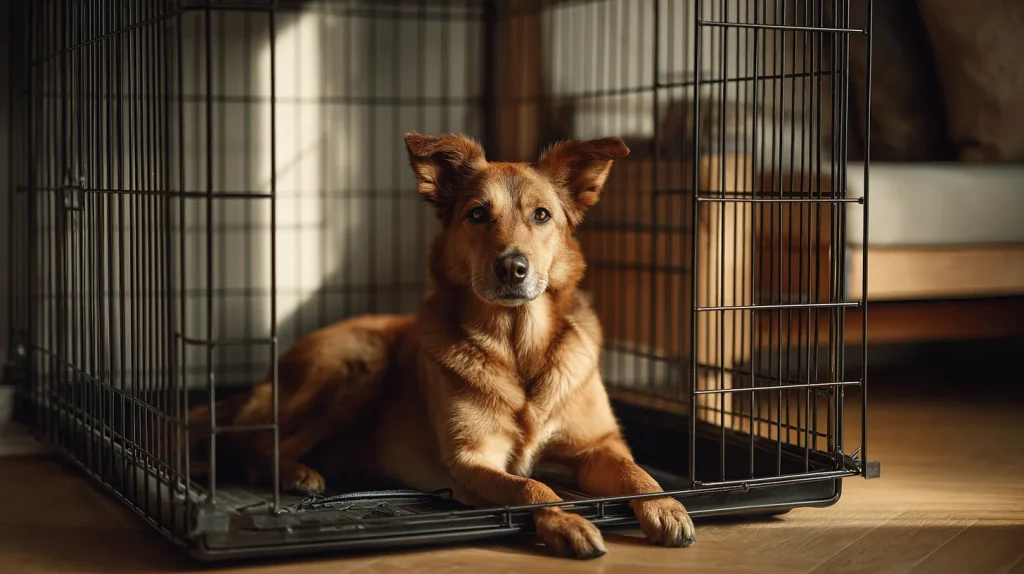
It’s a wire crate with a folding design, a divider panel, two doors, and a slide-out tray for cleaning. You can get it in six sizes. It’s not pretty, but it works. Vets recommend it. Trainers recommend it. Rescue groups use it by the hundreds.
The divider panel is what makes it great for puppies. You can start small and expand as your dog grows. That means one crate handles 18 months of growth without needing an upgrade.
For mild anxiety — the kind where your dog whines for five minutes then settles — this is enough.
For the dogs who treat crates like a personal challenge, keep reading.
Best Dog Crate for Anxiety and Escape Artists
Some dogs go through wire crates like cardboard. Others destroy plastic kennels inside an hour. If that’s your dog, you need something built differently.
Impact High Anxiety Crate is the one most trainers point to. It’s made from aircraft-grade aluminum, fully welded, with a door that locks from the outside and no interior hardware a dog can grab with their teeth. It’s heavy. It’s expensive (around $500–$700 depending on size). And it’s worth it if your dog genuinely panics when confined.
The ProSelect Empire Cage is another option at a lower price point. It uses 20-gauge reinforced steel tubes. Not as polished as the Impact, but it holds. Big dogs. Determined dogs. Dogs who once bent a door off a wire crate in under four minutes.
A few things matter more than steel gauge, though:
- No interior protrusions. Anxious dogs chew. Sharp edges from bent bars cut mouths and gums.
- Secure latches the dog can’t nudge open. Some clever dogs learn to pop single-latch doors.
- Ventilation. A panicking dog runs hot. Good airflow matters.
For the best dog crate for separation anxiety, the crate is only part of the answer. The other part is how you use it — and I’ll get to that.
Best Dog Crate Furniture (For When You Hate the Look of a Wire Cage)
Not everyone wants a metal kennel sitting in their living room. Fair.
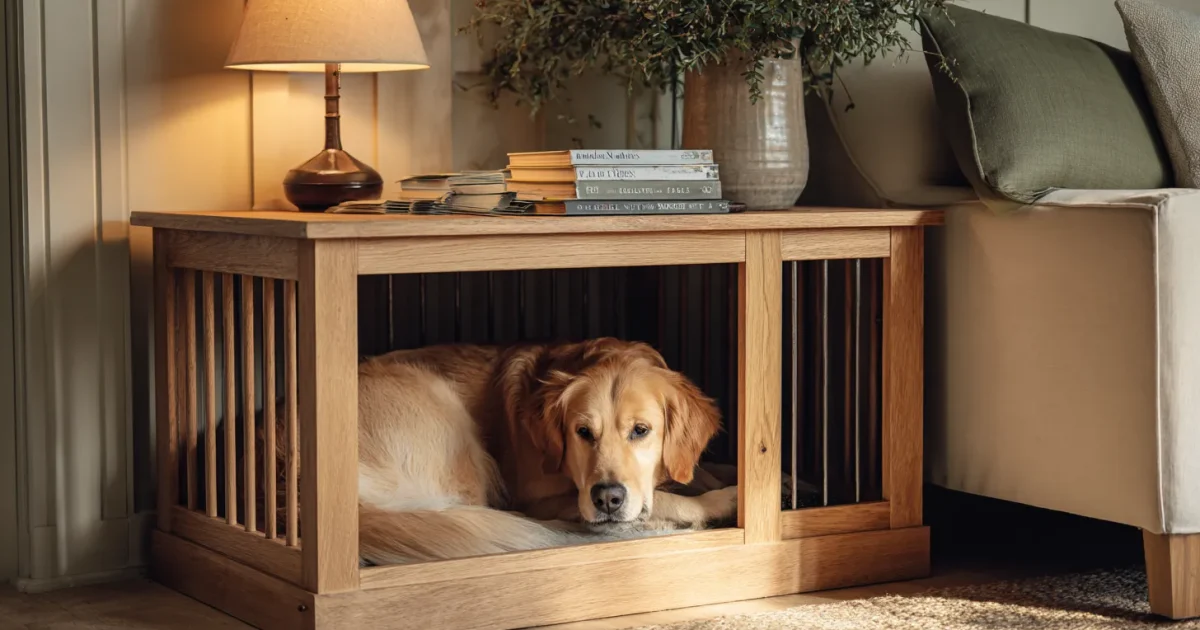
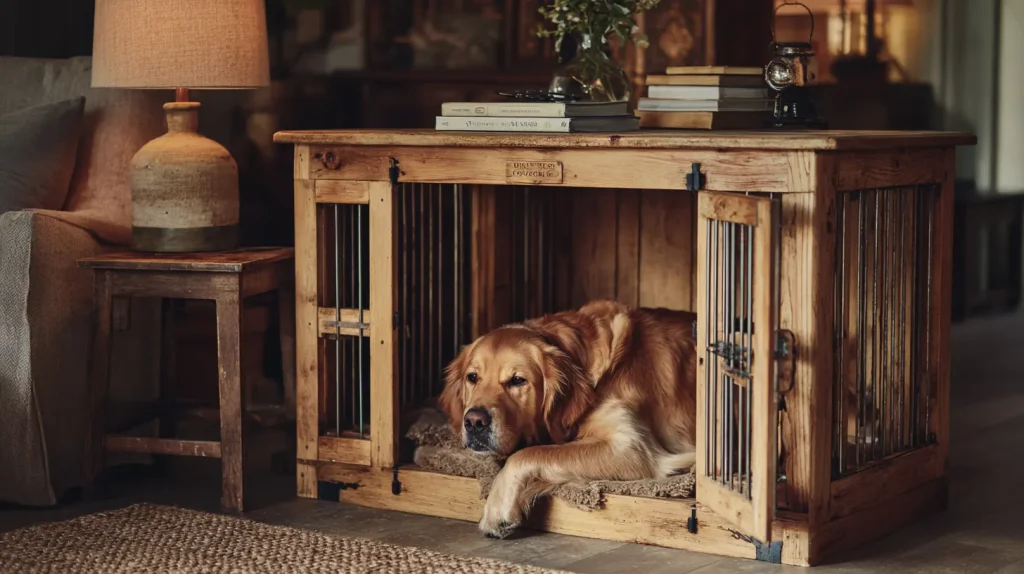
Furniture-style dog crates have gotten genuinely good in the last few years. The Fable Crate is the one I’d pick if I were going this route. It looks like a side table. The wood finish is clean. There’s a removable tray and enough ventilation to keep a dog comfortable. Dogs who are already crate-trained tend to love it because it feels more den-like — enclosed on three sides, which actually helps anxious dogs feel safer.
The Unipaws and Zoovilla brands also make solid furniture crates at a lower price. They’re not as refined, but they hold up and look a lot better than a wire box in the corner of your dining room.
One honest note: best dog crate furniture options are not for dogs with severe anxiety. A determined chewer will go through MDF (medium-density fiberboard, the material most wooden crates use) before you finish your morning coffee. If your dog is destructive, start with metal.
Best Dog Crate for Large Dogs
Large dogs need more floor space than most people expect. The rule is simple: your dog should be able to stand up without hunching, turn around completely, and lie flat on their side.
For dogs over 70 pounds, look at 42-inch or 48-inch crates. For dogs over 100 pounds — large breeds like Mastiffs, Great Danes, or Saint Bernards — go to 54 inches.
My picks for large dogs:
- Frisco Ultimate Heavy Duty Steel Crate — thick gauge, two locks, pull-out tray, looks more finished than most heavy-duty options
- MidWest Ginormous Crate — affordable, folds flat, good for large breeds that aren’t escape artists
- LEMBERI 48-inch Heavy Duty — reinforced tubes, strong value for the price, good for big dogs with mild to moderate anxiety
If you have a large dog AND a dog who escapes, the Impact High Anxiety Crate comes in sizes up to 36 inches, which fits most large breeds. It’s the only one I’d trust for a 90-pound dog with genuine separation anxiety.
The Part Most Crate Articles Skip: Why Your Dog Might Hate Any Crate
Here’s something that almost none of the product roundups talk about. The crate itself is often not the problem.
If you only put your dog in their crate right before you leave — grab your keys, put on shoes, say goodbye, close the crate — you’ve accidentally taught your dog that the crate predicts abandonment. Of course they hate it.
The fix is boring but it works: use the crate while you’re home too. Feed your dog in the crate. Let them nap in it with the door open. Sit nearby when you first close the door. Break the mental link between “crate = you’re leaving.”
A few other things that genuinely cause crate anxiety:
- Crate placed near the front door. Every knock, doorbell, and mail delivery becomes a stressor.
- Crate too big too soon. Counterintuitively, too much space can feel less secure to a puppy, not more.
- Only crating during stressful events. Thunderstorms, vet visits, travel. The dog learns to associate the crate with bad days.
I want to be direct about one thing: if your dog has severe separation anxiety — panting, drooling, injuring themselves trying to escape — a crate alone will not fix that. It might make it worse. The ASPCA notes that for some dogs, crate confinement during separation anxiety can increase stress rather than reduce it. A trainer or veterinary behaviorist is the right call before you spend money on a heavy-duty crate.
Best Dog Crate for Travel
For travel by car, you want something that stays put in a crash. Standard soft-sided crates are fine for well-behaved dogs on calm trips, but they offer zero crash protection.
GUNNER Kennels are the gold standard here. They’re the only dog crate with a 5-star crash-test rating from the Center for Pet Safety. The price reflects that (around $500+). If you drive highways with your dog regularly, it’s worth thinking about.
Ruff Land Kennels are a lighter, less expensive alternative. They don’t have the same crash-test rating but they’re far more protective than a soft carrier and a lot easier to move around.
For air travel, hard-sided plastic kennels are required by most airlines. The Petmate Sky Kennel and Vari Kennel are the two most commonly accepted. Check your airline’s specific requirements before you buy — size restrictions vary.
Best Dog Crate Covers and Accessories
A crate cover turns a wire kennel into something that feels more like a den. Most anxious dogs settle faster in a covered crate. It blocks visual stimulation — foot traffic, other pets, the TV — and makes the space feel quieter.
You can buy purpose-made covers from brands like MidWest and MWYK, or just use a large blanket with the front panel open. Leave the front uncovered so your dog can see out and doesn’t feel trapped.
For crate pads and beds, avoid anything with stuffing if your dog is a chewer. Flat, washable pads are the move for puppies and anxious dogs. The Big Barker Orthopedic Crate Pad is worth it for older dogs or large breeds with joint issues.
A small battery-powered crate fan clips onto the wire and circulates air on warm days. Cheap, useful, easy to forget you needed one until it’s 85 degrees.
How to Pick the Right Size
This is where most people go wrong on their first purchase.
Your dog’s crate should be:
- Long enough that they can lie flat with legs extended
- Tall enough to stand without ducking their head
- Wide enough to turn around
Measure your dog from nose to base of tail, then add 2–4 inches. Measure floor to top of their head while standing. That’s your minimum.
For puppies, buy the adult size and use the divider panel to shrink it. Most quality crates include one.
FAQ
My dog cries every time I close the crate door. Is something wrong?
Not necessarily. It usually means the introduction was too fast. Go back to basics — crate open, treats inside, no pressure to enter. Build up to closed-door time in seconds, not minutes. Whining that stops within a few minutes once you’re out of sight is normal. Panic that escalates — barking, scratching, panting — is a sign to slow way down or get professional help.
What’s the difference between a heavy-duty crate and a regular wire crate?
Gauge of steel and construction method, mostly. Regular wire crates use thinner wire that can bend. Heavy-duty crates use reinforced tubing, welded joints, and two-point locking systems. For a dog who has never tried to escape, a standard wire crate is fine. For a dog who has actually broken out of a crate, go heavy-duty from the start.
Can I leave my dog in a crate all day while I’m at work?
Short answer: not ideally. Adult dogs can hold their bladder for 6–8 hours, but extended crating every day isn’t great for their mental health. If you work full days, look into a dog walker, doggy daycare, or a dog door to a secure yard. The crate is for a few hours at a stretch, not a full workday every day.
Do furniture crates actually work for dogs with anxiety?
It depends on the anxiety level. Mild anxiety — yes, the enclosed den-like feeling often helps. Moderate to severe anxiety — probably not. Dogs who truly panic when confined need something escape-proof, and most furniture crates aren’t built for that. Start with behavior work first.
What’s the best dog crate for a puppy who will be a large dog?
Buy the adult size with a divider. A 42-inch crate with the panel set at the 24-inch position works for most puppies and eliminates the need to rebuy. The MidWest iCrate comes with a divider and is the easiest recommendation here.
The right crate won’t fix a dog who’s struggling — but the wrong crate will absolutely make things worse. Start with what your dog actually needs, not what looks cleanest on a shelf. And if your dog is melting down every time the door closes, that’s not a hardware problem. It’s a training one.