

- Quick Take
- What It Actually Does
- What Makes It Different
- Setup: Easy for You, Slower for the Cat
- What I Actually Like — and What Still Bugs Me
- Odor Control: Does It Actually Work?
- Is It Good for Multi-Cat Homes?
- Large Cats, Senior Cats, and Scared Cats
- What Owner Communities Get Right (and Wrong)
- The LitterHopper Add-On: Useful, Not Essential
- The Hidden Costs Nobody Loves Talking About
- Cleaning: Less Often, Still Genuinely Gross
- Litter Choice Matters More Than the App
- 🏆 Who Should Actually Buy This
- Has Much Changed Since Last Year?
- Is $700 Justified?
- FAQ
- Choosing With Confidence
A $700 litter box sounds ridiculous until you’re scraping cemented clumps at 11:40 p.m.
That’s the honest tension behind this review. Nobody wakes up excited to buy a robot toilet for a cat. You look at it because the old box smells, your cat kicks litter like she pays rent, or you’re tired of pretending “I’ll scoop later” means anything.
I’ll say this early: I like the Litter-Robot 4 more than I wanted to. That doesn’t mean everyone should buy it, and it doesn’t remove all litter box work — that claim gets repeated constantly, and I think it sets people up to be disappointed. It changes the work. Some days, that’s enough.
“If you’re short on time: the Litter-Robot 4 keeps the litter bed cleaner than manual scooping, controls odor better than an open pan, and is genuinely quiet. It’s a strong buy for two-cat homes and anyone who dreads daily scooping. For one tidy cat with an owner who already scoops twice a day, the $700 price is harder to justify.”
Quick Take
Litter-Robot 4 – 8.6/10 A self-cleaning automatic litter box from Whisker that keeps the litter bed cleaner between scoops than most manual routines manage, with genuinely quiet cycling and useful app tracking. It earns its price fastest in two-cat homes or for anyone whose real problem is smell and daily maintenance fatigue — less so for a single easy cat and an owner who already scoops reliably. The tradeoffs are real: a high upfront cost, real bulk in a small space, and a small percentage of cats who simply refuse to use it.
What It Actually Does
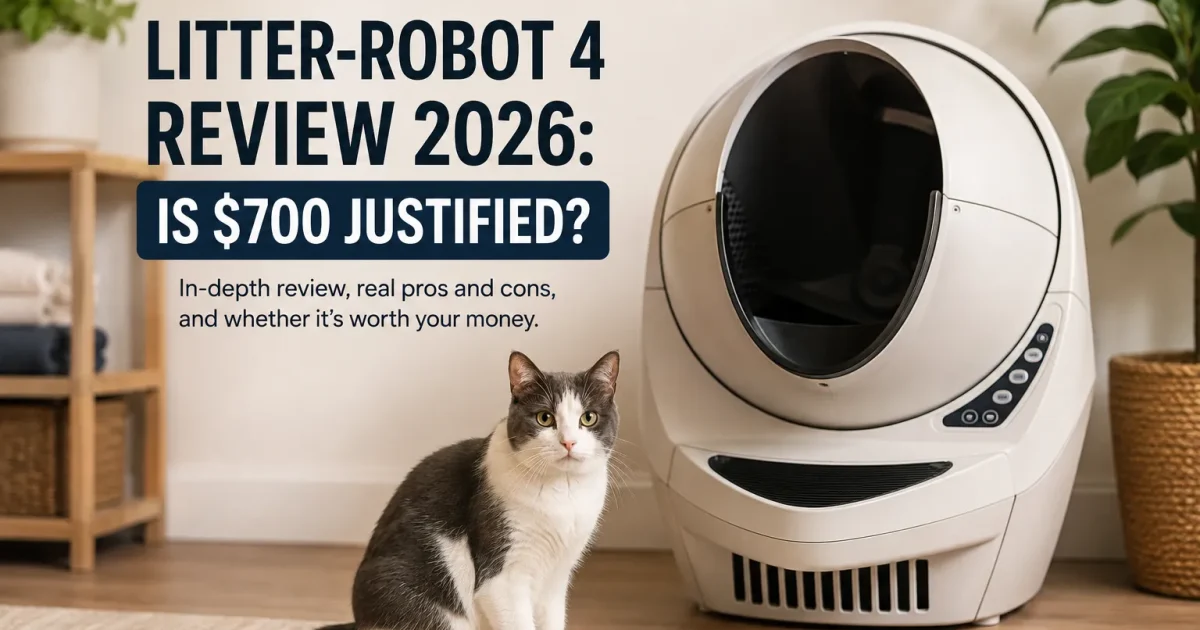
The Litter-Robot 4 is a self-cleaning automatic litter box. Your cat uses it, the globe waits a set amount of time, then slowly rotates. Clean litter falls back through a screen. Clumps drop into a sealed drawer below. That’s the simple version.
The better version: it keeps the litter bed cleaner than most humans manage on their own. Including me. I can admit that.
The main wins:
- Much less daily scooping
- Better odor control than a standard open box
- Quiet cycling
- Useful app alerts for waste level, litter level, and cat weight
- Strong value in two-or-more-cat homes
The main problems:
- The price is a real barrier
- It’s tall and bulky
- Some cats simply refuse it
- Larger cats may feel cramped inside the globe
- You still clean parts, wipe sensors, and empty the drawer regularly
For a two-cat home, I think it’s frequently worth it. For one easy cat and an owner who already scoops twice a day without complaint, maybe not. That’s a boring answer. It’s also the honest one.

What Makes It Different
A lot of coverage talks about “smart features” in vague terms. Here’s what actually matters in plain language.
Sensors notice when a cat enters and wait after the cat leaves before cycling. The app tracks waste drawer level, litter level, and each cat’s weight over time. The entry itself is wide — older Litter-Robot models looked more like a cave, which some cats hated, while the 4 feels noticeably more open from the front.
It’s quieter than I expected, too. Not silent — you’ll hear litter sliding around during a cycle — but the motor noise is low. A dishwasher is more annoying. A cat knocking a hair tie under the fridge at 2 a.m. is louder.
Cats don’t care about your expensive plans, though. A $20 open pan can beat a $700 robot if your specific cat is stubborn enough about it — which is exactly why I’d never remove the old box on day one.
Setup: Easy for You, Slower for the Cat
The unit arrives mostly ready. You place it, add clumping litter to the fill line, plug it in, and connect it to the Whisker app. The human side of setup isn’t hard at all.
The cat side is the real test. I’d place the Litter-Robot 4 beside the existing litter box, leave it powered off at first, and let the cat sniff and walk through it on its own terms — like a tiny landlord inspecting a property. After a day or two, run a manual cycle while the cat is nearby but not trapped close to it. Don’t hover.
This is where I disagree with some common advice. Some sources say to remove the old box quickly so the cat has no choice but to adapt. I don’t like that advice for nervous cats specifically. A confident young cat may handle a forced transition fine; a skittish senior cat may decide the hallway rug is the new bathroom instead. Cats like routine, and a moving litter box is a genuinely strange ask from their side of things.
[Related: our guide on transitioning a cat to a new litter box covers this in more detail.]
What I Actually Like — and What Still Bugs Me
The biggest advantage isn’t “no scooping.” It’s that the box stays clean after most individual uses — which matters for cats who hate stepping into old clumps, and matters even more in multi-cat homes, where one cat can ruin the box for the next cat in about seven seconds.
I also like the waste drawer. It keeps the unpleasant part out of sight — it doesn’t turn waste into roses, nothing does, but it keeps daily smell down meaningfully. The app turned out more useful than I expected, too; seeing visit patterns and waste alerts triggered that pet-parent thing where you suddenly become invested in bathroom data. A little embarrassing. Still genuinely useful.
What still bugs me: the deep clean isn’t fun. You still wipe the globe, still deal with litter dust, still empty a bag of concentrated waste, and when that drawer opens, the smell can be intense. The price also just sits there, unavoidable — around $699 before bundles, and adding a warranty, ramp, mat, OdorTrap packs, or a LitterHopper pushes the total up fast.
Odor Control: Does It Actually Work?
Mostly, yes — not perfectly. The Litter-Robot 4 outperforms a normal open pan because it removes clumps from the litter bed soon after use and drops them into a drawer with a carbon filter and a tighter seal than an open box ever has.
That helps a lot. But odor control still depends on four unglamorous factors: your litter, your cat’s diet, how often you empty the drawer, and how clean you keep the globe itself. Bad clumping litter will make this machine look worse than it is — soft clumps smear, wet clumps break apart, and dust coats the sensors and surfaces over time.
A firm clumping clay litter, low-dust if possible, is the right starting point. Scented litter can help some households mask remaining smell, but it can also make things smell like perfume fighting a crime scene — and some cats avoid boxes that smell too strong regardless of whether the scent is pleasant to a human nose. I’d start unscented, then adjust from there if needed.
Is It Good for Multi-Cat Homes?
This is where the value case gets stronger. The honest answer isn’t “one robot replaces every box” — that’s too clean a claim for how messy real cats actually are.
Whisker states one Litter-Robot can serve up to four cats, and I believe that’s true for the right household — but I’d still keep a backup box on hand for three or four cats, at least initially. For two cats, the value case gets much easier to make. Waste builds up fast in a normal box, even good owners miss scoops on busy days, and the robot keeps the bed cleaner between whatever human maintenance actually happens.
The app’s weight and visit tracking helps most when cats are different sizes; if they weigh nearly the same, that particular feature gets less useful. Still, pattern changes are worth watching regardless — a cat visiting the box repeatedly may be dealing with a urinary issue, and a cat suddenly avoiding the box may need attention. The robot doesn’t replace a vet, but it does make behavioral changes easier to notice early, which matters more than people tend to expect going in.
Large Cats, Senior Cats, and Scared Cats
This part gets skipped too often in other coverage. The opening is roomy; the interior is less roomy than product photos suggest. A big Maine Coon-type cat may use it fine — some do — but a cat that likes turning around several times, digging enthusiastically, and stretching out in a wide open pan may find the globe tight.
Senior cats may need the optional ramp, since stepping up can be uncomfortable with sore joints. Scared cats are their own case: the unit is quiet, but it does still move, and while some cats adjust without issue, others treat it with open suspicion.
I’d be more cautious if your cat hates covered spaces generally, gets nervous around new objects, has arthritis, is unusually large, or is under 3 pounds. For tiny kittens specifically, stick with manual mode or a standard box until they’re large enough — I wouldn’t trust a kitten with an unsupervised automatic cycle.
What Owner Communities Get Right (and Wrong)
Searching owner forums turns up two clear camps. One group says it’s worth every penny — less smell, less scooping, easier travel, better multi-cat cleanup. The other talks about errors, price, repairs, sensor issues, app glitches, or cats who flatly refused to use it. Both groups are telling the truth about their own experience.
That’s what makes owner communities genuinely useful: they show the messy middle that polished reviews often miss, since professional reviews typically test a product for a few weeks while forum owners are reporting back after years, firmware updates, and multiple bags of the wrong litter. The catch is that these communities can swing too hard in either direction — one broken unit doesn’t mean every unit is bad, and one delighted owner doesn’t guarantee your specific cat will take to it. Use forum threads for pattern spotting: if many people report the same specific problem, pay attention. If one person is furious two hours after a cold introduction, that’s more about cats needing time than about the product itself.
The LitterHopper Add-On: Useful, Not Essential
The LitterHopper is an add-on that sits on the back of the unit and tops up litter automatically as the level drops. It’s useful if fewer refill chores is what you’re after, but it doesn’t reduce overall maintenance — you still fill the hopper itself, still deal with litter dust, and still need the right litter type for good clumping.
My honest recommendation: buy the robot first, use it for a month, and see what actually bothers you day to day. If topping off litter turns out to be the recurring annoyance, the LitterHopper is worth adding. If emptying the waste drawer is the real irritant, the LitterHopper won’t touch that problem at all.
The Hidden Costs Nobody Loves Talking About
The robot itself is only part of the total spend. Depending on how you outfit it, you may also pay for waste drawer liners, carbon filters, OdorTrap packs, a ramp or steps, a litter mat, an extended warranty, a LitterHopper, and better-quality litter than you were using before.
You can usually skip the branded liners — many owners use regular trash bags or store bags that fit well enough. The extended warranty is a closer call: I lean toward yes if it fits your budget, since this isn’t a plastic scoop — it’s a device with sensors, a motor, and app connectivity, all of which can fail. I don’t love paying extra for peace of mind, but I like surprise repair bills even less.
Cleaning: Less Often, Still Genuinely Gross
Daily work goes down. The grossness that remains gets more concentrated. Instead of scooping once or twice a day, you’re emptying the drawer every few days to weekly — a single cat needs less frequent emptying, two cats need more, and three cats can fill it quickly.
You’ll also need to wipe the globe periodically — sooner if clumps are smearing, and more often if litter dust is building up around sensors and edges. A deeper clean means removing parts and washing the globe directly, which isn’t difficult but is still, undeniably, a litter box. Anyone claiming you’ll “never touch litter again” is selling an exaggerated version of what this product actually delivers. The honest version — you touch it meaningfully less — is still a real improvement.
Litter Choice Matters More Than the App
A bad litter choice can undercut the entire experience. The Litter-Robot 4 needs clumping litter that forms firm clumps — fine-grain clay generally performs best. Some natural litters work but may need a longer wait time before the cycle starts. Pellets are usually a poor fit; paper pellets, pine pellets, and many tofu litters don’t sift the way this design requires. Crystal litter can be inconsistent too, occasionally affecting sensors or tracking accuracy.
My honest advice: don’t test a new robot and a new litter brand at the same time. Use whatever litter your cat already accepts, provided it clumps reasonably well, and only experiment with a different litter once the cat is using the robot without drama. One variable at a time — cats aren’t project managers, and neither are we, really, when we’re troubleshooting two changes at once.
🏆 Who Should Actually Buy This
The Litter-Robot 4 makes the most sense for two-cat homes, busy people who reliably forget to scoop, owners who travel for short trips, anyone dealing with real smell issues from an open box, people with back pain or trouble bending, and cats who genuinely prefer a clean box every single time.
It makes less sense for tiny apartments without floor space to spare, very large cats who dislike tight spaces, cats that flatly refuse covered boxes, owners on a genuinely tight budget, and anyone expecting zero ongoing cleaning. It’s also worth planning around if you have a dog in the house — the entry is open, and a curious dog can still get its face inside. The robot isn’t a dog-proof vault, so if your dog treats cat waste as a forbidden snack, plan the room layout accordingly before buying.
Has Much Changed Since Last Year?
Plenty of earlier coverage was written before newer Whisker models and accessories became part of the comparison set. In 2026, the Litter-Robot 4 is still a strong option — it’s just no longer the newest thing on the shelf, which changes how its price and value read against the current lineup.
The upside of that: older smart products tend to improve with time, as early bugs get fixed, accessories mature, and owners find better cleaning workflows through experience. The downside is simply more models to weigh against it now. That can make the LR4 feel less exciting by comparison, but excitement was never really the point. The real question is whether it cleans well, controls odor, and keeps working reliably — and the answer is yes, with normal ongoing maintenance factored in.
Is $700 Justified?
For one cat, I hesitate. For two cats, I start nodding along. For three cats, I’d want a backup box in reserve, but I understand the purchase.
The price is justified if litter box maintenance is a genuine daily stress point in your home — if you dread scooping, smell litter from another room, or have cats who fight over a dirty box, the Litter-Robot 4 solves a real, recurring problem. If you already scoop twice daily without issue and your cat uses a cheap open pan with no smell complaints, keep the money. Not every pet product needs to become a lifestyle upgrade — sometimes a scoop and a stainless pan are genuinely fine as they are.
But if your current setup is making the house smell or making you resent a basic pet chore, the Litter-Robot 4 tends to feel worth it quickly.
FAQ
Is the Litter-Robot 4 actually worth it for one cat? Maybe. For a single cat, value comes down to how much you dislike scooping day to day. If your cat is tidy and you already scoop daily without complaint, the price is hard to justify. If you travel often, deal with back pain, or smell is a genuine problem, it starts to make a lot more sense.
Does the Litter-Robot 4 smell after a few days? It can. Most odor stays contained in the drawer until it’s opened. If it smells constantly, check your litter choice, the drawer liner, the carbon filter, and the globe itself — and consider emptying the drawer sooner, since waiting too long is usually the actual culprit.
What litter works best in the Litter-Robot 4? Firm clumping litter performs best — a low-dust clumping clay is a good starting point. Avoid pellets and litters with weak clumping strength; clumps that break apart during cycling get the robot dirty faster than intended.
Can big cats use the Litter-Robot 4? Some large cats use it without any issue. Others feel cramped inside. The opening is wide, but the interior space is still a defined globe shape — if your cat dislikes covered boxes or needs a lot of turning room, proceed cautiously and watch the first several uses closely.
Should I trust owner reviews on forums like Reddit? Use them for spotting real, recurring patterns rather than as a final verdict. They’re genuinely useful for surfacing common problems across many owners, but less useful for calm decision-making, since both delighted and frustrated owners tend to post with equal intensity.
Choosing With Confidence
The Litter-Robot 4 doesn’t eliminate litter box work — it changes its shape, concentrating it into less frequent, slightly grosser sessions instead of daily scooping. Whether that trade is worth $700 depends less on how many cats you have and more on how much the current daily chore is actually costing you in time, smell, or resentment.
If litter box maintenance is a real friction point in your house, this is one of the rare pet products that tends to earn its price back in peace of mind. If it isn’t, there’s no shame in sticking with a scoop and a good pan.
