
- Best CO2 System Planted Tank Setup for Most People
- Do You Actually Need CO2?
- Best Overall Pressurized CO2: FZONE Pro Series Regulator Kit
- Best Compact Kit: UNS Mini Dual Stage CO2
- Easiest Beginner Kit: Fluval 95g CO2 Kit
- Best Premium Choice: CO2Art Pro-SE
- Cheapest Start: DIY Yeast CO2
- Budget Refillable Route: Paintball CO2 Setup
- Pressurized CO2 vs DIY CO2
- What Comes in a Good Aquarium CO2 System?
- How Much CO2 Should You Add?
- Mistakes That Cause Algae After Adding CO2
- Best CO2 Setup by Tank Size
- FAQ
- What is the best aquarium CO2 system for beginners?
- Is a Fluval CO2 kit good for planted aquariums?
- Is pressurized CO2 better than DIY CO2?
- Can too much CO2 hurt fish?
- Do I need CO2 for easy aquarium plants?
CO2 is the upgrade that makes planted tanks look magical and mildly terrifying.
The first time I added it, I checked the bubble counter like it was a sleeping baby monitor. Too little CO2 and the plants barely noticed. Too much and the fish could be in trouble. That is why choosing the best co2 system planted tank setup is less about buying the fanciest regulator and more about matching the system to your tank, habits, and nerve.
Best CO2 System Planted Tank Setup for Most People
For most planted tank owners who are ready for real CO2, I would choose a FZONE Pro Series dual-stage regulator kit with a refillable CO2 cylinder. It gives stable output, room to grow, and better value than tiny disposable cartridge systems. For beginners who want less gear, the Fluval 95g CO2 kit is simple, but it gets expensive if you use it long term.
| Product & Model | Best For | The Big Win | The Catch | Price Tier |
|---|---|---|---|---|
| FZONE Pro Series Regulator | Serious beginners | Stable dual-stage control | Needs cylinder setup | Mid-Range |
| UNS Mini Dual Stage CO2 | Nano aquascapes | Clean compact build | Small tank focus | Premium |
| Fluval 95g CO2 Kit | Nervous beginners | Easy first setup | Costly cartridges | Mid-Range |
| CO2Art Pro-SE | High-end planted tanks | Very steady output | Higher upfront cost | Premium |
| DIY Yeast CO2 Kit | Experimenters | Very cheap start | Unsteady bubbles | Budget |
| Paintball CO2 Setup | Budget pressurized tanks | Refillable and compact | Adapter fuss | Mid-Range |
Do You Actually Need CO2?
Maybe not.
That answer annoys people because CO2 gets talked about like the secret door to planted tank success. It can be. It is also extra gear, extra testing, and one more thing to get wrong.
Many plants grow without added CO2. Java fern, anubias, cryptocoryne, Amazon sword, water sprite, hornwort, guppy grass, moss, and many floating plants can do well in low-tech tanks. They grow slower. That is not always bad.
Slow plants mean less trimming.
Less trimming means fewer wet sleeves.
I like CO2 for tanks where plant growth is the main point. Carpeting plants, dense stem groups, red plants, and tidy aquascapes all get easier with steady CO2. The plants can use brighter light and nutrients without stalling.
But if your tank has a few easy plants and happy fish, do not let the internet bully you into a regulator.
You need CO2 if:
- You want a carpet plant like Monte Carlo or dwarf hairgrass
- Your strong light keeps causing algae
- Your stem plants look thin and slow
- You want faster, fuller growth
- You enjoy tuning a tank
You may not need CO2 if:
- You keep slow plants
- You hate extra maintenance
- Your fish are the main focus
- Your tank already looks good
Best Overall Pressurized CO2: FZONE Pro Series Regulator Kit
The FZONE Pro Series regulator is the kit I would point most new CO2 users toward if they want to do this properly.
The key part is the dual-stage regulator. A regulator controls gas pressure from the cylinder. Dual-stage models tend to hold steadier output as the cylinder empties. That matters because unstable CO2 is one of the fastest ways to stress fish and grow algae.
I have a strong opinion here: if you are buying pressurized CO2, do not make the regulator the place where you save every last dollar.
A weak regulator can drift. A sticky needle valve can make small adjustments feel impossible. A bad solenoid can fail at the worst time. The solenoid is the part that turns CO2 on and off with a timer.
The FZONE setup is not the most polished system in the world, but it gives you the right bones:
- Dual-stage pressure control
- Solenoid for timer use
- Fine bubble adjustment
- Works with refillable cylinders
- Good value for planted tanks
You still need the rest of the system. That usually means a CO2 cylinder, tubing made for CO2, a check valve, bubble counter, diffuser, and timer.
The first setup can feel clumsy. You will leak-test fittings. You will adjust bubbles. You will stare at the drop checker and wonder if green means green enough.
It gets easier.
Best Compact Kit: UNS Mini Dual Stage CO2
UNS gear often feels like it was designed by people who care about neat aquascapes.
The UNS Mini Dual Stage CO2 setup is a good fit for nano tanks and tidy cabinet setups. It is compact, attractive, and made for people who do not want their CO2 gear to look like it came from a garage shelf.
That sounds shallow. It is not, at least not fully. A planted tank is often in a living room, office, or bedroom. If the gear is neat, you are more likely to keep it set up well.
This kit is best for:
- Nano planted tanks
- Rimless aquascapes
- Shrimp tanks with heavy plants
- Owners who care about clean gear layout
The catch is scale. Mini systems can be great for small tanks, but I would not choose one for a big, hungry plant tank. Bigger aquariums need more gas and more stable long-run use.
Also, shrimp keepers need to be careful. Shrimp can live in CO2 tanks, but fast pH swings are rough on them. Go slow. Watch behavior. If shrimp climb high or act restless after CO2 starts, back off.
Easiest Beginner Kit: Fluval 95g CO2 Kit
The Fluval 95g CO2 kit is the friendly-looking option on many store shelves.
It uses small disposable CO2 cartridges instead of a large refillable cylinder. That makes it less scary. You do not need to find a gas refill place right away. You can learn the parts without feeling like you brought home welding gear.
I understand the appeal.
I also think many people outgrow it fast.
The cartridges cost more over time, especially if the tank is larger than a nano setup. Output can feel limited. You may start with it because it feels simple, then later buy a full pressurized system anyway.
So who should buy it?
Someone with a small tank who wants to try CO2 gently. Someone who is not sure planted tanks will become their whole personality. Someone who would rather pay more later than deal with a full cylinder now.
That is a fair choice.
Just do the math before buying. If you plan to run CO2 every day on a 20-gallon or larger planted tank, a refillable cylinder system usually makes more sense.
Best Premium Choice: CO2Art Pro-SE
CO2Art has a good reputation among planted tank keepers for stable regulators.
The Pro-SE is the kind of system I would look at if I had a demanding tank with strong lighting, CO2-hungry plants, and no patience for fiddly output. It costs more upfront, but the better control can pay you back in fewer headaches.
Premium CO2 gear is not about showing off.
It is about tiny adjustments.
In a planted tank, one small twist can change the bubble rate enough to matter. A better needle valve lets you make that twist without overshooting. A steady regulator helps the tank get the same CO2 pattern every day.
Plants love steady.
Algae loves chaos.
The Pro-SE makes sense for:
- High-light tanks
- CO2 carpets
- Red stem plants
- Large planted aquariums
- Owners who already know they want pressurized CO2
If this is your first planted tank and you are still buying Java fern, this may be more than you need. If you are building a serious aquascape, it is a smart place to spend.
Cheapest Start: DIY Yeast CO2
DIY CO2 is usually sugar, yeast, water, tubing, and hope.
The yeast eats sugar and produces CO2. The gas travels into the tank through tubing and a diffuser or air stone. It works. Sort of.
I used DIY CO2 years ago because it was cheap and I was curious. The plants did respond. The output also changed as the mixture aged. It started strong, slowed down, and made me adjust around it.
That is the problem.
DIY CO2 does not give the same steady control as pressurized gas. You usually cannot shut it off at night in a clean way. The bottle pressure can vary. If the mix foams into the tubing, you can create a mess.
DIY CO2 is fine for experimenters. It teaches you what CO2 can do. It is not my pick for someone who wants a calm, reliable tank.
Use it only if you accept the mess and limits:
- Small tanks only
- Low to medium light
- Careful check valves
- No expensive livestock experiments
- Regular bottle changes
I would rather see most beginners save for a modest pressurized setup than spend months fighting DIY swings.
Budget Refillable Route: Paintball CO2 Setup
Paintball CO2 setups used to be a popular budget path.
The idea is simple: use a compact paintball CO2 cylinder with an adapter and aquarium regulator. The cylinder is smaller than standard tanks and can be easier to hide near a nano or 20-gallon aquarium.
This can work well. It can also be fiddly.
You need compatible threads, a good adapter, and a refill source. Some sporting goods stores no longer refill CO2 as easily as they once did. In some places, paintball fills are simple. In others, they are a pain.
If you already have easy refills nearby, this route can save space and money. If not, a standard 5-pound CO2 cylinder may be less annoying.
That is one of those boring details that matters more than any product ranking.
Before buying any system, ask: where will I refill the tank?
If the answer is “I have no idea,” solve that first.
Pressurized CO2 vs DIY CO2
Pressurized CO2 is better for most serious planted tanks.
It is steadier. It works with a timer. It scales better. It lets you make small adjustments.
DIY CO2 is cheaper at the start. It can help small low-budget tanks. It can also make you chase problems that are not worth the savings.
Here is the plain version:
Use DIY if you like tinkering.
Use pressurized CO2 if you want the tank to behave.
That may sound blunt, but I stand by it. Plants can adapt to many things. Fish can handle gentle change. What tanks hate is a wild swing one day and nothing the next.
What Comes in a Good Aquarium CO2 System?
A complete pressurized CO2 system has several parts.
The cylinder holds the gas. Common sizes include paintball tanks, small disposable cartridges, and refillable 2.5-pound or 5-pound cylinders.
The regulator lowers pressure so gas comes out in a controlled way.
The needle valve fine-tunes flow.
The solenoid turns gas on and off with a timer.
The bubble counter lets you see flow. It is not a perfect measure, but it helps.
The check valve stops aquarium water from flowing backward into the regulator. Do not skip this tiny part. It is cheap and saves expensive gear.
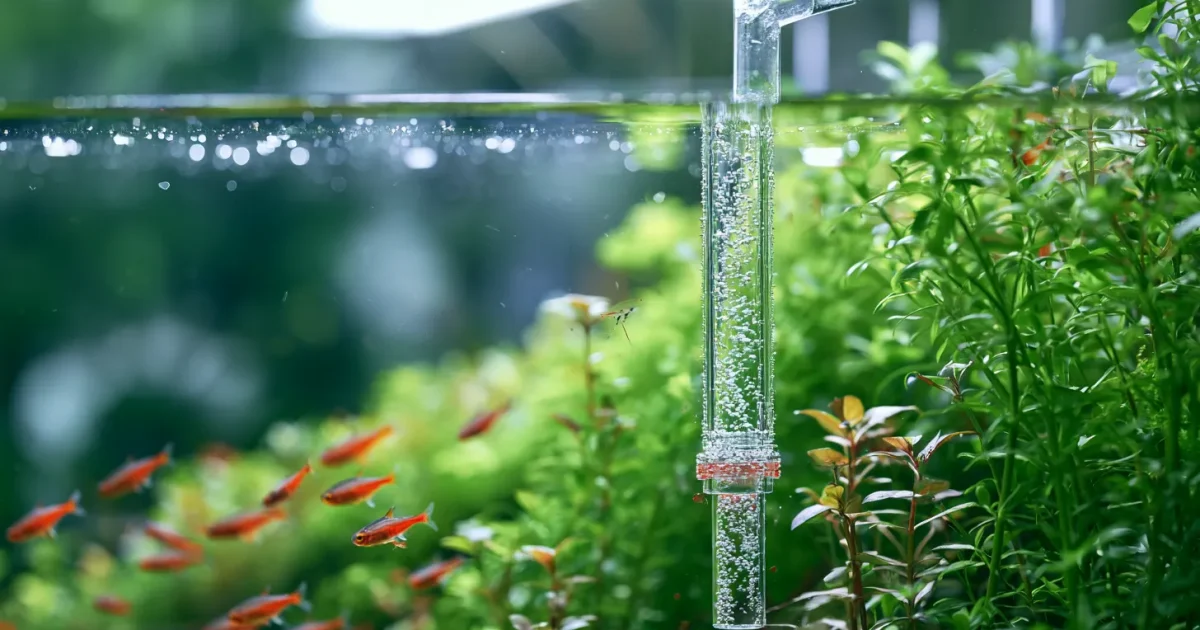
The diffuser breaks CO2 into small bubbles so it can dissolve into the water.
The drop checker gives a rough visual clue about CO2 level. Blue often means low. Green is the usual target. Yellow often means too high. It is slow to react, so do not treat it like a live alarm.
The timer keeps the schedule steady.
I like CO2 to turn on about one to two hours before the light turns on. Then I turn it off about one hour before the light goes off. The goal is to have CO2 ready when plants start using light.
How Much CO2 Should You Add?
Start low.
I know that advice sounds boring. It also keeps fish alive.
A common target is around 30 ppm of CO2 in planted tanks. PPM means parts per million. It is just a way to describe concentration in water. But home hobby testing is imperfect, and tanks do not all behave the same.
Use the fish as your first warning system.
Too much CO2 can make fish gasp near the surface, breathe fast, hide, or act weak. If that happens, turn off CO2, increase surface movement, and do a water change if needed.
Do not chase a drop checker color while fish look stressed.
Your plants are not more important than your animals.
For beginners, I would set a low bubble rate, watch for a week, then adjust slowly. One change at a time. Keep the light schedule steady while you tune CO2.
Mistakes That Cause Algae After Adding CO2
Adding CO2 can reduce algae. It can also make algae worse if the rest of the tank is unstable.
The first mistake is running too much light. CO2 lets plants use more light, but it does not give you permission to blast the tank for twelve hours.
The second mistake is uneven CO2. If gas levels swing a lot, plants stall and algae takes advantage.
The third mistake is poor flow. CO2 needs to move around the tank. If one corner gets bubbles and the other corner gets nothing, plants will not grow evenly.
The fourth mistake is skipping fertilizer. CO2 helps plants grow faster. Faster plants need nutrients. If nutrients run out, growth stalls.
The fifth mistake is making daily changes. Adjust CO2, wait, watch. Plants need time to answer.
This hobby rewards patient people and gently mocks the rest of us.
Best CO2 Setup by Tank Size
For a 5-gallon planted tank, I would either skip CO2 or use a tiny kit like Fluval or UNS. Small water volume changes fast, so go gently.
For a 10-gallon tank, a mini pressurized kit can work well. DIY can work too, but I would choose pressurized if livestock are valuable or delicate.
For a 20-gallon tank, a refillable cylinder with FZONE or CO2Art makes sense. This is where small cartridges start feeling expensive.
For a 40-gallon breeder, use a full pressurized system and a good diffuser or inline diffuser. The tank footprint is wide, so flow matters.
For a 55-gallon or larger planted tank, buy a reliable regulator and a 5-pound cylinder or larger. Tiny cartridge kits do not belong here.
FAQ
What is the best aquarium CO2 system for beginners?
For beginners who want real pressurized CO2, I like a FZONE dual-stage regulator with a refillable cylinder. If that feels too much, the Fluval 95g kit is simpler for small tanks, but it costs more over time.
Is a Fluval CO2 kit good for planted aquariums?
Yes, for small tanks and first attempts. It is easy to understand. The downside is cartridge cost and limited scale.
Is pressurized CO2 better than DIY CO2?
Yes, for steady plant growth. DIY CO2 is cheaper, but it can swing up and down. Pressurized CO2 gives better control and works with a timer.
Can too much CO2 hurt fish?
Yes. Too much CO2 can make fish gasp, breathe fast, or act weak. Turn CO2 off and add surface movement if fish look stressed.
Do I need CO2 for easy aquarium plants?
No. Many easy plants grow without added CO2. CO2 helps them grow faster and fuller, but it is not required for a healthy low-tech tank.
The best CO2 kit for aquarium plants is the one that gives steady gas without making you dread the tank.
For a casual low-tech setup, skip CO2 until plants show you they need more. For a planted tank with strong light, carpets, red plants, or dense stems, buy a real pressurized system. Spend on the regulator. Find your refill source first. Then make slow changes, because planted tanks do not reward panic.