


Mice produce urine constantly and in small amounts — far more frequently than larger rodents relative to their body size. In an enclosed glass tank, this urine produces ammonia that accumulates in the air within the enclosure. A mouse living in a poorly ventilated glass tank breathes concentrated ammonia for hours per day. The resulting respiratory irritation progresses to infection faster than most owners recognize, because the early symptoms (mild eye watering, occasional sneezing) look like normal small animal behavior.
Wire cages solve this by providing continuous air exchange through the bar walls. Ammonia doesn’t concentrate because fresh air constantly displaces it. This is why wire cages are generally the better choice for mice despite aquariums being visually appealing and often marketed as appropriate.
Aquariums can work for mice with proper management: a full-mesh lid (not a partial solid lid), frequent spot-cleaning of soiled bedding (at least every other day), and a bedding depth that allows urine to be absorbed away from the air exchange zone. In humid climates, the ventilation limitation of glass tanks makes wire cages the more reliable choice.
Best Mice Cages 2026: Quick Comparison
| Product & Model | Best For | The Big Win | The Catch | Price Tier |
|---|---|---|---|---|
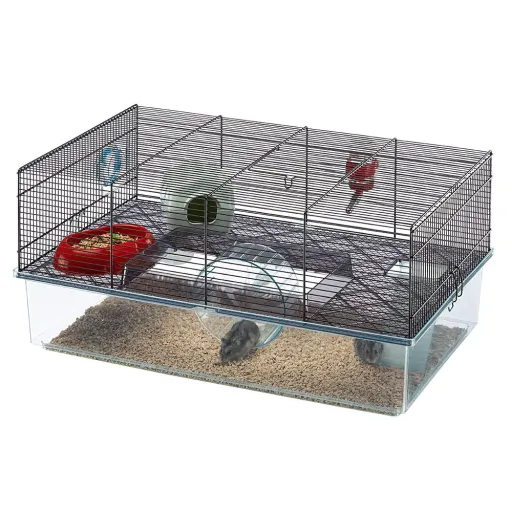
| Ferplast Favola Mouse Cage | Small group of female mice, well-ventilated wire cage | Good ventilation, appropriate 3/8″ bar spacing, multiple levels, wide availability | Somewhat small for groups larger than 3 females; requires monitoring for chewable plastic components | Budget |
| Grreat Choice Mouse Cage (Petsmart) | Budget, starter setup for female mice group | Available at major pet retailers, affordable, appropriate bar spacing | Small footprint for more than 2 mice; limited vertical enrichment | Budget |
| Large finch/bird flight cage (wire, tight bar spacing) | Buyers wanting maximum space on a budget | Very large footprint, designed for climbing, more floor and vertical space than dedicated “mouse cages” | Not marketed for mice — must verify bar spacing is 3/8″ or less; no included accessories | Budget |
| 20-gallon long aquarium (with full mesh lid) | Buyers wanting visual clarity and deeper substrate | No bar climbing risk (mice climb bars, sometimes get leg injuries if they fall); deep substrate possible | Ammonia accumulation risk without very frequent cleaning; full mesh lid required | Budget |
| Niteangel Wonderland Small Animal Cage | Quality-focused buyers wanting a premium wire option | Good build quality, deep base, appropriate spacing, better ventilation than most alternatives | More expensive than basic wire alternatives; may be overkill for a basic mouse setup | Mid-Range |
| Hamster “starter” cages with bar spacing over 1/2 inch | — | Cheap, marketed as small animal housing | Bar spacing allows mouse escape — mice can fit through 1/2 inch bar spacing at most | Budget |
The Male vs. Female Housing Difference
This is the most important practical consideration for new mouse owners that most cage guides skip over entirely.
Female mice: social, should be housed in groups of 3 or more. Females from the same litter or introduced before sexual maturity (around 4–5 weeks) bond readily and live together without significant aggression. A cage for female mice needs enough space for the group — at least 80cm x 40cm floor space for 3–5 females, more for larger groups.
Male mice: territorial, must typically be housed alone after reaching sexual maturity. Male mice placed together (even litter brothers who were previously bonded) will fight once hormones develop — fights are severe, causing deep wounds and death. Housing intact males is a one-per-cage situation, which changes the cage size calculation significantly — a single male needs appropriate space, but not the group-accommodating size a female colony requires.
The exception: male mice castrated before reaching sexual maturity, or siblings introduced very young and maintained together with appropriate cage size, occasionally maintain peaceful coexistence. This is the exception, not the rule. Don’t assume litter brothers will remain compatible indefinitely.
This means: if you’re buying mice from a pet store (where sexing errors are common), confirming sex before housing together is critical. Two females + one accidental male = pregnancy within weeks.
Bar Spacing: The Primary Commercial Cage Filter
Mice are small — adult mice typically weigh 20–40g. They can fit through bar spacing that seems impossibly narrow. The maximum appropriate bar spacing for pet mice: 3/8 inch (approximately 9.5mm). Anything wider is an escape risk for young or small mice.
Many cages marketed as “small animal” or even specifically for mice have bar spacing of 1/2 inch or wider — inadequate containment for most mice. Check the manufacturer specification before purchasing. When in doubt, test: push a finger sideways between two bars — if a finger fits through easily, a motivated mouse probably can too.
Wire bird cages (finch cages, small parakeet cages with tight bar spacing) are sometimes used for mice and often have appropriate bar spacing. Verify the specific cage measurement before purchase.
Aquarium Setup: If You Choose Glass
Aquariums require more management than wire cages to be appropriate for mice. If you choose a glass tank:
Full mesh lid: a solid or partial-mesh lid restricts ventilation enough to allow ammonia buildup. The lid must be full wire mesh with no solid panel sections, secured to prevent pushing open from inside.
Frequent spot-cleaning: remove soiled bedding areas every 1–2 days. Don’t let wet, urine-saturated bedding accumulate in an enclosed glass environment.
Bedding depth: 3–4 inches minimum. Deep bedding absorbs urine downward away from the air interface, slowing ammonia release into the enclosure air.
Size: minimum 20-gallon long (30″x12″ footprint) for a group of 3–4 females. More is better — the same “more volume = more air” principle applies.
In hot, humid climates: wire cages are strongly preferred. Aquarium ammonia accumulation accelerates in warmth and humidity.
Enrichment Inside the Cage
Mice are intelligent, active, and curious — more so than their reputation as a “starter pet” suggests. Bare cage with a wheel and food dish is insufficient. Enrichment that actually engages mice:
Wheel: mandatory, solid-surface, appropriate size (6.5–8 inches for most adult mice). Mice run multiple miles per night.
Nesting material: tissue paper, shredded paper, or soft hay. Mice construct elaborate nests and rearrange nesting material regularly. Providing nesting material rather than just bedding engages this behavior.
Tubes and tunnels: cardboard toilet paper rolls, paper towel rolls, or commercial small animal tubes. Mice investigate enclosed spaces persistently. Rotating different tunnel configurations keeps the enrichment fresh.
Climbing: mice climb on cage bars, branches, ropes, and any available vertical surface. A short section of grape vine or cork bark provides natural climbing enrichment.
Chews: wood chews (apple, willow, aspen) for dental wear.
Scatter feeding: mix a portion of the daily food into the bedding rather than placing all food in a dish. The mouse forages for individual pieces — 20–30 minutes of behavioral engagement versus 2 minutes at a bowl.
Cleaning Schedule
Mice produce a distinctive musky odor (more so in intact males) that builds quickly. Spot-clean soiled bedding corners every 2 days. Full substrate replacement weekly for a group of females; every 5–7 days for a single male (intact males produce more odor-causing secretions). Wash the cage interior monthly with mild soap.
Don’t clean the entire cage all at once — mice scent-mark their territory, and a fully cleaned cage triggers weeks of intensive re-marking behavior. Leave a small amount of used (clean-looking, not soiled) bedding in the cage during full changes to preserve the familiar scent profile.
FAQ
Can male and female mice live together?
Only for intentional breeding, under controlled conditions, and with separate housing prepared for the resulting offspring. Male and female mice housed together will breed — female mice can conceive within hours of giving birth and can produce a litter every 3 weeks. Unless you have the resources and homes for multiple litters, house male and female mice separately.
Do mice get lonely?
Female mice: yes. Female mice housed alone show higher stress markers, reduced behavioral variety, and shorter lifespan compared to group-housed females. They should be kept in groups of at least 3 (groups of 3 are more stable than pairs — if one dies, the remaining animals have a companion rather than facing sudden isolation). Male mice: don’t house together unless pre-social introduction before sexual maturity was successful; single male housing is often necessary.
What bedding is best for pet mice?
Paper-based bedding (Carefresh, Kaytee Clean & Cozy) is the standard recommendation. Aspen shavings are acceptable. Cedar and pine shavings are not appropriate — same aromatic oil respiratory concerns as with hamsters and gerbils. Deep bedding (3+ inches) allows mice to burrow and construct nests, which is important behavioral enrichment.
What’s the minimum cage size for pet mice?
For 3 female mice: at least 80cm x 40cm (approximately 30″x16″) floor space. More is better — mice are active and the additional floor space is used. For a single male: 40cm x 30cm is a working minimum, but providing more space and enrichment compensates for the solo housing requirement.
How long do pet mice live?
1.5–3 years, with 2 years being average. This is short compared to rats (2–4 years), guinea pigs (4–7 years), and rabbits (8–12 years). The short lifespan is the primary welfare difference new owners should consider — getting attached to an animal with a 2-year expected lifespan requires emotional preparation that some owners don’t anticipate.