

- Best Picks at a Glance
- The Spine Alignment Principle
- Surface Type: Solid vs. Barred
- Detailed Reviews
- Niteangel Most Silent Wheel (10" or 12")
- Wodent Wheel Senior (11")
- Niteangel Most Silent Wheel (8")
- Tic-Tac 8.6" Wheel
- Bucatstate 11" Silent Wheel
- What to Avoid
- 🏆 Editor's Pick
- The Starter Kit Wheel Problem
- Wheel Placement and Substrate Depth
- FAQ
- Bottom Line
A hamster on a wheel that’s too small runs with its back arched upward — spine curved in the wrong direction — for hours every night. Wild Syrian hamsters run 5–8 miles nightly. In captivity, they do the same on whatever wheel you give them. If that wheel is 6 inches in diameter, they’re spending hours a night in a posture that, over weeks and months, causes spinal damage, disc compression, and chronic pain.
The 6-inch plastic wheels that come bundled with most starter hamster cages — the “included wheel” in every colorful kit — are too small for Syrian hamsters. A Syrian on a 6-inch wheel physically cannot run with a straight back. Once you know to look for it, the curvature is visible to the naked eye: haunches lifted higher than the shoulders, back arched upward, compensating for a radius that’s too tight.
The correct size for a Syrian hamster is 10–12 inches minimum. For dwarf species, 8 inches minimum. These aren’t arbitrary marketing numbers — they’re the diameters at which a hamster can actually run without forced spinal curvature.
“If you’re short on time: get at least a 10-inch solid-surface wheel for a Syrian hamster, or 8 inches for most dwarf species — never the 6–7 inch barred wheel that ships with most starter kits. The Niteangel Most Silent Wheel is the community standard for a reason: correct sizing, a solid surface, and near-silent operation. Watch the hamster’s back as it runs — if it curves upward, the wheel is too small regardless of what the label says.”
Best Picks at a Glance

Niteangel Most Silent Wheel (10″ or 12″) – 9.4/10
The community standard for Syrian hamsters. Near-silent double ball bearings, a solid running surface, and an adjustable stand — the main downside is price, and it needs some assembly.
Niteangel Most Silent Wheel (8″) – 9.0/10
The same quality as the larger model, scaled down correctly for dwarf and Chinese hamsters. Double-check that 8 inches suits your specific dwarf species, since Roborovskis may do fine on 6.5″.
Wodent Wheel Senior (11″) – 8.9/10
The safety-first pick for Syrians. An enclosed housing protects tails and feet from getting caught, with a quiet solid surface — it just has no integrated stand, so it needs to attach to a cage wall or a DIY mount.
Tic-Tac 8.6″ Wheel – 8.0/10
A solid budget alternative for dwarf hamsters. Reasonable quality at a lower price than Niteangel, with some rattling reported at high speed.
Bucatstate 11″ Silent Wheel – 7.9/10
A mid-range budget option for Syrians. Correct size and a solid surface at roughly half the Niteangel price, though quality control varies across batches.
The Spine Alignment Principle
To evaluate any wheel you’re considering, picture a hamster running on it. The back should form a straight line, or curve very slightly downward — concave, the natural running posture on flat ground. If the wheel’s diameter forces the spine to curve upward instead — convex — the wheel is too small, no matter what the packaging claims.
The actual test: put the hamster on the wheel, let it run briefly, and watch from the side. Back curved downward or flat means the size is correct. Back curved upward means it’s too small and needs replacing immediately.
This test overrides any general diameter rule, because hamsters vary in body length — some Syrians are compact, others are noticeably larger. A 10-inch wheel works for most adult Syrians, but an unusually large individual may need 12 inches. An 8-inch wheel suits most Campbells and Russian dwarfs, while Roborovskis, being smaller, may do fine on 6.5 inches as long as the spine stays straight while running.
Surface Type: Solid vs. Barred
The running surface matters just as much as diameter for foot health. Wire or barred surfaces let feet and toes slip through the gaps, and injuries — bumblefoot (a pressure sore condition) and toe fractures — happen on barred wheels in hamsters that run for hours nightly.
Every wheel recommended in this guide uses a solid running surface. If a wheel has a barred or wire running surface, it shouldn’t be used for a hamster, regardless of how well it scores on anything else.
That solid surface can be smooth plastic, textured plastic, or mesh-pattern solid plastic — a texture on the surface with no actual gaps for feet to slip through. This last type is common in quality wheels and provides good traction without the injury risk that comes with true wire spacing.
Detailed Reviews
Niteangel Most Silent Wheel (10″ or 12″)

Rating: 9.4/10
This wheel has become the dominant recommendation across hamster welfare communities for a simple reason: it does everything right at once. Correct sizing across 8″, 10″, and 12″ options, a solid running surface, near-silent operation via double ball bearings, an adjustable stand, and wide availability.
Pros
- Correct sizing available across multiple diameters
- Near-silent double ball bearing operation
- Adjustable stand height
- Widely available
Cons
- Expensive relative to budget alternatives
- Requires assembly
The silence matters more for owners than for the hamster itself — hamsters often run heavily at night, and a squeaky or rattling wheel at 2am is genuinely disruptive to sleep nearby. The same double ball bearing design that makes it quiet also means the spin requires less effort per stride, which is easier on the hamster’s joints over long nightly runs. Price is the main objection — $30–50 depending on size, against $5–10 starter-kit wheels — but for equipment a hamster uses for hours every night across 2–3 years, the per-use cost is negligible. If you’re picking one thing to upgrade in a hamster setup, this is it.
Wodent Wheel Senior (11″)
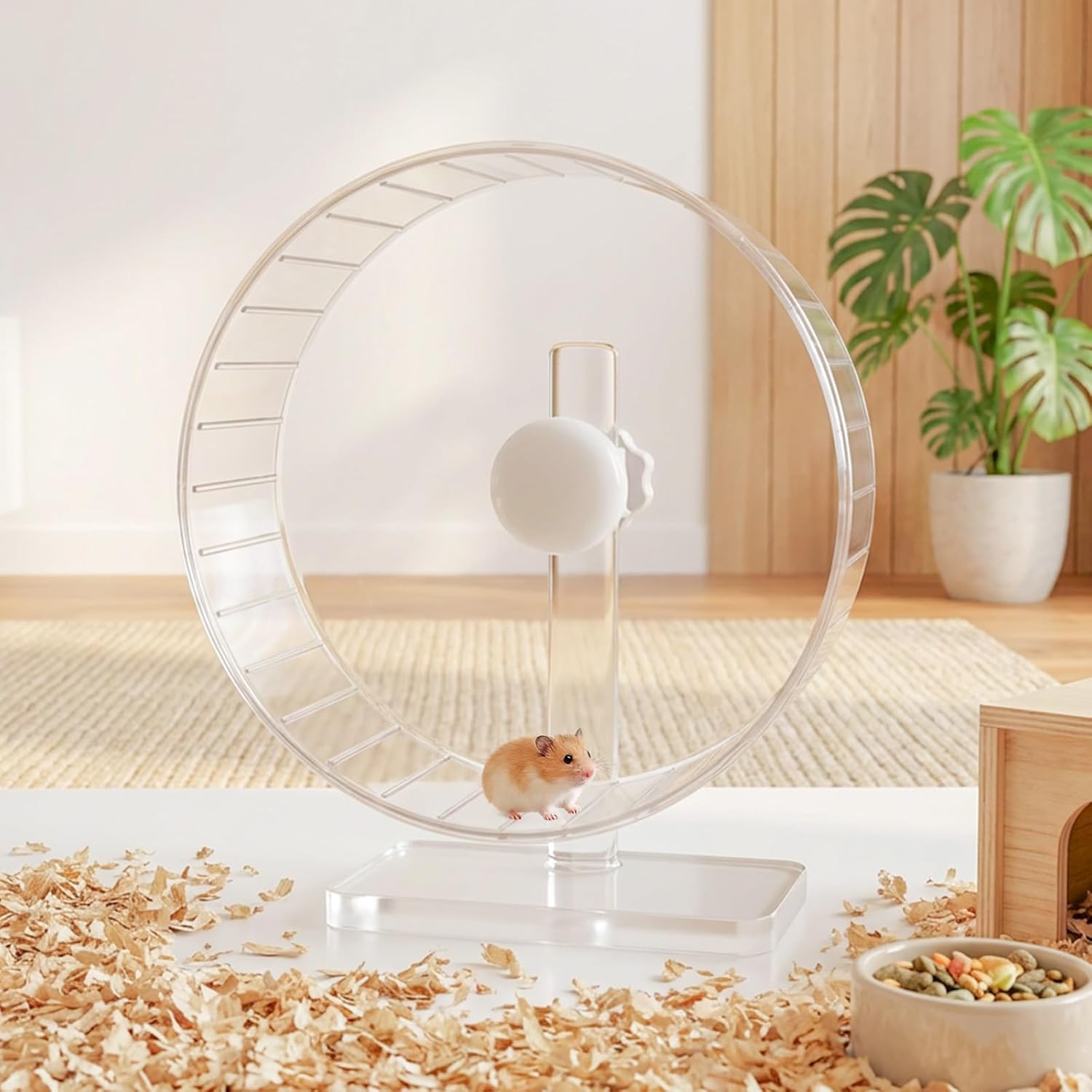
Rating: 8.9/10
This one takes a different design approach entirely: the running surface sits inside a partial housing, with openings for the hamster to enter and exit. That housing doubles as a tail shield, preventing a loose tail from getting caught in the axle — a documented injury risk with open-back wheels running at high speed.
Pros
- Enclosed housing eliminates tail and limb entrapment risk
- Solid running surface
- 11″ size appropriate for most Syrian hamsters
- Very quiet operation
Cons
- No integrated stand — requires wall attachment or a DIY mount
The trade-off is mounting. It attaches to a cage wall or wire side, which works well in wire-topped enclosures or aquarium setups with a mounting bar, but needs a creative solution in fully enclosed cages — DIY stands are common in the Wodent Wheel community for exactly this reason. For buyers prioritizing enclosed safety design above all else, this is the recommendation. For a simpler stand-and-done setup, Niteangel is the easier path.
Niteangel Most Silent Wheel (8″)

Rating: 9.0/10
The same engineering as the larger Niteangel model, scaled correctly for dwarf and Chinese hamsters rather than just shrunk without reconsidering proportions.
Pros
- Same quality construction as the full-size model
- Correctly sized for most dwarf species
- Near-silent operation
Cons
- Verify 8″ actually suits your specific dwarf species — some smaller individuals may need less, others may need more
Setup tip: don’t assume every dwarf species needs the same diameter. Roborovskis, being smaller, may run fine on 6.5 inches — check spine posture directly rather than defaulting to the largest available size out of caution.
Tic-Tac 8.6″ Wheel
Rating: 8.0/10
A well-regarded budget option specifically within the dwarf hamster community, offering correct sizing at a noticeably lower price than the Niteangel equivalent.
Pros
- Appropriate size for most dwarf species
- Significantly cheaper than Niteangel
- Solid running surface
Cons
- Less quiet than Niteangel
- Some rattling reported at high speed
Who should watch for issues: owners of especially fast dwarf species, particularly Roborovskis, where bearing noise at top speed is the main reported limitation. For lower-speed runners, this is a solid, affordable choice.
Bucatstate 11″ Silent Wheel

Rating: 7.9/10
The most commonly recommended budget wheel specifically for Syrian hamsters — correct size, a solid surface, and a price roughly half of Niteangel’s.
Pros
- Correct 11″ diameter for Syrian hamsters
- Solid running surface
- Significantly cheaper than Niteangel
Cons
- Quality control inconsistent across batches
- Some units develop bearing noise over time
Realistic expectation: this is a workable option for owners willing to manage occasional adjustment to keep it level and quiet. It won’t match Niteangel’s consistency, but it clears the two bars that actually matter — correct size and a solid surface — at a meaningfully lower price.
What to Avoid
Generic pet store wheels (6–7″, barred). Cheap and available everywhere, and that’s the entire appeal. These wheels combine the two most significant wheel problems at once: wrong size for a Syrian hamster, and a barred surface that risks toe and foot injury. They aren’t a starter option to upgrade from later — they shouldn’t be used at all.
🏆 Editor’s Pick
For most owners, the Niteangel Most Silent Wheel is worth buying from day one rather than starting with whatever shipped in the cage kit. It’s become the default community recommendation because it doesn’t force a trade-off between size, surface safety, and noise — it gets all three right simultaneously, across sizes that actually fit both Syrian and dwarf hamsters correctly.
The spine-curvature problem this whole guide opens with is a direct, physical consequence of wheel diameter, not a minor comfort issue — and it’s completely avoidable with the right equipment. Niteangel’s adjustable stand also solves a second, less obvious problem: positioning the wheel correctly above deep substrate, which matters more than most new owners expect going in. The price premium over a starter-kit wheel is real, but spread across the hours a hamster spends running every single night for years, it’s one of the lowest-regret upgrades in the entire setup.
If tail and limb safety is your top priority over stand convenience, the Wodent Wheel Senior is the strong alternative — just plan your mounting solution before it arrives.
The Starter Kit Wheel Problem
Nearly every hamster starter cage sold at pet retailers ships with a wheel included, and nearly all of those included wheels are 6–7 inches in diameter with barred running surfaces — combining the two most significant wheel problems that exist, wrong size and wrong surface type, in a single product.
Remove the included wheel before the hamster ever gets a chance to use it. The cost of a correct wheel, $15–50 depending on brand, is the single most important upgrade purchase for any new hamster setup.
If a hamster has already spent time on a too-small or barred wheel, switch to an appropriate one as soon as possible. Spinal changes from long-term small-wheel use can sometimes make a hamster hesitant about a new, larger wheel at first — leave it in the enclosure and give them time to adjust. Most hamsters start using a correctly sized wheel within a few days of having access to it.
Wheel Placement and Substrate Depth
In enclosures with deep substrate — 6 to 10 inches — the wheel needs to sit high enough that the running surface stays above the substrate line, or bedding will build up against the base and stop the wheel from spinning freely. Niteangel’s adjustable stand handles this by raising the wheel height directly; other wheel designs may need a platform or raised mount to achieve the same result.
In aquarium setups specifically, a stand that elevates the base above the expected bedding depth is necessary. Some owners build simple platforms out of wooden blocks or cut sections of PVC pipe to get the right height.
Never let substrate bury the wheel axle — it causes premature bearing wear and makes even a quiet wheel start running noisily.
FAQ
What wheel size do I need for a Syrian hamster?
A minimum of 10 inches in diameter, with 12 inches preferred for larger individuals. The real test: watch the hamster run and check that its back stays straight or curves slightly downward (concave). If the back curves upward (convex), the wheel is too small regardless of its labeled diameter.
Are silent hamster wheels worth the extra cost?
For owners keeping the hamster in or near a bedroom, yes — a wheel running squeaky or rattling for hours a night is genuinely disruptive to sleep, and Niteangel’s near-silent operation makes a real difference. For enclosures set up further from sleeping areas, a cheaper budget wheel with the correct size and a solid surface is a perfectly acceptable choice.
My hamster ignores the wheel. What’s wrong?
A few possibilities: the wheel is too small and the hamster has learned it’s uncomfortable to use; the wheel is too large and a younger or smaller animal hasn’t figured out how to use it effectively yet; or the hamster simply needs more time to adjust. Most hamsters engage with a correctly sized, solid-surface wheel within a few days. If a hamster consistently ignores a wheel that’s genuinely the right size, have them checked by a vet — sudden wheel disinterest in a previously active hamster can signal illness or injury.
Can hamsters share a wheel?
Syrian hamsters must be housed alone — they’re solitary animals and will fight, sometimes fatally, if housed together. Dwarf hamsters can sometimes be kept in same-sex pairs, and a single wheel large enough for both is fine as long as neither is competing for access. If one hamster is monopolizing the wheel and the other isn’t getting exercise time, add a second wheel to the enclosure.
Do I need to clean the hamster wheel?
Yes — hamsters urinate and defecate while running, and a dirty wheel becomes both a hygiene issue and a potential source of foot irritation. Wipe down the running surface weekly with a damp cloth, and do a full clean with mild soap monthly, making sure it’s completely dry before going back in the enclosure.
Bottom Line
Diameter and surface type aren’t cosmetic specs here — they’re the two things standing between a hamster and hours of nightly discomfort or injury. Skip whatever wheel came in the starter kit, size correctly for the species (10–12″ for Syrians, 8″ for most dwarfs), and confirm with the spine test rather than trusting the label alone. The Niteangel Most Silent Wheel gets all of this right by default; a budget option like the Bucatstate or Tic-Tac is a reasonable substitute as long as it clears the same two bars