
- Best Picks at a Glance
- The Cleaning Problem: Why Most Fountain Guides Miss It
- Plastic vs. Stainless Steel vs. Ceramic
- Detailed Reviews
- Pioneer Pet Raindrop
- Catit Flower Fountain
- Drinkwell Platinum Dog Fountain
- PETKIT Eversweet (UV Sterilization)
- Veken Pet Fountain 95oz
- PetLibro Capsule Fountain
- 🏆 Editor's Pick
- Practical Buying Advice
- Capacity: Get This Right Before Buying
- The Filter Cost Nobody Mentions
- Noise: The Bedroom Fountain Problem
- Getting Cats to Actually Use the Fountain
- FAQ
- Bottom Line
Cats were desert animals. Their ancestors got most of their hydration from prey, not standing water. That’s why your cat can walk straight past a full bowl and then sit at the kitchen faucet meowing for you to turn it on. Running water triggers a drinking instinct that still water simply doesn’t — it’s not pickiness, it’s biology.
Chronic dehydration is one of the biggest contributors to kidney disease in cats, a condition that affects a large share of cats as they age. A pet fountain your cat actually uses can meaningfully increase daily water intake. So the real question isn’t whether fountains help — it’s which one your specific pet will use, and which one you’ll actually keep clean six months from now.
That second part is where most buying guides fall short.
“If you’re short on time: the Pioneer Pet Raindrop is the best all-around pick for cats thanks to its stainless steel build and easy cleaning. If you’re on a budget or have multiple cats, the Catit Flower Fountain is the safe, inexpensive choice. For big dogs or multi-pet homes, go with the Drinkwell Platinum. Whatever you choose, prioritize material and cleaning ease over price — a fountain you stop cleaning stops helping.”
Best Picks at a Glance
Pioneer Pet Raindrop – 9.2/10 The best overall fountain for cat owners who want something that stays genuinely clean. Stainless steel construction, quiet operation, and a design that doesn’t look out of place in a modern kitchen.
Catit Flower Fountain – 8.6/10 The budget pick that actually works. Cats recognize the flower design quickly, capacity is generous for the price, and replacement parts are easy to find — just plan on cleaning it more often since it’s plastic.
Drinkwell Platinum Dog Fountain – 8.4/10 Built for volume. With 168oz of capacity and dual filtration, it’s the right call for large dogs or multi-pet households where a smaller fountain would need refilling constantly.
PETKIT Eversweet (UV) – 8.3/10 The tech pick. Continuous UV-C sterilization and app monitoring appeal to owners who want more control over water cleanliness, at a premium price and with an extra charging step.
Veken Pet Fountain 95oz – 8.5/10 A stainless-and-plastic hybrid that undercuts the Pioneer Pet on price while still offering a large capacity and a visible water level window — a strong pick for multi-cat homes on a budget.
PetLibro Capsule Fountain – 8.0/10 Best for small apartments and one or two cats. It’s the quietest option here and the most compact, but it’s not built for large dogs or big multi-cat households.
The Cleaning Problem: Why Most Fountain Guides Miss It
The most common reason people quietly stop using a pet fountain isn’t a dead pump, noise, or the price tag. It’s mold — specifically the pink or brown biofilm that builds up in the pump housing, in reservoir crevices, and underneath a fountain’s decorative elements.
Plastic fountains have more seams, crevices, and pump components where biofilm can take hold without a cleaning brush ever reaching it. Stainless steel and ceramic surfaces are smoother, easier to take apart, and easier to actually get clean.
Before you get to brand comparisons, this is the decision that matters most: the material you choose determines whether cleaning the fountain is a five-minute task or a twenty-minute hunt for a brush small enough to fit the pump intake. Get it wrong, and the fountain becomes something you avoid touching until it’s obviously gross.
Plastic vs. Stainless Steel vs. Ceramic
Plastic is the cheapest option upfront, and it comes in the most variety across the most brands. The tradeoff is consistent across owner reviews: plastic develops biofilm faster, scratches more easily, and those microscopic scratches become anchor points for bacteria and mold. If you’re committed to a weekly cleaning routine and swapping filters on schedule, plastic works fine. If cleaning tends to happen only after you notice something looks off, plastic will look off faster than the alternatives.
Stainless steel is easier to clean and doesn’t scratch the way plastic does, so there’s no biofilm adhesion on the metal surfaces themselves. The pump is still plastic, so it still needs regular disassembly and cleaning — but the reservoir and flow surfaces are dramatically lower-maintenance than a plastic fountain’s. Stainless models typically cost more and tend to look better in a modern kitchen.
Ceramic is the easiest material to clean of the three. It’s non-porous, the ceramic parts are dishwasher-safe (the pump isn’t), and biofilm doesn’t adhere to the surface the way it does on scratched plastic. The tradeoff is fragility — dropping a ceramic fountain on tile ends very differently than dropping a plastic one. It’s also the heaviest and generally the most expensive option.
My take: for cats especially, ceramic or stainless steel is worth the price premium. The plastic fountain that looked like a deal turns into an unpleasant cleaning chore within weeks. The stainless or ceramic fountain is the one you’ll actually keep clean — which means it’s the one that actually keeps your cat drinking.
Detailed Reviews
Pioneer Pet Raindrop
Rating: 9.2/10
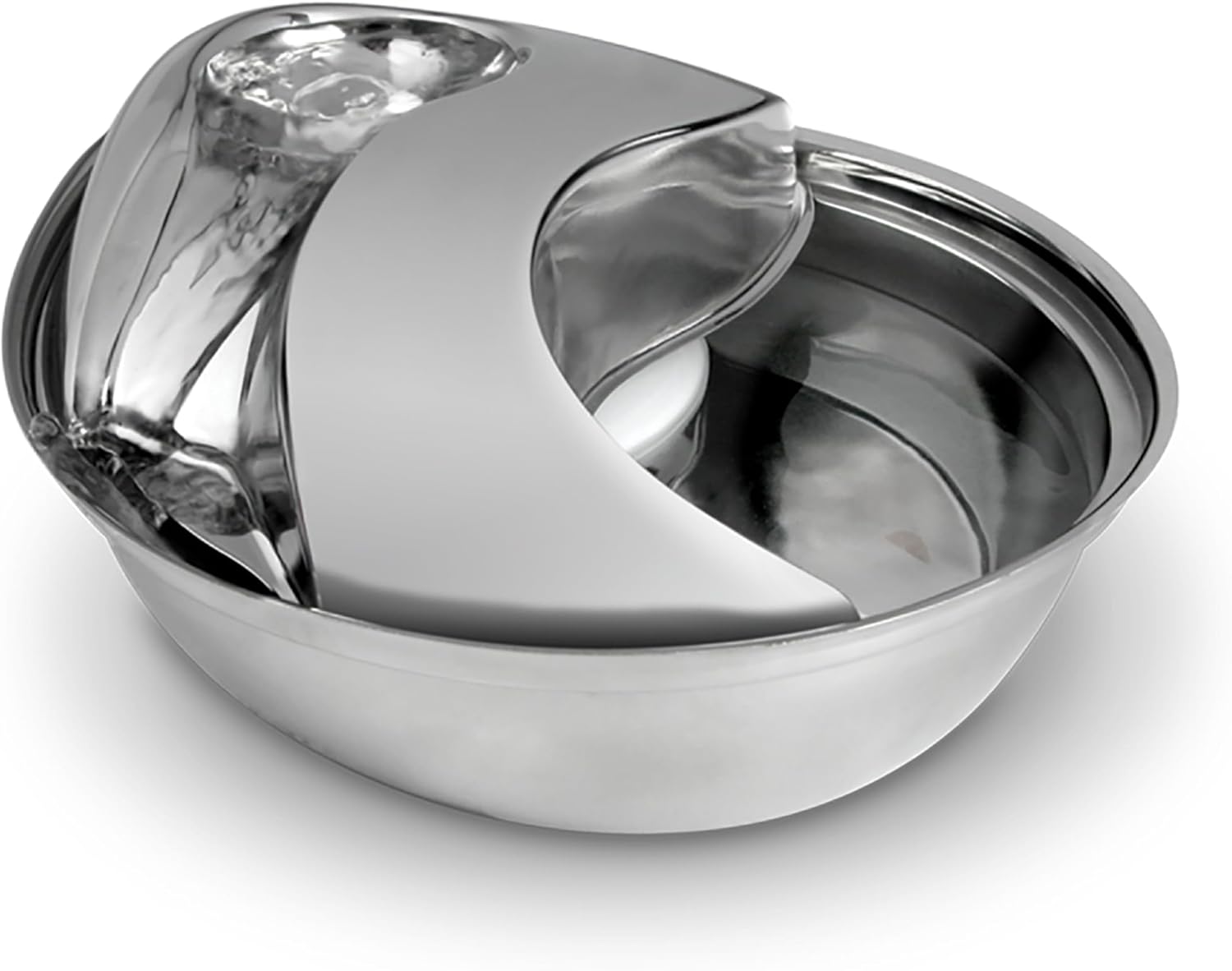
This is the fountain I’d point most cat owners toward first. It’s stainless steel throughout, which means the cleaning problem described above mostly disappears — no scratched plastic surfaces for biofilm to grip onto, and the exterior is dishwasher-safe. It also runs quietly, which matters if the fountain lives anywhere near where you sleep.
Pros
- Stainless steel construction resists biofilm and scratching
- Dishwasher-safe exterior components
- Quiet pump, suitable for bedrooms or quiet rooms
- Attractive, modern design
Cons
- The pump itself is still plastic and needs manual cleaning
- Capacity is moderate — not ideal for large dogs or big multi-cat households
Where this one falls short is capacity. If you’ve got three or more cats, or a household with a medium-to-large dog also drinking from it, you’ll be refilling more often than you would with something like the Drinkwell Platinum. For one or two cats, it’s close to ideal.
Catit Flower Fountain
Rating: 8.6/10
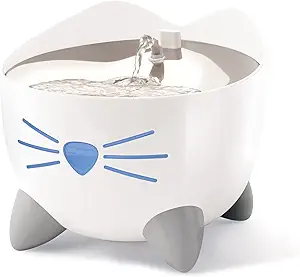
The Catit’s flower-shaped water feature is one of the more recognizable designs in this category, and that’s not just aesthetics — cats seem to take to the moving “petals” of water faster than they do with some flatter fountain designs. At 3L, it covers most one-to-two-cat households comfortably, and because it’s been around a long time, replacement filters and parts are easy to find almost anywhere.
Pros
- Cats tend to recognize and use it quickly
- 3L capacity handles most single or two-cat homes
- Inexpensive, with widely available replacement parts
Cons
- Plastic construction means more frequent deep cleaning
- Less durable long-term than stainless or ceramic options
Who should avoid it: anyone unwilling to commit to a real cleaning schedule. This is a fountain that rewards weekly maintenance and punishes neglect — biofilm shows up faster in plastic, and the Catit’s shape has a few tucked-away spots that need direct attention with a small brush.
Drinkwell Platinum Dog Fountain
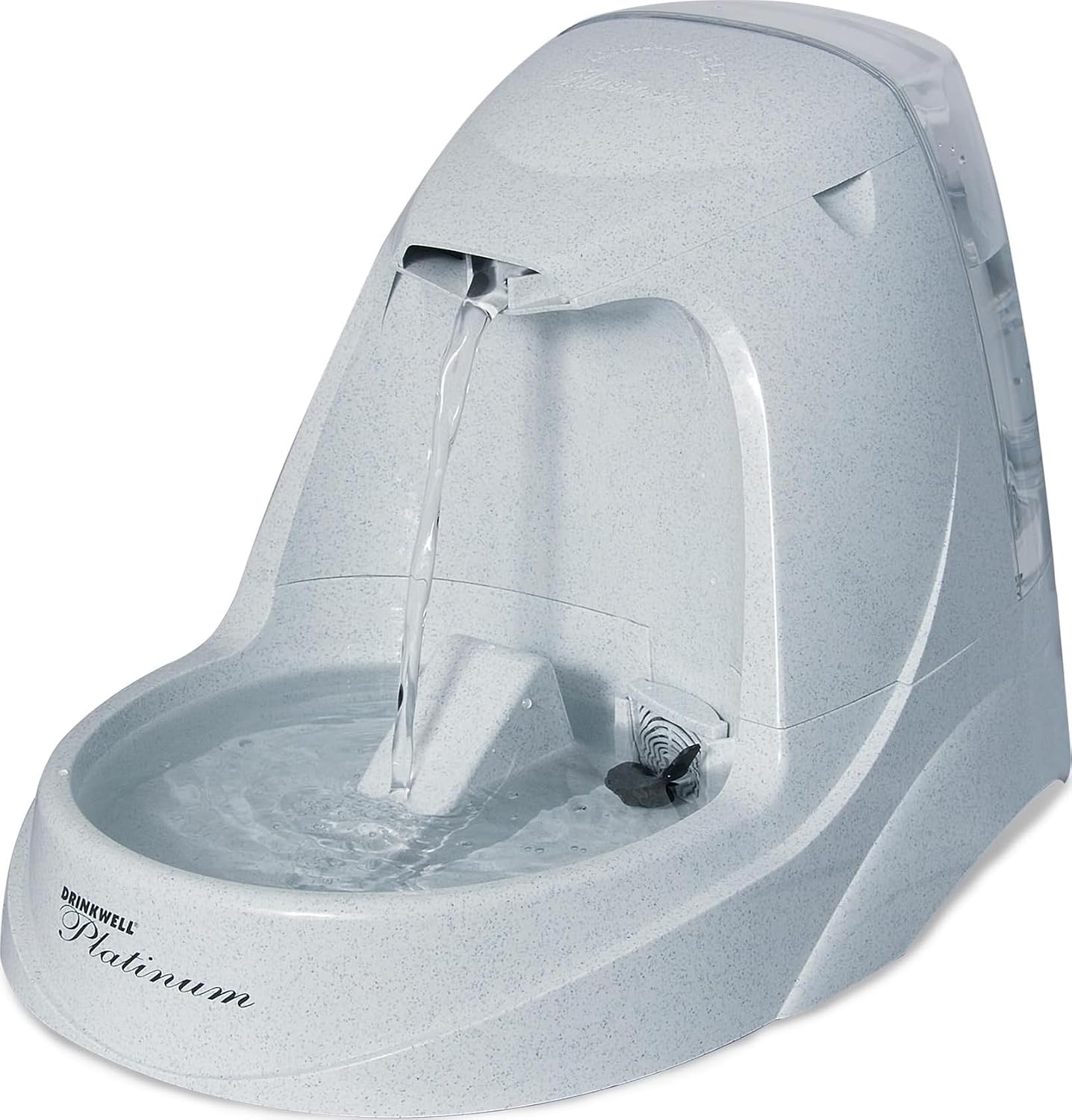
Rating: 8.4/10
Despite the name, this isn’t only for dogs — it’s really a capacity play. At 168oz (5L), it’s built for situations where a cat-sized fountain would mean constant refilling: large dogs, multiple pets, or busy multi-cat households. The pre-filter plus carbon filter combination and adjustable flow give it more flexibility than most fountains at this price.
Pros
- Large 168oz capacity handles high-demand households
- Dual filtration (pre-filter + carbon)
- Adjustable flow rate
Cons
- Large footprint — needs real counter or floor space
- Some users report pump noise
- Plastic construction, same biofilm considerations as other plastic fountains
Value for money here is genuinely strong if you need the capacity. If you don’t — say, one small cat — this is overkill, and you’d be better served by something smaller where water doesn’t sit as long between refills.
PETKIT Eversweet (UV Sterilization)
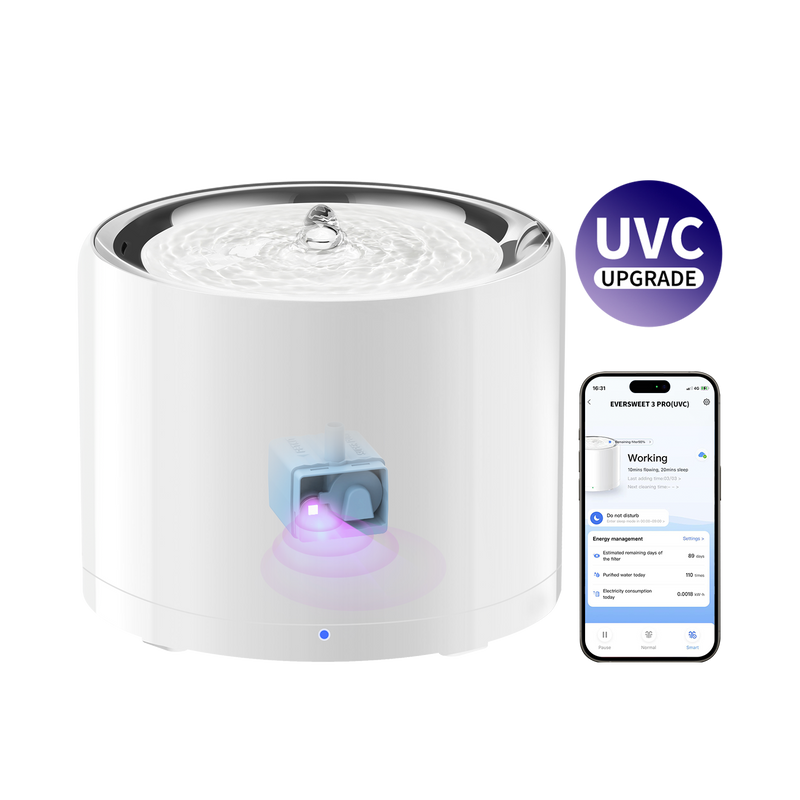
Rating: 8.3/10
This is the fountain for owners who want more visibility into what’s actually happening to the water. The continuous UV-C sterilization is a genuine point of difference from the rest of this list, and the companion app adds monitoring most fountains simply don’t offer. The wireless pump also opens up placement options a corded fountain can’t.
Pros
- Continuous UV-C sterilization
- App-based monitoring and smart sensor that pauses when empty
- Wireless pump gives more flexibility in placement
Cons
- Most expensive fountain on this list
- App dependency for some features may not appeal to everyone
- Wireless pump needs separate charging, which is one more thing to remember
This one is less about “does it work” and more about “do you want the extra layer of tech.” If UV sterilization and app monitoring matter to you, the premium is easy to justify. If you just want clean water without another gadget to charge, one of the simpler stainless or ceramic options will serve you just as well.
Veken Pet Fountain 95oz
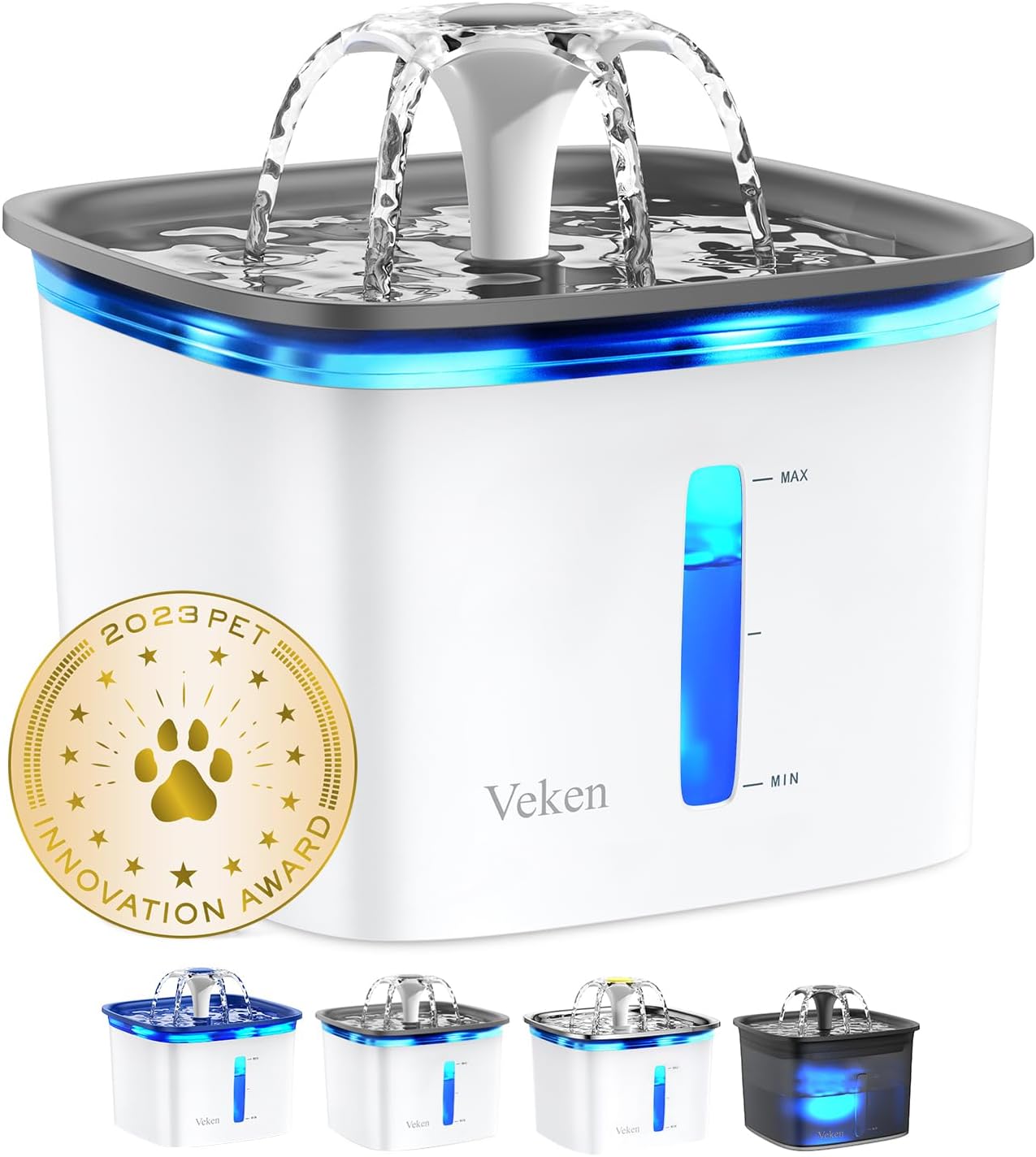
Rating: 8.5/10
The Veken splits the difference between the Catit’s price and the Pioneer Pet’s material quality. It combines stainless steel with BPA-free plastic components, giving you a large 95oz capacity and a visible water level window at a lower price point than the Pioneer Pet.
Pros
- Stainless steel and BPA-free plastic combination
- Large capacity for the price
- Visible water level window makes refilling easier to time
Cons
- Mixed materials mean the pump housing and some components are still plastic
- Not quite as low-maintenance as an all-stainless fountain
Best for: multi-cat households looking for a stainless option without paying Pioneer Pet prices. It won’t be quite as easy to keep spotless as an all-metal fountain, but it’s a meaningful step up from all-plastic options at a similar price.
PetLibro Capsule Fountain
Rating: 8.0/10
If you live somewhere small — an apartment, a studio, a room where a bulky fountain just won’t fit — this is the one built for that. It’s the quietest fountain on this list, the pump is hidden rather than visible, and the compact footprint suits one or two cats well.
Pros
- Extremely quiet operation
- Compact, minimalist design with no visible pump
- BPA-free construction
Cons
- Smaller capacity — not suited to large dogs or multi-cat homes
- Requires regular filter replacement like other filtered fountains
Setup tip: because it’s compact, placement is more flexible than bulkier fountains — it tucks into corners or countertop spots that wouldn’t fit the Drinkwell or Veken. Just don’t expect it to keep up with more than two cats.
🏆 Editor’s Pick
If I had to recommend just one fountain, it’s the Pioneer Pet Raindrop. Not because it’s the cheapest or the biggest — it’s neither — but because it solves the actual problem most fountain owners run into: they stop cleaning it, and a dirty fountain is worse than no fountain at all.
Stainless steel doesn’t scratch the way plastic does, which means biofilm has nowhere easy to grip. That alone is the difference between a five-minute weekly wipe-down and a twenty-minute session hunting for a brush that fits into pump crevices. Add quiet operation and a design that won’t clash with your kitchen, and it’s the fountain most likely to still be running — and still be clean — a year from now.
If your household needs more capacity than the Raindrop offers, the Veken 95oz is the best next step up in materials without jumping to premium pricing, and the Drinkwell Platinum is the right call if you’re dealing with large dogs or several pets at once.
Practical Buying Advice
Capacity: Get This Right Before Buying
A fountain too small for your household means constant refilling. One too large for a single cat means water sits longer than it should before it’s replenished.
Rough guidelines:
- 1–2 cats or small dogs under 20 pounds: 50–80oz (1.5–2.5L)
- 3+ cats or medium dogs (20–50 pounds): 80–130oz (2.5–4L)
- Large dogs (50+ pounds) or multi-pet households with dogs: 150oz+ (4.5L+)
The Catit at 3L (100oz) covers most single-to-two-cat situations comfortably. The Drinkwell Platinum at 5L (168oz) is built for larger dogs or multiple pets. Buying the biggest fountain available for a single cat isn’t a win — it just means water sits in the reservoir longer between full refills.
The Filter Cost Nobody Mentions
Most fountains use replaceable carbon filters that pull out odors and particulates and keep the water tasting fresh. Replacement filters typically run $3–8 each and need swapping every 2–4 weeks.
That works out to roughly $50–130 per year depending on the fountain and how often you replace filters. Over three years, filters for a mid-range fountain can add up to more than the fountain cost in the first place. That’s not a reason to skip a fountain — the water quality benefit is real — but it’s context that often gets left out when guides push the cheapest upfront option.
Fountains with triple filtration (sponge pre-filter, carbon block, cotton pad) tend to stretch filter life a bit further, since each stage takes some of the load off the carbon filter. Some owners run the sponge pre-filter alone and replace the carbon filter less often — whether that works for you depends on your municipal water quality.
Noise: The Bedroom Fountain Problem
Fountains run continuously, with the pump circulating water around the clock. That’s mostly a non-issue in a kitchen. In a bedroom or otherwise quiet room, it becomes something to actually check before buying.
The most common noise complaints center on a few things: sucking or gurgling sounds as the water level drops (most fountains get louder the emptier they are), pump vibration against hard floors — kitchen tile amplifies this — and general water flow or splashing sounds.
Quieter picks from this list: the PetLibro Capsule (built specifically to be ultra-quiet), the Pioneer Pet Raindrop (a notably quiet pump), and the PETKIT Eversweet, thanks to its wireless pump design. Some Drinkwell models and older Catit units show up more often in noise complaints in user reports. If the fountain’s going in a bedroom, check noise reviews for that exact model — a loud fountain at 3 a.m. is a very different experience than the same fountain running in the kitchen during the day.
Getting Cats to Actually Use the Fountain
Not every cat adopts a new fountain right away. The running water is the whole point, but cats can be suspicious of new objects showing up in their territory, and some won’t go near it for days.
A few things that actually help:
- Place the fountain near where the cat currently drinks, not across the house
- Leave it running for several days before expecting them to use it — they’ll investigate on their own schedule
- Some cats respond better when the fountain sits near a wall rather than out in the open
- Gradually moving the old water bowl a little farther from the food each day, while keeping the fountain close to the food, can nudge a hesitant cat toward it
Cats and dogs aren’t stubborn here, exactly — they’re just not going to use something they don’t trust yet. Give it a week before assuming it’s a bust.
FAQ
Do pet water fountains actually help cats drink more? Yes. Multiple studies and consistent owner reports back this up — running water increases cats’ daily water intake compared to standing bowls, and the effect is especially noticeable in cats who were reluctant drinkers before. The improvement is meaningful enough that veterinarians regularly recommend fountains for cats with urinary health concerns.
How often should I clean a pet water fountain? Disassemble and clean the pump at least monthly. Rinse the reservoir and change the filter every 2–4 weeks. If you notice any pink or brown biofilm forming, clean more often — every two weeks is a good baseline in that case. Ceramic and stainless steel are dramatically easier to keep clean than plastic.
Is tap water or filtered water better in a pet fountain? Standard municipal tap water is fine for most fountains. If your tap water has noticeable sediment or a strong chlorine smell your pet avoids, filtered water can improve acceptance — though running the fountain’s own carbon filter as intended handles most chlorine taste on its own. Well water with high mineral content can speed up scale buildup in the pump, so filtering is more worthwhile in that situation.
Can dogs use cat water fountains? Small dogs can, generally without issue. Medium to large dogs need more capacity and flow volume than most cat-sized fountains provide. A 100oz cat fountain might technically hold enough water for a small dog, but a larger dog will empty it fast and need frequent refills. Match the fountain to your largest pet using the capacity guidelines above.
What’s the best pet water fountain for multiple cats? The Catit Flower Fountain (3L, plastic, budget-friendly, good for 2–3 cats), the Veken 95oz (stainless option, works well for multiple cats or mixed pets), or the Drinkwell Platinum for households mixing cats with medium dogs. For three or more cats, prioritize capacity and ease of cleaning over price — you’ll be cleaning it more often no matter which one you pick.
Bottom Line
The fountain that helps your pet drink more isn’t necessarily the one with the most features or the biggest capacity — it’s the one you’ll actually keep clean. Start there. If you’ve got one or two cats and want something you can maintain without dreading it, the Pioneer Pet Raindrop is the safest bet. If budget matters more than material, the Catit gets the job done as long as you commit to cleaning it weekly. And if you’re dealing with a big dog or a full house of pets, size up to the Drinkwell Platinum or the Veken 95oz before anything else.