
- Thermostat Types: Which Does What
- Best Picks at a Glance
- Detailed Reviews
- Inkbird ITC-308 (on/off, dual stage)
- Inkbird ITC-306T (dimming)
- Herpstat 2 (proportional)
- BN-LINK Digital Thermostat Controller
- Vivarium Electronics VE-100
- WILLHI WH1436A
- 🏆 Editor's Pick
- Which Thermostat for Which Heating Element
- Probe Placement: Where You Put It Matters
- Setting Up the Thermostat
- Monitoring: The Thermostat and the Thermometer Are Different Tools
- FAQ
- Getting the Setup Right
The most common ball python thermostat mistake isn’t buying a bad thermostat. It’s buying the right thermostat for the wrong heating element. Run an on/off thermostat on a halogen basking lamp and you get rapid power cycling that kills the bulb within weeks. Run a standard dimming thermostat on most heat mats and you either damage the mat’s wiring or fail to regulate temperature at all. The thermostat type has to match the heating element — and most guides skip straight to product recommendations without explaining that match-up first.
“If you’re short on time: for the standard heat-mat setup most ball python keepers use, get the Inkbird ITC-308 — it’s the community standard, accurate to ±0.5°F, and affordable. If your setup includes a basking lamp instead, you need a dimming thermostat like the Inkbird ITC-306T, not an on/off model — running on/off control on a bulb destroys it in weeks. Serious breeders wanting the tightest possible temperature stability should look at the Herpstat 2.”
Ball pythons rely primarily on belly heat for thermoregulation — the hot-end floor surface (88–92°F) drives digestion, immune function, and feeding response, while the cool end (76–80°F) provides the gradient they use for behavioral thermoregulation. Getting the thermostat right is the difference between stable temperatures and constant fiddling, between a snake that feeds reliably and one that mysteriously fasts.
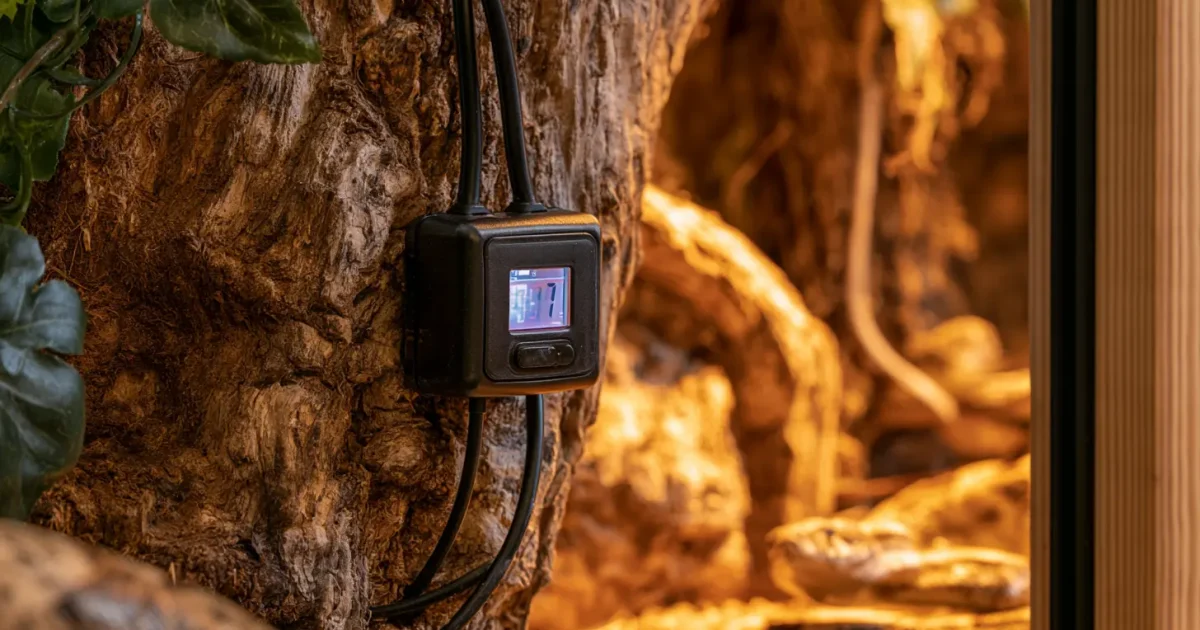
Thermostat Types: Which Does What
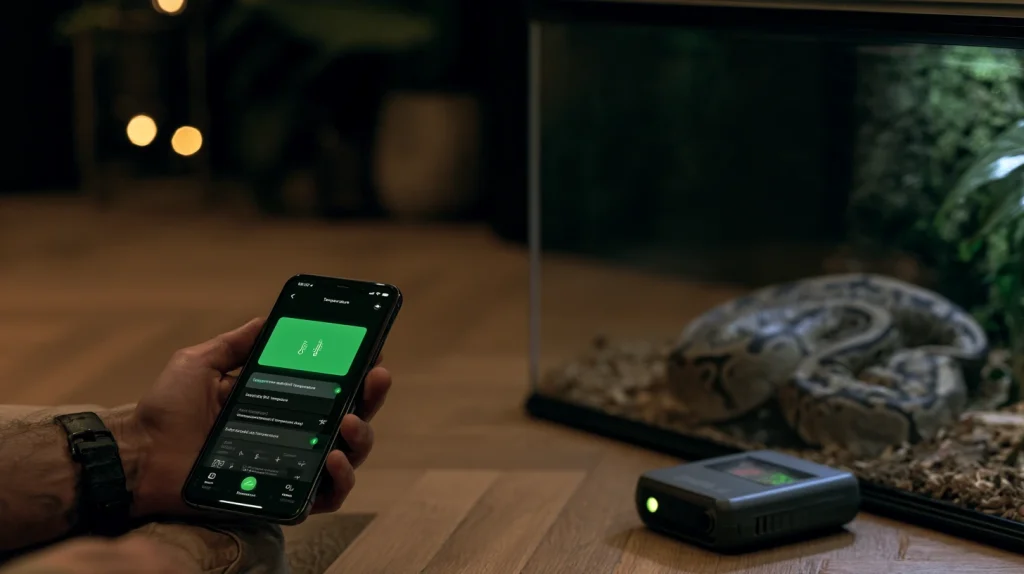
On/off thermostats — Inkbird ITC-308, BN-LINK, WILLHI — cut power completely once the target temperature is hit, then restore it when temperature drops below the threshold. That rapid cycling between full power and off is fine for heat mats, ceramic heat emitters, and other resistive elements that tolerate it without damage. It’s the wrong choice for incandescent or halogen bulbs, where rapid cycling shortens bulb life dramatically and produces a visible flicker that stresses reptiles.
Dimming thermostats — Inkbird ITC-306T, Vivarium Electronics VE-100 — reduce voltage proportionally instead of cutting power outright. A basking lamp getting 70% voltage just dims slightly rather than switching off, giving more stable temperature maintenance, avoiding cycling damage to the bulb, and producing a more naturalistic environment. Use these for halogen or incandescent basking lamps and some Deep Heat Projectors — check DHP compatibility with the specific model before buying.
Proportional thermostats — the Herpstat series — take dimming control further, adjusting output based on how far the current temperature is from the target rather than a simple dim/full setting. The result is extremely stable temperature with minimal fluctuation, which is why professional breeders favor them. Worth the premium for serious operations; arguably more control than a single-snake setup needs.
Best Picks at a Glance
Inkbird ITC-308 (on/off, dual stage) – 9.3/10 The community-standard choice for heat mats and ceramic heat emitters — accurate, affordable, and the default recommendation for most ball python setups.
Inkbird ITC-306T (dimming) – 8.5/10 The right pick if your setup uses a basking lamp instead of (or alongside) a heat mat — dimming control that preserves bulb life.
Herpstat 2 (proportional) – 8.9/10 The precision choice for breeders and advanced keepers who want programmable day/night cycling and the tightest possible temperature stability.
BN-LINK Digital Thermostat Controller – 7.0/10 A reliable, safety-certified budget on/off option for straightforward heat mat control.
Vivarium Electronics VE-100 – 7.2/10 A solid reptile-specific dimming thermostat for basking lamp setups, if you’re comfortable with a less widely-reviewed brand than Inkbird.
WILLHI WH1436A – 6.3/10 The bare-bones budget on/off option for very simple heat mat setups.
Detailed Reviews
Inkbird ITC-308 (on/off, dual stage)
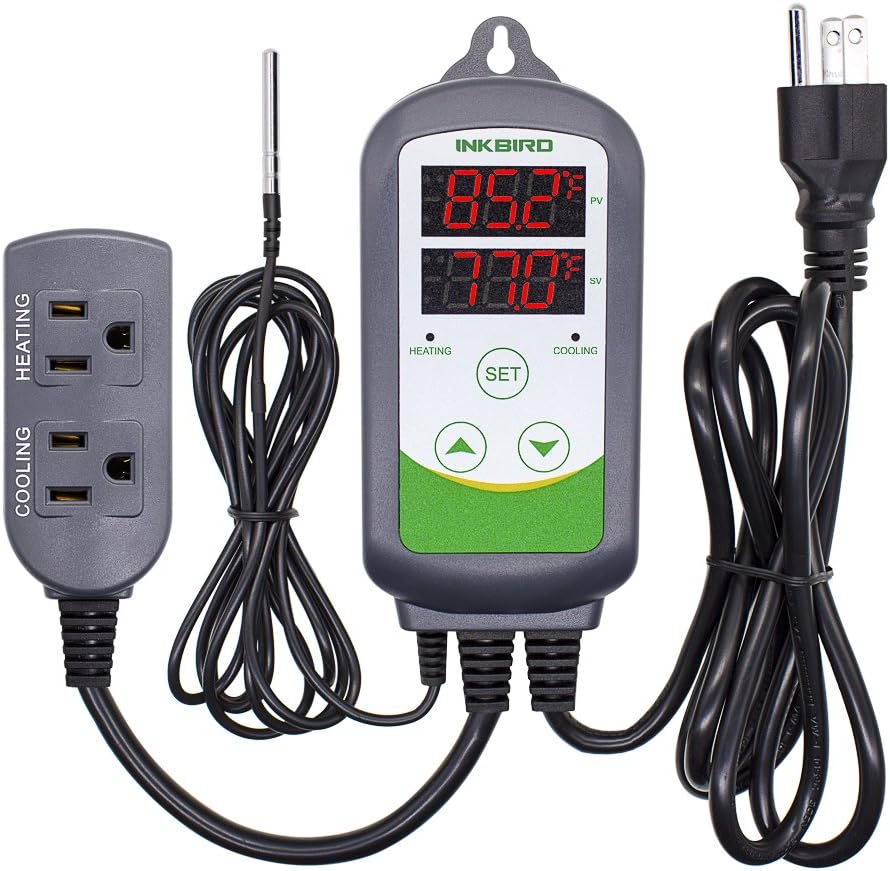
Rating: 9.3/10
This is the thermostat most ball python keepers end up with, and it earns that reputation. It’s an on/off dual-stage controller accurate to ±0.5°F, with dual heating and cooling outlets and a temperature alarm — priced well below what that combination of features usually costs.
Pros
- ±0.5°F accuracy, comfortably precise for reptile thermal needs
- Dual heating/cooling outlets
- Temperature alarm included
- Widely trusted throughout the reptile-keeping community
- Affordable
Cons
- On/off type only — not appropriate for basking lamps or DHPs without a separate dimming function
Best for: the standard heat-mat setup that the large majority of ball python keepers actually run. This is the default recommendation unless your setup specifically uses a basking lamp.
Inkbird ITC-306T (dimming)
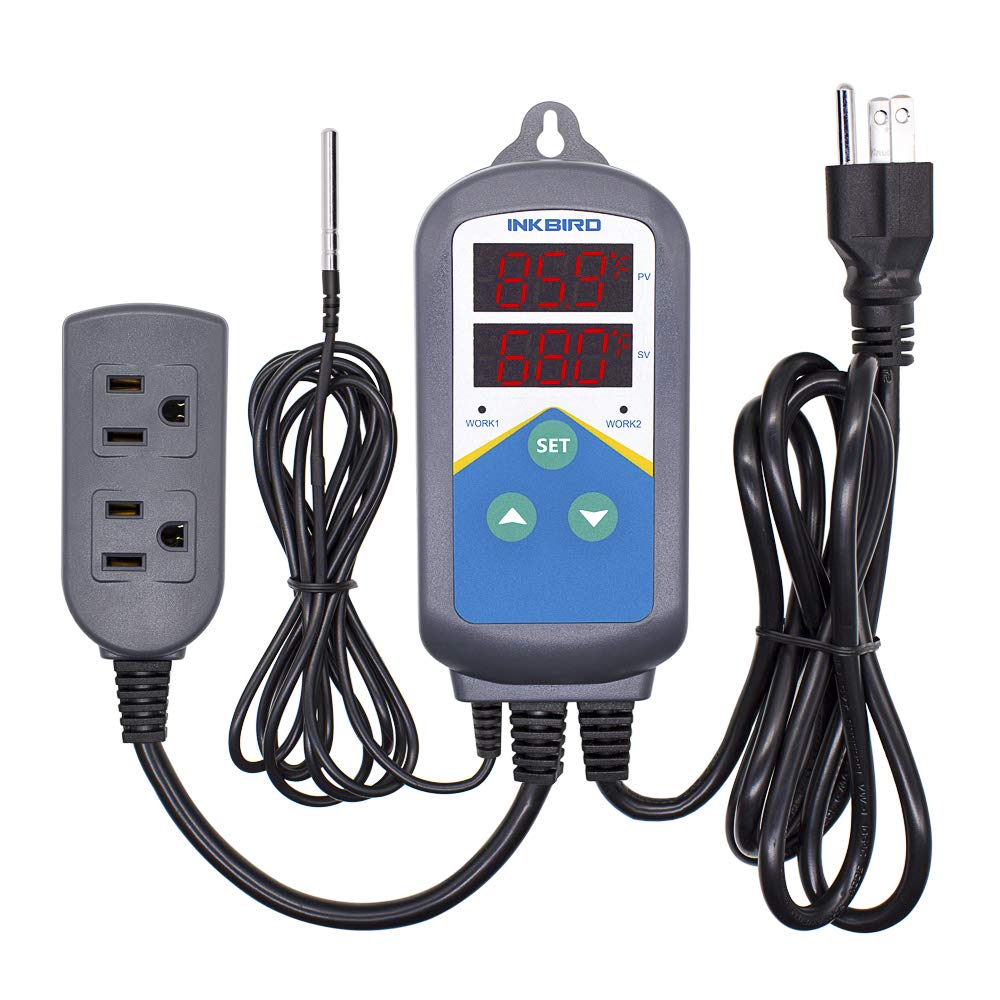
Rating: 8.5/10
For setups that include a basking lamp or Deep Heat Projector, the ITC-306T fills the gap the ITC-308 can’t — genuine dimming control that preserves bulb life, along with a built-in timer for day/night cycling and dual probe support.
Pros
- Dimming function protects bulb life
- Built-in day/night timer
- Dual probe support
- More sophisticated control than a basic on/off unit
Cons
- Costs more than on/off models
- Not every heating element is compatible with dimmer control — not all heat mats work with it
Best for: ball python setups using a basking lamp for warm-side air temperature, whether as a supplement to a heat mat or as the primary heat source.
Herpstat 2 (proportional)
Rating: 8.9/10
The Herpstat 2 is the professional-grade option, built around proportional control that adjusts output continuously based on distance from the target rather than a simple on/off or dim/full setting. Multiple set points allow programmed day/night temperature cycling.
Pros
- Industry standard for proportional control
- Built-in timers with multiple set points for day/night cycling
- Extremely accurate, minimal temperature fluctuation
Cons
- The highest price in this category
- More functionality than most single-snake setups actually require
Best for: serious breeders and advanced keepers, or setups where temperature stability is critical — active breeding projects or species with unusually narrow temperature tolerances.
BN-LINK Digital Thermostat Controller
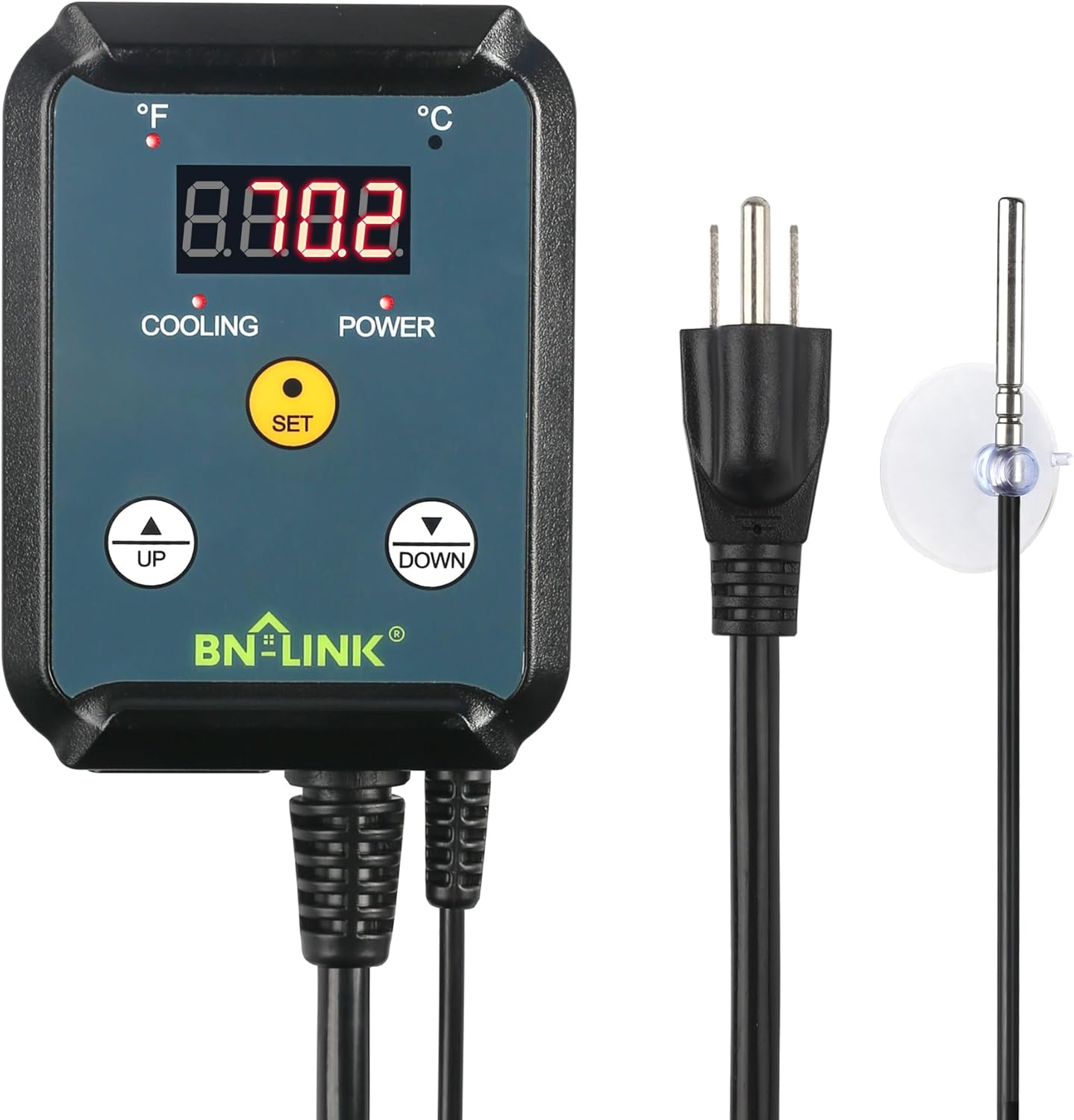
Rating: 7.0/10
A no-frills, safety-certified on/off controller for heat mat setups. It lacks the alarm and refinements of the Inkbird ITC-308, but it handles the core job reliably at a lower price.
Pros
- Affordable, simple, reliable
- Safety certified
- Widely used in the reptile-keeping community
Cons
- On/off type only
- Limited features compared to the Inkbird ITC-308
- No temperature alarm
Best for: budget-conscious keepers running a straightforward heat mat setup who don’t need an alarm function.
Vivarium Electronics VE-100
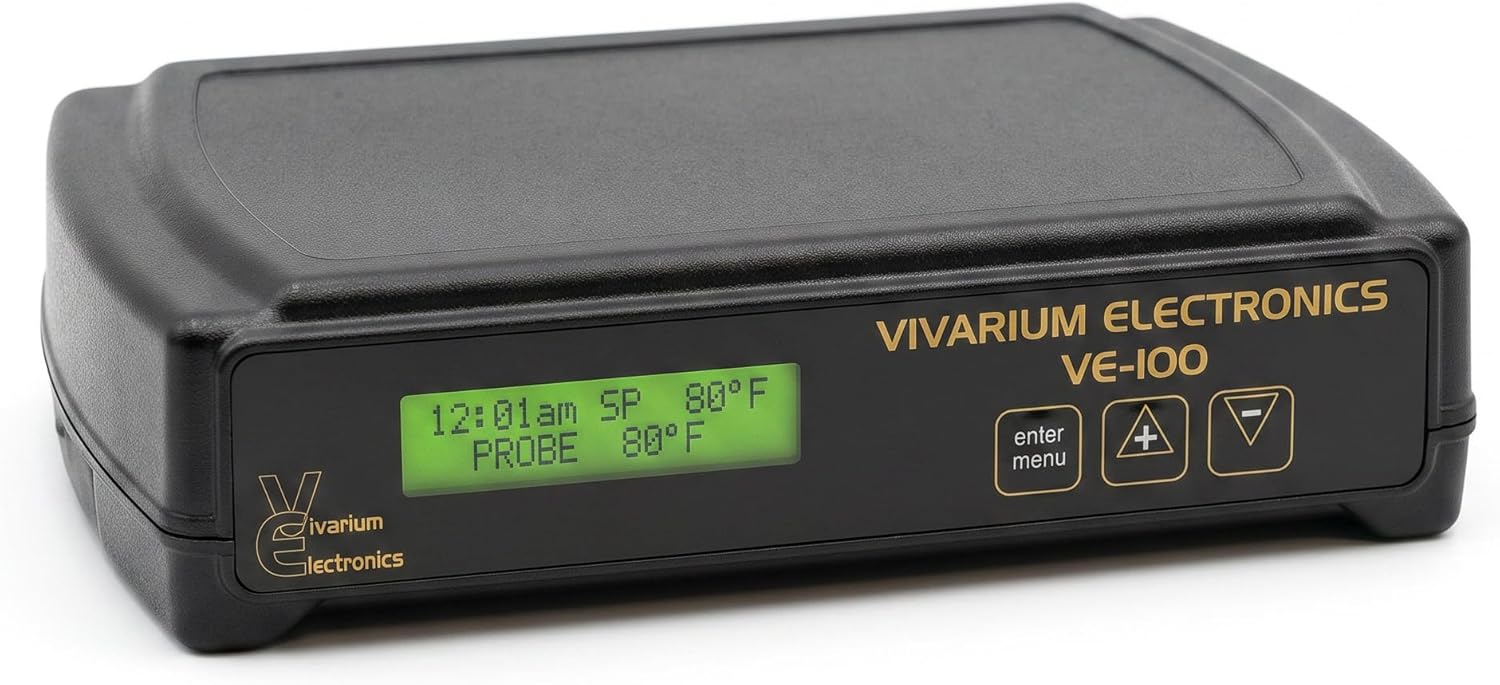
Rating: 7.2/10
A reptile-specific dimming thermostat aimed at basking lamp setups, offering reliable performance and good dimming control, though with less market presence and fewer community reviews than the Inkbird alternative.
Pros
- Good dimming control
- Reliable
- Reptile-specific design
Cons
- Less widely available than Inkbird
- Fewer reviews than the Herpstat or Inkbird lines
Best for: keepers specifically wanting a dimming thermostat and comfortable with a less widely reviewed brand.
WILLHI WH1436A
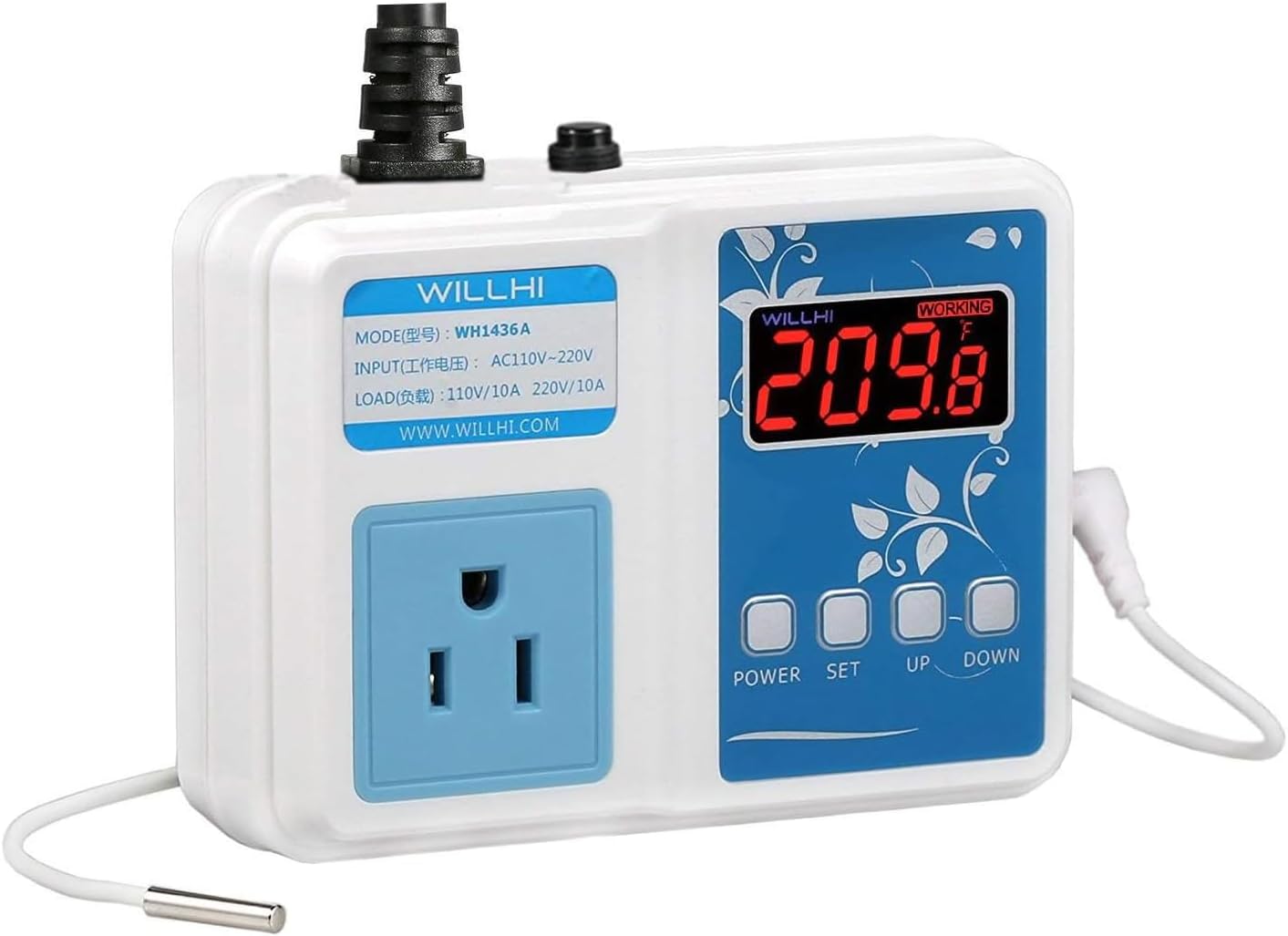
Rating: 6.3/10
About as basic as reptile thermostats get — an affordable, compact on/off controller with adequate accuracy for a simple heat mat setup, provided probe placement is done carefully.
Pros
- Very affordable
- Compact
- Adequate accuracy
Cons
- Limited to on/off control only
- Requires careful probe placement to get accurate readings
Best for: simple, single-enclosure heat mat setups on a tight budget.
🏆 Editor’s Pick
For the setup most ball python keepers actually run — a heat mat as the primary heat source, no basking lamp — the Inkbird ITC-308 is the clear pick. It’s accurate, affordable, and has years of community trust behind it. If your enclosure uses a basking lamp instead, don’t reach for the ITC-308 out of habit — the ITC-306T is the correct match, and using an on/off thermostat on a bulb will shorten its life dramatically. For anyone running a serious breeding operation or a setup where temperature stability genuinely can’t waver, the Herpstat 2’s proportional control and programmable day/night cycling are worth the higher price.
Which Thermostat for Which Heating Element
Under-tank heater (heat mat): on/off thermostat. The Inkbird ITC-308 is the community standard here. Place the probe on the floor surface above the mat, inside the warm hide — not under the mat, not outside the enclosure. Target 88–92°F at the floor surface above the mat.
Ceramic Heat Emitter (CHE): on/off thermostat. The same Inkbird ITC-308 or the BN-LINK both work well, since CHEs are resistive elements that tolerate on/off cycling without damage. These are typically used for overnight heating without visible light.
Halogen/incandescent basking lamp: dimming thermostat — Inkbird ITC-306T, Vivarium Electronics VE-100, or a Herpstat. On/off cycling destroys bulbs within weeks.
Deep Heat Projector (Arcadia DHP): check the manufacturer’s guidance for your specific model — some DHPs support dimming control, others specify on/off, and Arcadia’s documentation lists which thermostat types are compatible.
Most ball python setups run on a heat mat with an on/off thermostat and don’t need a basking lamp at all. In setups that do add a basking lamp for supplemental warm-side air temperature, a separate dimming thermostat for that lamp is the appropriate addition.
Probe Placement: Where You Put It Matters
The probe reads temperature at exactly its position — nowhere else. Get placement wrong, and you’re regulating the wrong number.
Heat mat setup: place the probe on the floor surface, inside the warm hide, directly above the heat mat. This captures the floor temperature your snake experiences while belly-heating. Don’t place it under the mat (reads hotter than the snake’s actual contact temperature) or outside the hide (reads ambient air, not the surface the snake uses).
CHE or lamp setup: place the probe at mid-height on the warm side for air temperature control. If your thermostat supports dual probes, one at floor level for surface monitoring and one at mid-height for air control gives the most complete picture.
A common mistake is placing the probe against the enclosure wall instead of on the floor surface where the snake’s belly actually makes contact — wall placement reads air temperature, which runs consistently lower than the floor temperature directly above a heat mat.
Setting Up the Thermostat
- Position the probe at the correct location — floor surface inside the warm hide, for heat mat setups
- Set the target temperature (88–90°F for most ball pythons)
- Let the setup equilibrate for 30–60 minutes before checking with an IR temp gun
- Verify the floor temperature under the warm hide matches the thermostat target within about 2°F
- Verify the cool side sits at 76–80°F ambient — this isn’t thermostat-controlled, it’s your room temperature baseline without added heat
If the thermostat is set to 89°F but an IR gun reads 94°F on the floor, the heat mat is likely too powerful for the thermostat to regulate effectively in that setup. Try reducing the mat’s coverage area, adding insulation between the mat and the enclosure, or switching to a proportional thermostat.
If the thermostat is short-cycling — switching on and off very rapidly — the probe is probably too close to the heat source and reacting to immediate feedback. Repositioning it slightly farther from the direct mat surface usually resolves this.
Monitoring: The Thermostat and the Thermometer Are Different Tools
The thermostat controls temperature at one point. A thermometer — an IR temp gun, digital probe, or hygrometer-thermometer — monitors and verifies what’s actually happening. Trust but verify: check the enclosure’s real temperature with an IR temp gun weekly for the first month, and again any time a setting changes or equipment is disrupted.
A $15–20 IR temp gun aimed at the floor surface inside the warm hide gives the most accurate read on what your snake is actually experiencing. That single inexpensive tool provides more diagnostic value for spotting problems than the thermostat’s own display, which only ever tells you the reading at its probe’s specific location.
FAQ
Does a ball python need a thermostat? Yes, if you’re using a heat mat or ceramic heat emitter. An unregulated heat mat can reach 120°F or higher — hot enough to cause thermal burns on the snake’s ventral surface. Those burns are painful, slow to heal, and can become infected. Running a heat mat without a thermostat is a documented cause of ball python injury and death; a thermostat isn’t optional for a heat mat setup.
What’s the best thermostat for a ball python heat mat? The Inkbird ITC-308 is the community standard — accurate to ±0.5°F, dual heating/cooling outlets, a temperature alarm, widely available, and affordable. The BN-LINK is an acceptable budget alternative. Both are on/off type, which is the correct match for heat mats.
Can I use one thermostat for multiple enclosures? Only if they use the same heating element type and share the same target temperature zone. The thermostat reads a single probe and controls all its outlets based on that one reading. Two enclosures in the same room targeting the same temperature could theoretically share a two-outlet thermostat, but this isn’t recommended for reliability — any temperature variation between the enclosures means one is accurately controlled and the other is essentially a guess. One thermostat per heating element, per enclosure, is the safer setup.
Inkbird vs. Herpstat: which is better? For most keepers with one or a few snakes, Inkbird is the better fit — the ITC-308 is accurate, affordable, and covers what most setups actually need. For professional breeders, advanced keepers wanting proportional control and programming, or setups where temperature stability is critical (active breeding projects, species with unusually narrow tolerances), the Herpstat is worth its higher price. The price gap reflects real functional differences — it’s just that those extra features matter more to some keepers than others.
What happens if the thermostat probe fails? Many thermostats include a probe failure alarm that triggers if the probe disconnects or reports an implausible reading. On failure, the heating element typically defaults to full power, which means the enclosure can overheat quickly. Check the thermostat display regularly, and keep a spare probe — or a spare thermostat — on hand. Inkbird probe replacements are inexpensive and easy to find.
Getting the Setup Right
Match the thermostat type to the heating element first — on/off for heat mats and CHEs, dimming or proportional for basking lamps and DHPs — and everything else falls into place from there. The Inkbird ITC-308 covers the large majority of standard ball python setups accurately and affordably; save the Herpstat’s added precision for the setups that genuinely need it, and always verify the thermostat’s number against an actual IR temp gun reading before trusting it.