
- If you're short on time:
- Best Picks at a Glance
- The Top Three in Detail
- Golden Pothos (Epipremnum aureum)
- Umbrella Plant (Schefflera arboricola)
- Hibiscus (Hibiscus rosa-sinensis)
- 🏆 Editor's Pick: Golden Pothos
- Practical Buying Advice
- Plants to Avoid
- Preparing Store-Bought Plants for the Enclosure
- Positioning in the Enclosure
- FAQ
- Choosing With Confidence
Take the plants out of a chameleon enclosure and what’s left is a glass or screen box with a light in it. That’s not an exaggeration — it’s basically the whole problem. Chameleons drink by licking dew off leaves, not from a water dish. They hide by pressing into foliage and vanishing through color camouflage. They manage stress by retreating into cover. Take away the plants, and you’ve taken away the behaviors that keep a chameleon calm. Its baseline stress just stays elevated, day after day.
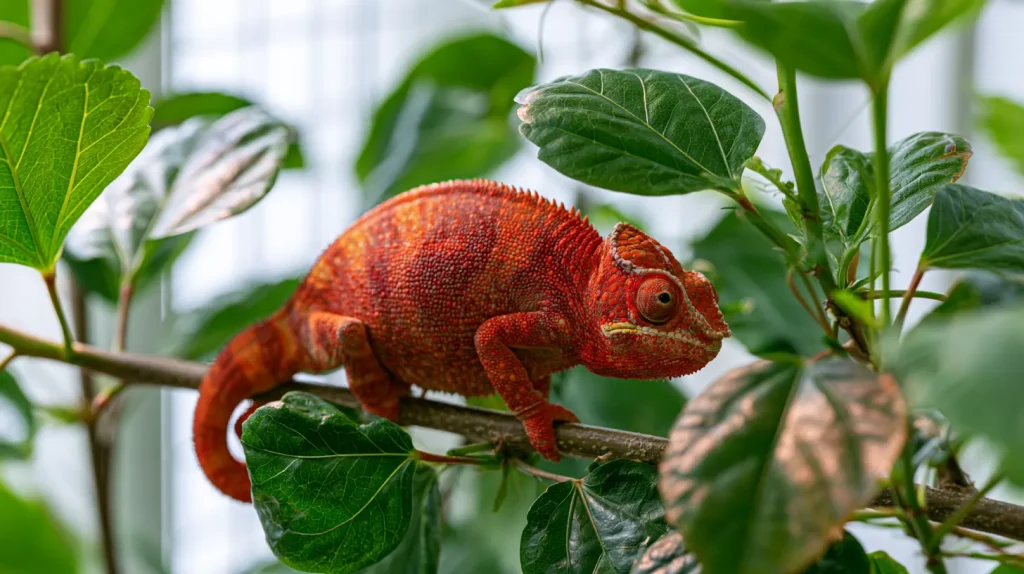
Plants in a chameleon enclosure aren’t decoration. They’re doing three jobs at once, and a good setup covers all three:
Humidity. Leaves transpire moisture continuously between mistings. A well-planted cage holds humidity far longer than a bare one — skip the plants, and humidity crashes soon after each misting cycle, leaving your chameleon in dry air for most of the day.
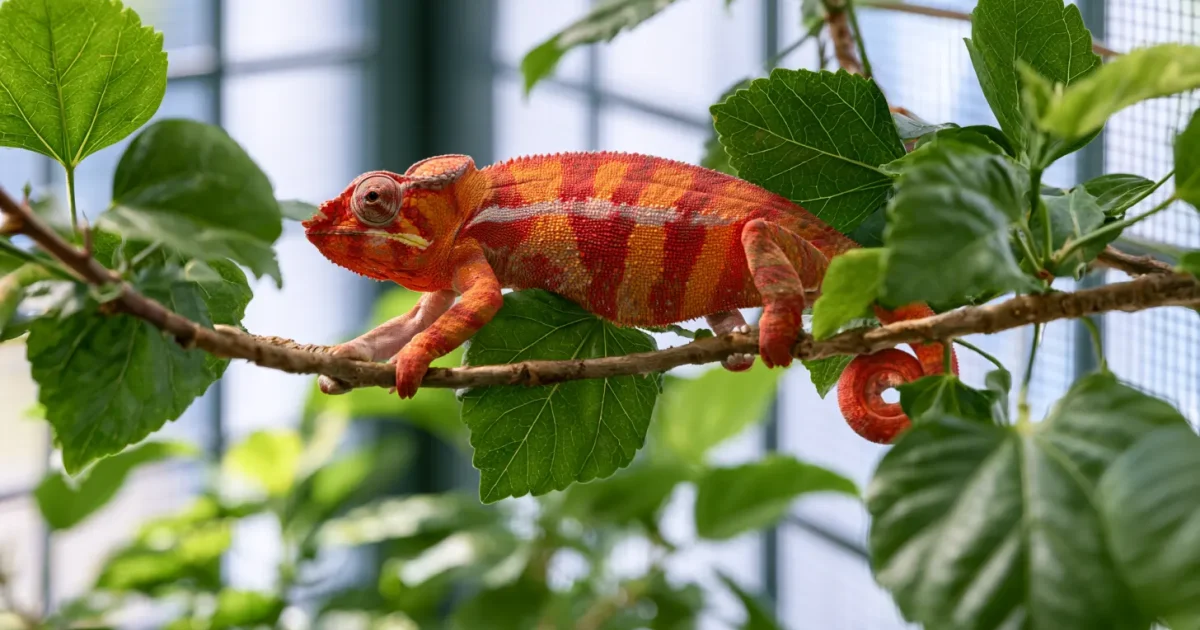
Visual cover. In the wild, a chameleon is almost never fully exposed. It’s always partly hidden in foliage. Open, exposed enclosures work against that instinct — chameleons can’t do the camouflage-and-hide behavior that keeps them settled. Dense planting gives them the cover they need to stop treating every moment as exposed and vulnerable.
Structure. Plants create the branches and pathways a chameleon uses to move through its territory — basking spot, cool zone, drip line, and back again. Without structure, there’s nowhere to go.
If you’re short on time:
Golden Pothos, Umbrella Plant (Schefflera), and Hibiscus cover the three things a chameleon enclosure needs most: humidity, structure, and edible browsing. Pothos is the easiest starting point for anyone, schefflera builds the climbing framework, and hibiscus doubles as a safe snack and a natural basking perch. Together, they fill roughly 60–70% of the enclosure’s visual space, which is the target for a properly planted cage.
Best Picks at a Glance
Golden Pothos (Epipremnum aureum) – 9.5/10 The default first plant for almost every chameleon keeper. Fast-growing, low-light tolerant, and nearly impossible to kill — ideal if you’re just building your first planted enclosure.
Umbrella Plant (Schefflera arboricola) – 9.2/10 The best structural centerpiece. Its branching stems create natural perches and climbing paths that trailing plants like pothos can’t provide on their own.
Hibiscus (Hibiscus rosa-sinensis) – 8.8/10 The only plant here your chameleon can actually eat. Great as a basking perch that doubles as a snack, but it’s the most light-hungry plant on the list.
Pothos Variants — Marble Queen, Neon – 8.9/10 Same species as Golden Pothos, same safety profile, different look. Good if you want visual variety without changing your care routine.
Spider Plant (Chlorophytum comosum) – 8.0/10 A solid supplemental plant for keepers who already have structure and coverage sorted and want to add variety without much extra care.
Ficus benjamina (Weeping Fig) – 7.8/10 A large, striking structural option for keepers ready to manage its acclimation quirks — best kept for those with some enclosure-planting experience already.
The Top Three in Detail
Golden Pothos (Epipremnum aureum)
Rating: 9.5/10
Pothos is close to a universal starting point for chameleon enclosures, and it earns that reputation. It grows fast in almost any direction, tolerates low light well enough to thrive under artificial setups, and transpires enough moisture to make a real, noticeable difference in how long humidity holds between mistings.
Pros
- Trails and climbs to cover large areas quickly
- Tolerates low to medium indirect light
- Transpires well, helping stabilize humidity
- Cheap, widely available, and easy to propagate from cuttings
Cons
- Contains insoluble calcium oxalate crystals — not something you want your chameleon eating in quantity
- Some cultivars (Pearls and Jade, Silver Satin) carry higher oxalate levels and should be avoided
The toxicity note deserves context rather than alarm. Calcium oxalate crystals are the same compound that makes raw taro root irritating to eat — they cause physical irritation if a large quantity is ingested, not systemic poisoning. Most chameleons simply don’t eat pothos in the first place. Keepers have used it for decades without documented toxicity incidents. The practical way to think about it: pothos is a non-food plant the chameleon coexists with, not a toxic one it needs protecting from.
Stick specifically to Golden Pothos — the classic green-and-yellow variegated trailing variety. Avoid “Pearls and Jade” or “Silver Satin,” which are different cultivars with notably higher oxalate concentrations.
Care basics: water when the top inch of soil dries out — though in practice, the enclosure’s regular misting usually keeps soil appropriately moist without extra watering. Trim vines back when they get leggy or sparse, and root the cuttings in water; it’s a free way to grow more coverage plants for later.
Umbrella Plant (Schefflera arboricola)
Rating: 9.2/10
If pothos is about coverage, schefflera is about structure. Where pothos trails, schefflera grows upright with multiple branching stems that naturally form perches at different heights. Set one in the center of a 2x2x4 enclosure and it becomes both climbing framework and cover in one plant.
Pros
- Multiple stems create natural, varied perching positions
- Good humidity retention
- Generally considered safe if a chameleon nibbles it
Cons
- Needs more light than pothos to thrive
- Can outgrow a 48-inch enclosure within 12–18 months, so pruning becomes a regular task
- Smaller specimens can be harder to source than pothos
Schefflera is also broadly accepted as safe for chameleons that browse on it occasionally — it doesn’t contain compounds known to cause issues at normal nibbling levels, and problems from ingestion aren’t something keepers commonly report.
Care basics: give it more light than you’d give pothos — a T5 HO UVB tube plus a basking lamp is typically enough for healthy growth. Keep it trimmed and proportional to the enclosure; left alone, it will outgrow a standard 48-inch cage faster than most keepers expect.
Hibiscus (Hibiscus rosa-sinensis)
Rating: 8.8/10
Hibiscus stands apart from the other two because it’s genuinely edible. Flowers, leaves, and stems are all appropriate for a chameleon to eat, which makes it common practice to use a hibiscus branch as the primary basking perch — the chameleon gets a safe plant to nibble on while it’s soaking up light.
Pros
- Fully edible — flowers, leaves, and stems
- Doubles as an interactive basking perch
- Active blooms give chameleons something to investigate and hunt around, which adds behavioral enrichment purely structural plants don’t offer
Cons
- The most light-demanding plant on this list
- Drops leaves quickly if light levels aren’t sufficient
Best for: keepers who already have a strong UVB setup and want a perch that also functions as enrichment and a safe snack.
Who should avoid it: keepers running lower-output lighting setups where hibiscus is likely to drop leaves and struggle — pothos or schefflera will do better in that situation.
Care basics: it needs bright indirect to partial direct light — a T5 HO UVB tube is usually adequate. Without enough light, expect leaf drop. Given good light, it grows enthusiastically and blooms repeatedly, which is when it earns its keep as an enrichment plant.
🏆 Editor’s Pick: Golden Pothos
If you can only start with one plant, make it pothos. It’s not the flashiest option and it isn’t edible, but it’s the plant that will succeed regardless of your lighting setup, your enclosure size, or your experience level — and that reliability is what actually matters for a first planted enclosure. Schefflera and hibiscus both ask more of your lighting and your maintenance schedule. Pothos asks almost nothing and still delivers real humidity benefits and fast coverage. Once it’s established and thriving, adding schefflera for structure and hibiscus for enrichment becomes a much easier next step — you’re building on a setup that’s already working, rather than troubleshooting three demanding plants at once.
Practical Buying Advice
Features that actually matter: transpiration rate (humidity impact), light tolerance relative to your existing UVB setup, and growth habit (trailing vs. upright) relative to the zone you’re filling.
Features that don’t matter much: how “exotic” or rare a plant looks. A common pothos does more functional work in an enclosure than a striking but demanding specimen that struggles under standard lighting.
Common buying mistakes: buying one small plant and expecting it to fill an entire enclosure, skipping the decontamination period for nursery plants, and choosing plants based on appearance without checking their light or safety profile first.
Plants to Avoid
- Pothos: Pearls and Jade, Silver Satin varieties — higher oxalate concentration than standard Golden Pothos.
- Any pesticide-treated nursery plant — systemic pesticides persist in plant tissue. If you’re buying from a hardware store or nursery, repot into clean soil and water it in for 4–6 weeks before it goes anywhere near the enclosure.
- Ficus varieties other than benjamina — other ficus species can have more irritating latex sap; research any non-benjamina ficus individually before use.
- True Pothos (Scindapsus aureus) — previously classified alongside Epipremnum, and some sellers still mislabel it as pothos. It has a different safety profile, so buy from sellers who correctly identify the species.
- Definite avoids: ivy (Hedera helix), philodendron (higher calcium oxalate than pothos and genuinely toxic), dieffenbachia, oleander, any Euphorbiaceae family plant, peace lily, and snake plant in large quantities.
Preparing Store-Bought Plants for the Enclosure
Repot into untreated organic potting mix — organic matter and perlite, no fertilizers or moisture-control polymers. Nursery soil often carries fertilizer pellets and wetting agents that can throw off your enclosure environment.
Wash every leaf with clean water — no soap. This removes surface dust and surface-sprayed pesticide, though it won’t touch systemic treatments, which is exactly why the 4–6 week decontamination period matters.
Size appropriately. A 6-inch nursery pot of pothos dropped into a 48-inch cage looks lost and does nothing for coverage. For a 2x2x4 enclosure, aim to fill 60–70% of the interior visual space — start with at least 2–3 plants positioned differently, and let trailing growth fill the gaps over time.
Positioning in the Enclosure
Upper zone (top 18 inches): basking and primary perching. A hibiscus branch works well as the basking perch itself, with schefflera branches creating a path to and from it.
Mid zone (middle 12–18 inches): your highest-density coverage zone. Pothos trailing along the sides, schefflera filling the central volume — this is also the zone where your chameleon is most visible to you day to day.
Lower zone (bottom 12 inches): drainage and soil. Plants here should tolerate more humidity and less light — pothos handles lower light well and this zone naturally stays more humid from misting runoff.
FAQ
Is pothos safe for chameleons? Golden Pothos (Epipremnum aureum) has been used by chameleon keepers worldwide for decades without documented toxicity incidents. It contains insoluble calcium oxalate crystals that would irritate if eaten in large quantities, but chameleons typically don’t eat pothos in the first place — it functions as a non-food plant the chameleon lives alongside rather than consumes. Avoid Pearls and Jade pothos specifically, since it carries a higher oxalate concentration.
Do I have to use live plants? Live plants are strongly preferred, mainly for the humidity function — they transpire moisture continuously, which stretches the time between mistings and keeps the environment more stable overall. Artificial plants only hold moisture right after misting and dry out fast. The humidity difference is significant enough that experienced keepers generally advise against going artificial-only.
How many plants does a chameleon enclosure need? Enough to cover 60–70% of the interior visual space from the front. For a standard 24x24x48 enclosure, that usually means 3–5 plants of varying sizes: a structural centerpiece like schefflera, trailing pothos along the sides and bottom, and an edible option like hibiscus near the basking zone.
Can I use plants from my backyard? Only if you can confidently identify the species and rule out pesticide exposure. Herbicide drift from neighboring properties and fertilizer runoff make backyard plants a real risk without careful vetting. Sticking to known-safe species from a clean, controlled source is the safer route.
How often do I water the plants in the enclosure? In a properly misted setup, the misting system itself — typically running 2–4 times daily — usually keeps the soil consistently moist without extra watering. Check root-level soil moisture periodically; pothos and schefflera both prefer consistently moist, not waterlogged, soil.
Choosing With Confidence
There’s no single “correct” chameleon plant setup, but there is a reliable order of operations: start with pothos because it will succeed under almost any conditions, add schefflera once you want real climbing structure, and bring in hibiscus when your lighting can support it and you want a plant your chameleon can actually eat. Get the coverage to 60–70% of the enclosure’s visual space, keep an eye on which zones are drying out fastest, and adjust from there. The plants aren’t the finishing touch on the enclosure — they’re the part that makes it functional for the animal actually living in it.