
- Why Enclosure Direction Changes Gecko Behavior
- Quick Comparison: Top Leopard Gecko Enclosures for 2026
- In-Depth Reviews
- Exo Terra Allglass Terrarium 36"x18"x18"
- REPTI ZOO 36"x18"x18" Front-Opening Terrarium
- Zen Habitats 4x2x1 PVC Panel Enclosure
- 20-Gallon Long Aquarium (30"x12"x12")
- 40-Gallon Breeder Aquarium
- Custom PVC Tub Setups
- Buying Guide: How to Choose the Right Enclosure
- Tank Size: What the Current Standard Says
- The Three-Hide Requirement
- Heating Setup: UTH vs. DHP
- UVB: The Guidance Is Evolving
- Frequently Asked Questions
- Conclusion
A leopard gecko that flinches every time a hand reaches in from above isn’t being difficult — it’s reacting the same way it would to a hawk, owl, or monitor lizard closing in from the sky. In the wild, threats to a ground-dwelling gecko come from overhead far more often than from the side. A top-opening aquarium forces every single interaction — feeding, misting, handling — to mimic that exact attack angle.
Do that hundreds of times over the first year of ownership, and you shape the animal’s entire relationship with you. The gecko doesn’t learn that hands are safe; it learns that danger always comes from above, and it responds by hiding more, bolting when the lid opens, and never quite settling into the calm, curious temperament leopard geckos are famous for.
This single design detail — where the door is — is arguably the highest-leverage decision a new keeper makes, and it’s the reason this guide leads with enclosure access rather than size or price.
Why Enclosure Direction Changes Gecko Behavior
Front-opening enclosures let you approach at the gecko’s eye level, from the same side it experiences every other stimulus in its environment: food, water changes, substrate movement, cage-mate interactions in the wild. Over weeks, this builds a different baseline expectation. The gecko doesn’t associate your hand with the sky-predator silhouette at all, because it never sees your hand from that angle.
This is why nearly every experienced keeper — breeders, reptile veterinarians who keep personal collections, and long-time hobbyists — defaults to front-opening enclosures, even though standard top-opening aquariums remain the default recommendation at most pet stores. It’s not that top-opening tanks are unsafe or that geckos housed in them are unhealthy. Plenty of geckos in 20-gallon long tanks live full, healthy lives. But if you’re choosing an enclosure today, and you have the budget flexibility, front access is the single upgrade with the clearest behavioral payoff.
Quick Comparison: Top Leopard Gecko Enclosures for 2026
| Enclosure | Best For | Standout Feature | Main Limitation | Price Tier |
|---|---|---|---|---|
| Exo Terra Allglass Terrarium 36″x18″x18″ | Most keepers — the accessible front-opening standard | Front-opening double doors, raised bottom for safe under-tank heating, hinged top screen for lighting | Glass sheds heat faster than PVC, so warm-side temperatures need closer monitoring | Mid-range |
| REPTI ZOO 36″x18″x18″ Front-Opening Terrarium | Budget-conscious keepers who still want front access | Front-opening doors at a lower price point, usable ventilation screen top | Build quality and door hinges are noticeably less robust than the Exo Terra | Budget |
| Zen Habitats 4x2x1 PVC Panel Enclosure | Keepers prioritizing heat retention and a more finished setup | Excellent insulation, front-opening, solid top that supports even heat distribution without mesh heat loss | Higher upfront cost, online-only purchase, less visual clarity than glass | Premium |
| 20-Gallon Long Aquarium (30″x12″x12″) | Absolute minimum-budget or juvenile housing | Cheapest entry point, available at nearly any pet store | Top-opening only; below current adult floor-space recommendations | Budget |
| 40-Gallon Breeder Aquarium | Budget keepers wanting adult-sized floor space | Meets the current minimum floor space guideline at low cost | Still top-opening, so the behavioral trade-off remains | Budget |
| Custom PVC Tub Setup | Experienced keepers, multi-gecko households, breeders | Maximum insulation and customization, common in breeding operations | Requires DIY skills or custom fabrication; no display visibility | Budget–Mid |
In-Depth Reviews
Exo Terra Allglass Terrarium 36″x18″x18″
This is the enclosure most experienced keepers point beginners toward, and the reasoning holds up under scrutiny. The double front doors give calm, predictable access at gecko eye level, and the raised bottom panel creates a small air gap that helps prevent an under-tank heater from overheating the glass directly against the substrate — a real safety consideration for anyone using a heat mat.
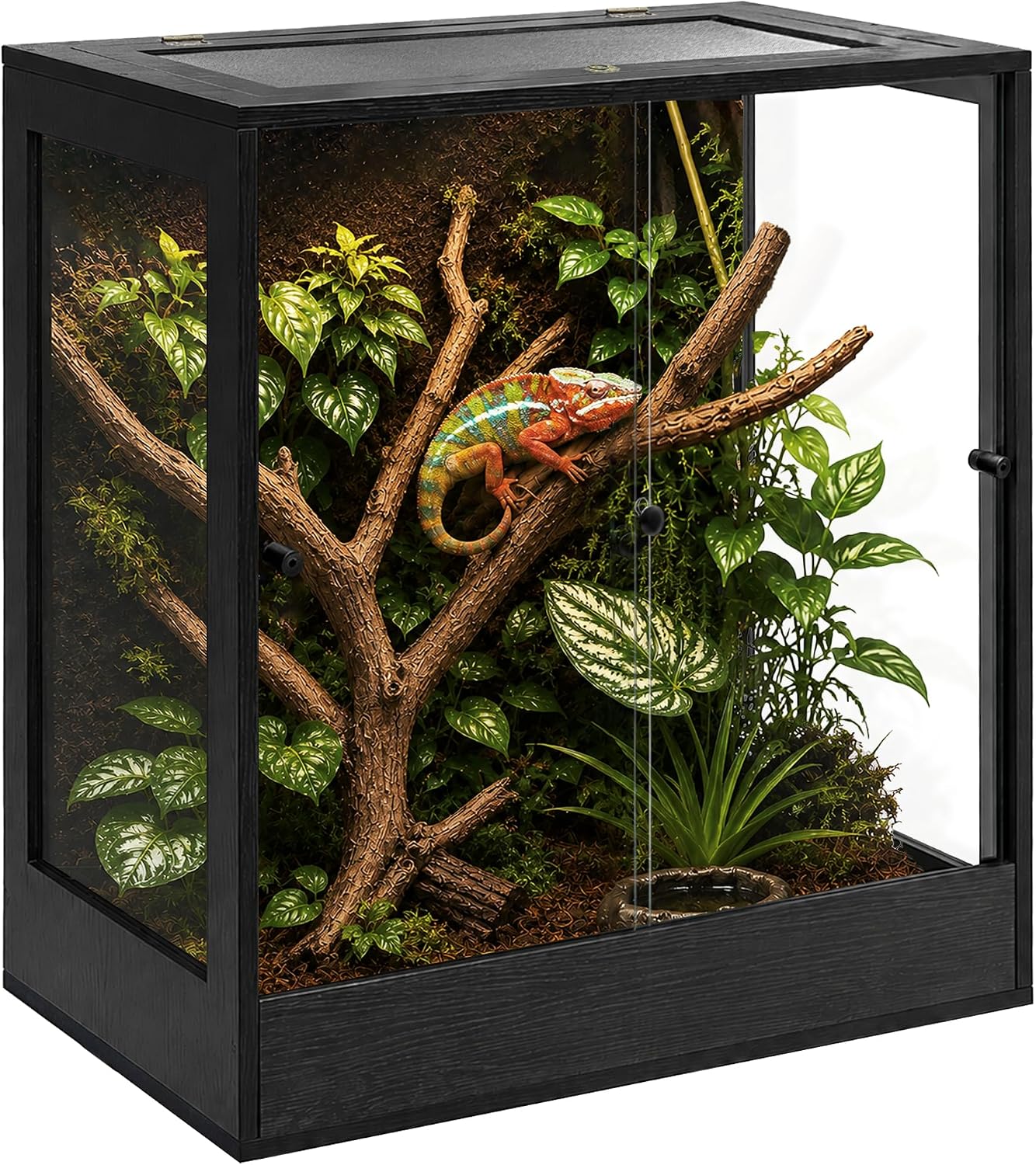
Ventilation is solid thanks to the hinged screen top, which also makes it easy to mount a low-output UVB fixture or a small basking bulb if you choose to add one. Build quality is consistent — seams are well-sealed, and the doors latch securely enough to deter an escape-prone gecko without needing extra hardware.
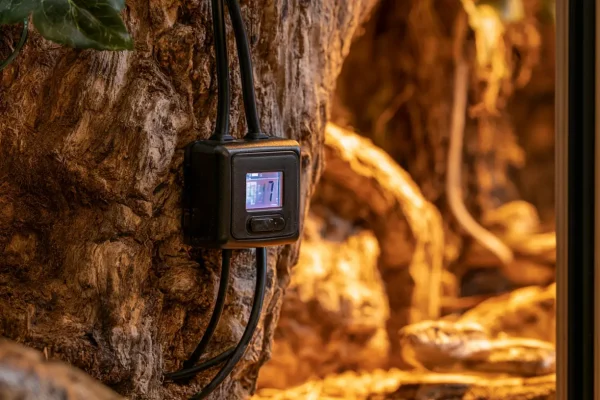
The catch is thermal: glass loses heat readily, especially in a room that runs cool overnight or in winter. This isn’t a flaw so much as a property of the material, but it means you can’t set a heat mat and forget it — you’ll want a digital thermostat with a probe on the warm-side floor, checked periodically with an infrared thermometer, especially through seasonal temperature swings.
Ideal owner: First-time keepers who want the behavioral benefits of front access without committing to custom fabrication or a premium price tag. Who should look elsewhere: Keepers in especially cold climates without reliable indoor climate control, who may find PVC’s better heat retention worth the extra cost.
REPTI ZOO 36″x18″x18″ Front-Opening Terrarium
This is the enclosure to consider when the Exo Terra’s price is the barrier rather than the front-opening design itself. It hits the same floor-space footprint and the same front-access doors, which means the core behavioral benefit is preserved.

Where it gives ground is in the details: door hinges feel less substantial over time, and the overall glass and frame construction is a step below the Exo Terra in fit and finish. For a single gecko in a stable indoor environment, none of this is likely to cause a functional problem — but keepers who handle their gecko frequently, and therefore open and close the doors often, may notice wear sooner.
Ideal owner: Budget-conscious keepers who want front access without a premium price. Who should look elsewhere: Keepers who plan to rehome or reuse the enclosure long-term and want hardware that holds up to years of daily use.
Zen Habitats 4x2x1 PVC Panel Enclosure
PVC panel enclosures solve the heat retention problem that glass can’t avoid. The insulated walls hold warm-side and cool-side temperatures far more consistently, which matters most in homes without tight climate control. The solid top — rather than an open mesh screen — also helps keep heat and humidity from escaping, which can make maintaining the 70–80% relative humidity target inside the moist hide considerably easier.
It’s still front-opening, so the behavioral benefits described earlier apply here too. The trade-offs are cost and visibility: PVC isn’t as visually clear as glass, so if you want a fully “on display” setup for observation, glass will show your gecko more clearly. It’s also generally not available in brick-and-mortar pet stores, so budget for shipping and assembly time.
Ideal owner: Keepers in colder or more variable climates, multi-gecko households, or anyone prioritizing long-term heat stability over display clarity. Who should look elsewhere: Keepers who want to walk into a store and walk out with a tank the same day, or who value maximum visual clarity for observation and photography.
20-Gallon Long Aquarium (30″x12″x12″)

This is the classic starter tank, and it’s worth being honest about what it is: a functional minimum, not a long-term ideal. It’s cheap, available everywhere, and perfectly adequate for a juvenile gecko. For an adult, it falls short of current floor-space guidance (more on that below), and its top-opening design means every interaction happens from the predator-approach angle.
Ideal owner: Someone housing a juvenile temporarily before an upgrade, or a keeper testing the hobby before investing further. Who should skip it: Anyone housing an adult gecko long-term — the floor space is limiting, and there’s no front-access option without modification.
40-Gallon Breeder Aquarium

This meets the current adult floor-space minimum at a low price point, which makes it a reasonable budget choice if a front-opening enclosure isn’t in the budget yet. The extra floor space over a 20-gallon long allows more realistic hide placement and a workable temperature gradient.
The behavioral trade-off remains, though — it’s still a top-opening tank. Some keepers offset this by adding a front-access modification (a cut acrylic panel with a hinge, for example) or by simply slowing down and using calm, predictable overhead movements to reduce the startle response.
Ideal owner: Budget keepers who need adult-appropriate floor space now and plan to upgrade access later, or who are comfortable adapting their handling style. Who should skip it: Keepers who want the behavioral benefits of front access from day one.
Custom PVC Tub Setups
Common in breeding operations and among experienced keepers managing multiple animals, tub setups (often rack-mounted) prioritize insulation, easy cleaning, and space efficiency over display value. They can be extremely cost-effective per enclosure when built at scale, and PVC’s heat retention makes climate control straightforward.
The catch is that this isn’t an off-the-shelf purchase — it requires either real DIY skills or a custom builder, and there’s no front-facing visibility for casual observation or showing the animal off.
Ideal owner: Experienced keepers, breeders, or anyone housing several geckos who values function and cost-efficiency over display. Who should skip it: First-time keepers who want a single, ready-to-use display enclosure without building anything.
Buying Guide: How to Choose the Right Enclosure
Features that matter:
- Front-opening access (behavioral benefit, easier feeding and spot-cleaning)
- A floor footprint that meets or exceeds 36″x18″ for an adult
- Secure, escape-proof door or lid hardware
- Ventilation appropriate to your heating method
- Material suited to your climate control (PVC for colder rooms, glass for display and airflow)
Features that matter less than marketers suggest:
- Height — leopard geckos are terrestrial and don’t use vertical space the way arboreal species do
- Elaborate built-in décor — functional hide placement matters more than aesthetics
- “Complete kit” bundles that include a heat rock or an oversized basking bulb; these are frequently mismatched to the species’ actual needs
Common buying mistakes:
- Buying based on adult size before checking whether the enclosure supports proper thermal gradients
- Assuming a screen-top lid alone provides enough security without checking latch quality
- Skipping a thermostat to save money on a heat mat setup — this is a genuine safety risk, not just a nice-to-have
Beginner recommendation: The Exo Terra 36x18x18 balances price, access, and reliability well enough that it’s a reasonable default unless budget rules it out.
Premium recommendation: A Zen Habitats PVC enclosure for keepers who want the best long-term thermal stability and don’t need glass clarity.
Long-term costs to budget for: replacement thermostats and thermometers every few years, occasional hide replacement, and the ongoing cost of heat mats or DHP bulbs, which typically need replacing every 1–2 years depending on use.
Upgrade path: many keepers start juveniles in a 10- or 20-gallon tank, then move to an adult-sized front-opening enclosure by 6–8 months. Buying the adult enclosure from the start avoids a wasted purchase if budget allows.
Tank Size: What the Current Standard Says
Sizing guidance has shifted over the past several years. The old standard of a 20-gallon long (30″x12″) is now considered a functional minimum rather than an ideal. Current guidance circulating among experienced keepers and reptile-care resources recommends at least 36″x18″ of floor space for a single adult — roughly the footprint of a 40-gallon breeder tank or an equivalent front-opening enclosure.
Leopard geckos are ground-dwelling. Floor space, not height, is what determines whether the enclosure can actually support a proper temperature gradient and all three required hides with enough walking space between them.
For juveniles: a 20-gallon long is appropriate short-term housing. Plan to move to adult-sized housing by 6–8 months of age.
The Three-Hide Requirement
This detail gets underemphasized in a lot of beginner care sheets, and it matters more than almost anything else in the setup.
Warm hide: placed directly over the heat source on the warm end — not near it, over it. Floor temperature underneath should read 88–92°F, measured at the substrate surface with an infrared thermometer rather than an air thermometer. This hide supports digestion and immune function through belly heat.
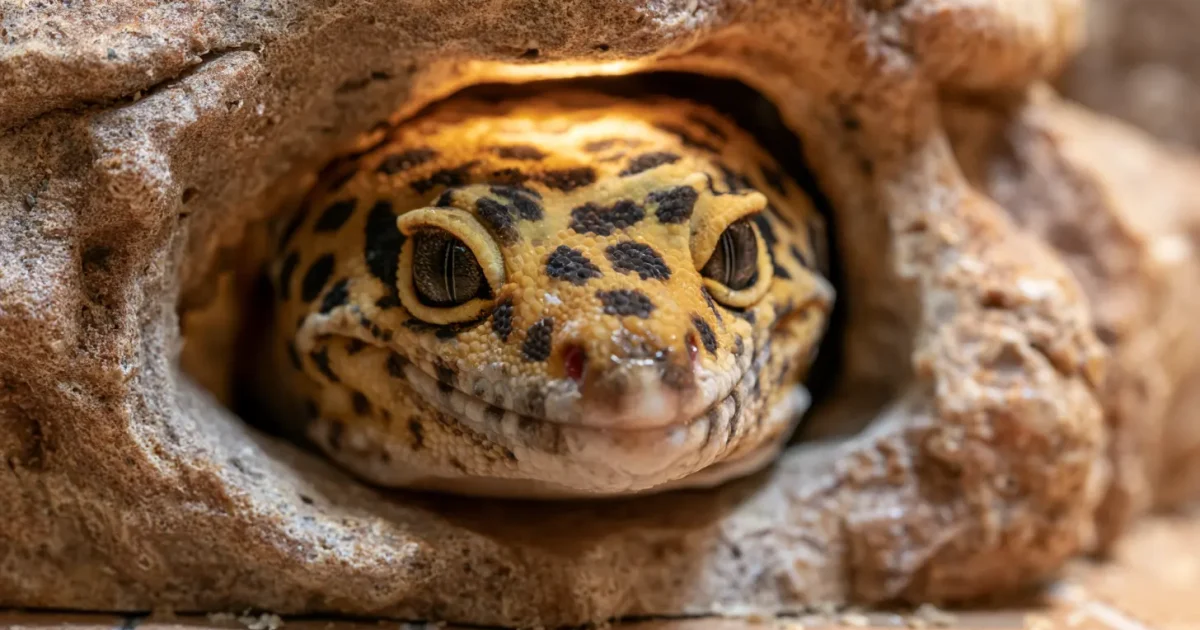
Cool hide: on the opposite end, with no heat source, at an ambient 70–75°F. Both warm and cool hides need to be present at all times — a common beginner mistake is providing only the warm hide.
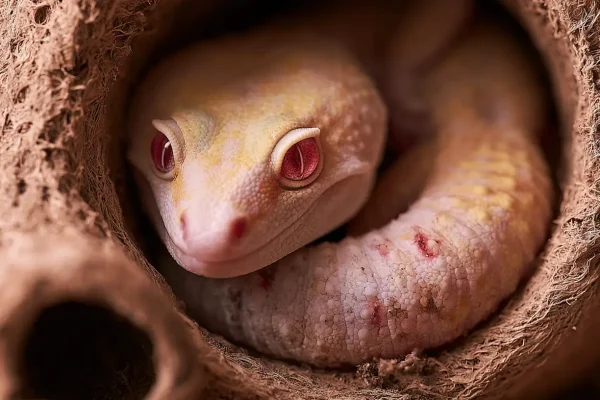
Moist hide (humid hide): frequently missing from basic setups, but essential. Lined with damp sphagnum moss, damp paper towel, or coconut fiber, it should maintain 70–80% relative humidity inside the hide even while the room’s ambient humidity sits lower, around 30–40%. This hide supports clean shedding, prevents retained eye caps and stuck shed on the toes and tail tip, and matters for egg development in females.
Skipping the moist hide is one of the more common causes of shedding complications in captive leopard geckos — it isn’t an optional extra.
Heating Setup: UTH vs. DHP
| Factor | Under-Tank Heater (UTH) | Deep Heat Projector (DHP) |
|---|---|---|
| Heat delivery | Surface conduction through substrate | Infrared, penetrates deeper into muscle tissue |
| Placement | Under the tank, warm-side third of the floor | Overhead-mounted |
| Best suited to | Budget setups, glass tanks with raised bottoms | Keepers wanting more even, deep-tissue warmth |
| Safety requirement | Must be run on a thermostat — never unregulated | Also benefits from thermostat regulation |
| Common use pattern | Standard, long-established approach | Increasingly used alone or alongside UTH |
Leopard geckos are crepuscular to nocturnal and rely primarily on belly heat rather than the high-intensity basking lamps used for diurnal species like bearded dragons. Whichever method you choose, a thermostat is non-negotiable — unregulated heat mats can climb well past safe temperatures and cause burns. Heat rocks should be avoided entirely; they heat unevenly and are a well-documented cause of thermal injury to the belly and feet.
UVB: The Guidance Is Evolving
Older care sheets state flatly that UVB is unnecessary for a nocturnal species. That position has softened somewhat as more research has looked at wild gecko behavior.
Research on wild leopard gecko activity patterns indicates they’re exposed to measurable, low-level UVB during crepuscular activity windows — nowhere near the intensity a bearded dragon receives at midday, but not zero either. Several reptile husbandry organizations now suggest low-level UVB (something in the range of an Arcadia 6% or a Zoo Med ReptiSun 5.0 T5 tube) as a reasonable enrichment addition rather than a strict requirement.
For most healthy adult geckos receiving adequate dietary calcium and D3 supplementation, UVB isn’t mandatory. For geckos with a history of metabolic bone disease, lower bone density, or keepers who simply prefer to provide it as a precaution, a low-output UVB tube on a 10–12 hour timer is a reasonable addition — the high-output 12–14% tubes made for bearded dragons are not appropriate here.
Frequently Asked Questions
What’s the minimum tank size for a leopard gecko?
Current guidance puts the adult minimum at 36″x18″ of floor space — the footprint of a 40-gallon breeder or an equivalent front-opening enclosure. A 20-gallon long (30″x12″) is workable as a bare floor for a single adult but limits how well you can space out the three hides and maintain a proper temperature gradient. Juveniles can start in a 10-gallon tank, with a plan to move to adult housing by 6–8 months old. Sizing up earlier rather than later tends to save money in the long run, since you avoid buying an intermediate tank you’ll outgrow quickly.
Can two leopard geckos share a tank?
It depends heavily on sex and enclosure size. Two females sometimes coexist peacefully in a large enough space (48″x18″ or bigger), though resource competition around hides, food, and basking spots needs ongoing monitoring — cohabitation that looks fine for months can shift if one gecko becomes dominant. Two males should never be housed together; territorial aggression between males is frequently serious and can be fatal. A male and female together will breed, often before a keeper intends to let that happen, which brings its own health and logistical considerations for the female. Because leopard geckos are naturally solitary in the wild, most experienced keepers default to housing them individually — the enrichment case for cohabitation is weak relative to the real risks involved.
Do leopard geckos need a heat lamp?
They need a reliable heat source, but it doesn’t have to be an overhead lamp. Under-tank heaters, always paired with a thermostat, remain the traditional and widely used approach. Deep Heat Projectors are gaining popularity because they warm more evenly and penetrate deeper than surface conduction alone. A low-wattage basking bulb can supplement warm-side heating if you want it, but it’s the resulting temperatures that matter, not the specific piece of equipment — aim for 88–92°F on the warm-side floor and 70–75°F on the cool side, both measured at substrate level.
Why is my leopard gecko always hiding?
There are several common explanations, and it’s worth working through them in order rather than assuming the worst. A newly set up enclosure often triggers extended hiding simply because the gecko needs time to settle — up to two weeks of minimal handling is normal and healthy. Hides that are too large can also be the culprit; geckos want to feel enclosed walls around their body, and a loose-fitting hide doesn’t provide that sense of security. Incorrect temperatures — either too hot or too cold — will also drive a gecko into extended hiding as it tries to self-regulate. Start by checking floor temperatures with an infrared thermometer, then evaluate whether your hides fit snugly, and give a newly settled gecko time before assuming something is medically wrong. Persistent hiding alongside weight loss, lethargy, or appetite changes is a reason to consult a reptile veterinarian.
Can I use a glass aquarium for a leopard gecko?
Yes — glass aquariums, whether a 20-gallon long or a 40-gallon breeder, are workable housing as long as you address ventilation and heating properly. A well-fitted screen top handles airflow, and either an under-tank heater on a thermostat or a lamp-and-thermostat combination can provide the necessary belly heat. The main limitation is top-only access, since standard aquariums don’t offer a front door. Some keepers address this with a front-access modification (cutting and hinging an acrylic panel into the front pane), while others simply accept the limitation and compensate with slow, predictable overhead movements to reduce the gecko’s startle response over time.
Conclusion
The right enclosure for a leopard gecko isn’t just about square footage or price — it’s about how the animal will experience every single interaction with you for the next 15-plus years. Front-opening access changes that experience at a fundamental level, which is why it’s worth prioritizing over most other features if your budget allows it.
If you’re starting from zero, a 36″x18″ front-opening enclosure like the Exo Terra gives you the behavioral benefit and the adult-appropriate floor space in one purchase, without requiring DIY skills or a premium budget. If cost is the deciding factor, a 40-gallon breeder tank meets the size guidance and can be paired with calm handling habits to offset the top-opening design. If you’re setting up for the long haul, want the best heat retention, or you’re housing more than one gecko, PVC panel enclosures are worth the higher upfront cost.
Whichever enclosure you land on, the details underneath the door style matter just as much: three properly placed hides, a heat source that’s thermostat-controlled without exception, and temperatures verified with an actual thermometer rather than a guess. Get the enclosure and the fundamentals right together, and you’ll have a gecko that’s calm, visible, and genuinely enjoyable to keep — rather than one that spends its life pressed into the back corner of a hide.