
- Quick Answer: The Best Aquarium Water Test Kit for Most Freshwater Tanks
- Why Testing Aquarium Water Is Not Optional
- Best Overall: API Freshwater Master Test Kit
- Best Fast Check: Tetra EasyStrips 6-in-1
- Best Ammonia Watcher: Seachem Ammonia Alert
- Best Nitrate Detail: Salifert Nitrate Test Kit
- Best Saltwater Starter Kit: Red Sea Marine Care Kit
- Best Digital Option: Hanna Checkers
- Liquid Tests vs Strips
- What to Test in a New Aquarium
- What to Test in an Established Tank
- How to Read Results Without Panicking
- Common Testing Mistakes
- My Picks by Tank Type
- FAQ
- What is the best aquarium water test kit for beginners?
- Are aquarium test strips accurate enough?
- How often should I test aquarium water?
- Why does my API ammonia test show a little green?
- Do I need a different test kit for saltwater?
A fish can look fine in water that is already going wrong.
That is the nasty little truth behind the best aquarium water test kit search. Clear water can hide ammonia. A cycled tank can still build nitrate. A pH number can drift slowly until your fish are living in a different tank than the one you thought you had. I have trusted “it looks clean” before. The tank corrected me.
Quick Answer: The Best Aquarium Water Test Kit for Most Freshwater Tanks
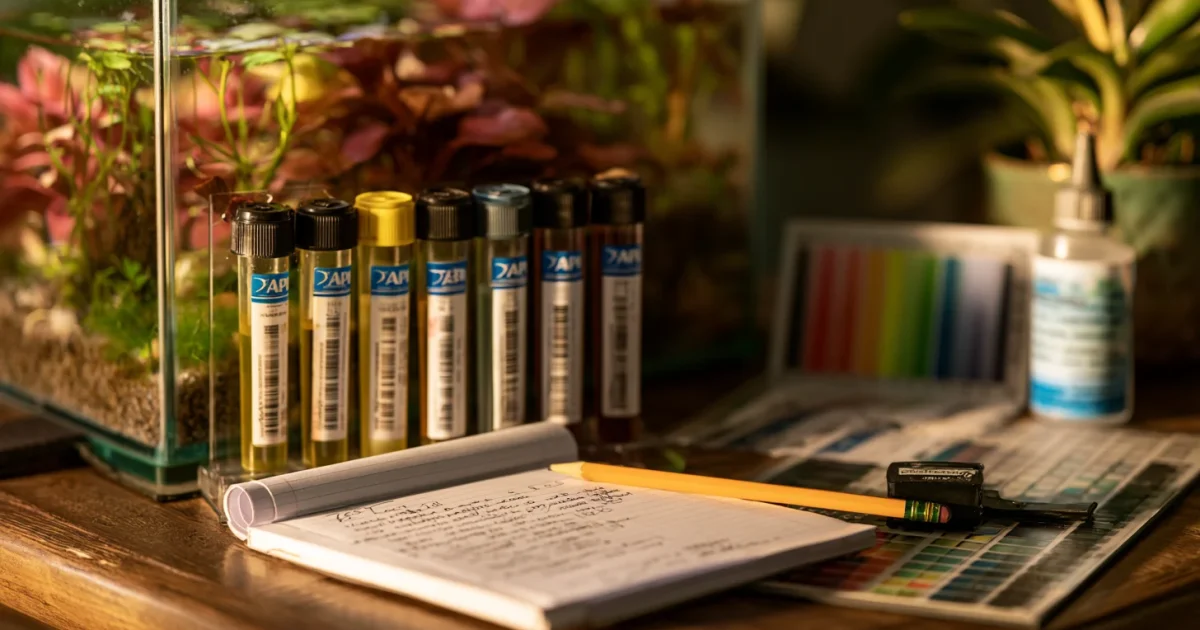
For most freshwater aquariums, the API Freshwater Master Test Kit is still the easiest first buy. It tests pH, high range pH, ammonia, nitrite, and nitrate, which are the numbers most owners need to watch. Strips are faster, but the API liquid kit gives better value and better detail for cycling and problem solving.
| Product & Model | Best For | The Big Win | The Catch | Price Tier |
|---|---|---|---|---|
| API Freshwater Master Test Kit | Most freshwater tanks | Core tests covered | Color matching takes practice | Budget |
| Tetra EasyStrips 6-in-1 | Quick routine checks | Fast dip results | No ammonia test | Budget |
| Seachem Ammonia Alert | New tanks | Constant ammonia watch | Not a full kit | Budget |
| Salifert Nitrate Test Kit | Planted and reef tanks | Better nitrate detail | Single-parameter only | Mid-Range |
| Red Sea Marine Care Kit | Saltwater beginners | Marine-focused basics | Costs more | Premium |
| Hanna Checkers | Reef dosing | Digital readout | One tester per parameter | Ultra-Premium |
Why Testing Aquarium Water Is Not Optional
Fish do not breathe vibes.
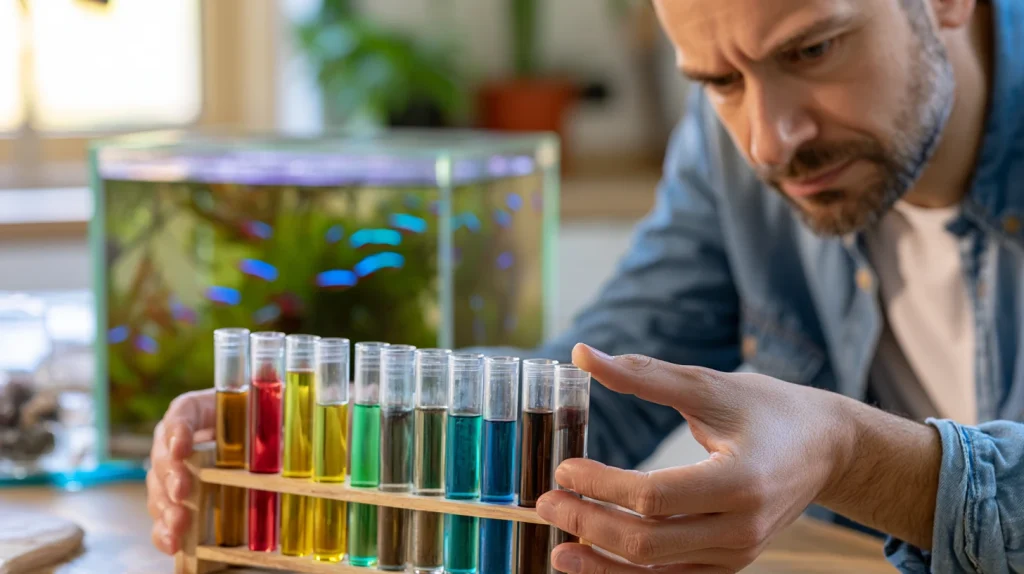
They live in chemistry. Ammonia, nitrite, nitrate, pH, KH, GH, temperature, and chlorine all affect them. You do not need to become a lab tech, but you do need a way to see what the water is doing.
The first two danger numbers are ammonia and nitrite.
Ammonia comes from fish waste, leftover food, dead plants, and anything rotting in the tank. It is toxic. Nitrite is also toxic. In a new tank, these numbers can rise while the filter bacteria are still growing.
Nitrate is less harsh, but it can still stress fish when it builds up. It also feeds algae.
pH tells you how acidic or basic the water is. Most fish can handle a range, but they hate sudden swings.
KH is carbonate hardness. It helps hold pH steady. GH is general hardness. It relates to minerals like calcium and magnesium.
That sounds like a lot. It is.
But for a normal freshwater tank, you can start with five basics:
- Ammonia
- Nitrite
- Nitrate
- pH
- Temperature
Best Overall: API Freshwater Master Test Kit
The API Freshwater Master Test Kit has been the default answer for years because it covers the tests that save fish.
It includes liquid tests for pH, high range pH, ammonia, nitrite, and nitrate. That means you can track a new tank cycle, check why fish are acting odd, and watch nitrate between water changes.
The value is strong. You get many tests from one box. It costs more than a small bottle of strips at first, but the cost per test is usually low.
I like it because it teaches you the tank.
You fill the tube, add drops, shake, wait, and compare color. It is slower than strips. It also makes you pay attention. That sounds silly, but slowing down helps. You notice if nitrate has crept from orange to red over a month. You notice if ammonia appears after adding fish.
The catch is color matching.
Some shades are close. The nitrate test can be annoying because one bottle needs heavy shaking. If you do not shake it enough, the result can be wrong. I am not 100% sure every beginner realizes that on the first read, because the box looks simpler than the steps feel.
Still, if a friend asked me what is the best aquarium water test kit for a freshwater tank, this is the one I would hand them.
Best Fast Check: Tetra EasyStrips 6-in-1
Test strips are not useless. That is one bit of advice I push back on.
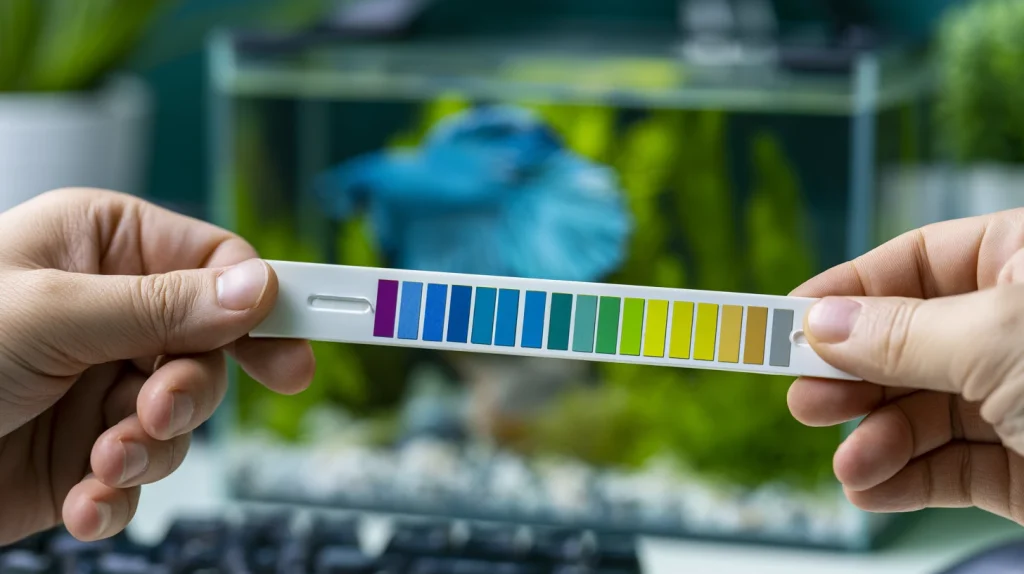
Some fishkeepers talk about strips like they are fake testing. They are not perfect, but they can help. The Tetra EasyStrips 6-in-1 can quickly check nitrate, nitrite, hardness, chlorine, alkalinity, and pH.
That speed is useful.
If you are in a rush, a strip is more likely to get used than a liquid kit. A rough check is better than no check.
The big problem is ammonia. Many multi-parameter strips do not test ammonia. That means they are not enough for cycling a new tank or checking sudden fish stress.
I would use strips for:
- Weekly quick checks on stable tanks
- Spotting nitrate trends
- Checking tap water changes
- Travel or pet-sitter checks
I would not rely on strips alone for:
- New tanks
- Sick fish
- Filter crashes
- Ammonia worries
Use strips like a smoke alarm, not a full inspection.
Best Ammonia Watcher: Seachem Ammonia Alert
The Seachem Ammonia Alert is not a normal test kit. It is a small sensor card that stays inside the tank and changes color when free ammonia rises.
Free ammonia is the more dangerous form. That makes this little card useful in new tanks, quarantine tanks, hospital tanks, and tanks where you recently changed filters or added fish.
It is not a replacement for a liquid ammonia test.
But it is a nice extra set of eyes.
I like it most for beginners who are cycling with fish in the tank. Fish-in cycling is not my favorite plan, but it happens. Stores give bad advice. Kids get excited. Someone brings home a betta and a tank on the same day. Then the owner needs help fast, not a lecture.
This card can warn you between full tests.
The catch is that it only does one job. It does not test nitrite, nitrate, or pH. It can also be slower to respond than a direct test. Treat it as backup, not the whole safety plan.
Best Nitrate Detail: Salifert Nitrate Test Kit
Nitrate matters in freshwater, planted, and saltwater tanks.
In a basic community tank, nitrate tells you if water changes are keeping up. In planted tanks, it also tells you whether plants may be hungry or the tank is building waste. In reef tanks, nitrate becomes part of a more careful balance.
The Salifert Nitrate Test Kit is a good pick when you want better nitrate detail than a broad strip or basic kit gives.
Do most freshwater beginners need it? No.
But it makes sense if:
- You keep a planted tank
- You fight algae
- You keep sensitive fish
- You run a reef tank
- Your API nitrate colors feel too hard to read
Single-parameter kits are a little annoying because they do one thing. But sometimes one thing done well is exactly what you need.
Best Saltwater Starter Kit: Red Sea Marine Care Kit
Saltwater tanks ask different questions.
Freshwater owners worry about ammonia, nitrite, nitrate, and pH. Saltwater owners care about those too, but reef tanks add alkalinity, calcium, magnesium, phosphate, and salinity. Corals can be fussy in ways guppies are not.
The Red Sea Marine Care Kit is a good starter set for marine aquariums because it focuses on the early safety numbers: ammonia, nitrite, nitrate, pH, and alkalinity.
That is enough for a fish-only saltwater tank and a good start for a beginner reef.
It is not enough for a full coral dosing plan. If you keep stony corals, you will need more tests. Alkalinity becomes a regular habit. Calcium and magnesium matter too.
For a beginner saltwater aquarium kit, I would rather see someone buy a marine-focused test kit than force a freshwater kit into a job it was not made for.
[INTERNAL LINK: beginner saltwater aquarium kit]
Best Digital Option: Hanna Checkers
Hanna Checkers are small digital testers for specific water parameters.
They are popular with reef keepers because reading tiny color shifts by eye gets old. A digital number feels cleaner. It also helps when you are dosing and need to see trends.
The catch is cost.
Each checker tests one thing. You may buy one for alkalinity, one for phosphate, one for nitrate, and so on. Reagents cost money too. This is not the budget path.
I would not tell a brand-new freshwater owner to buy Hanna Checkers. That would be silly. But for reef tanks, planted tanks with dosing routines, or people who hate color charts, they can be worth it.
Just remember this: a digital number is only useful if the test is done right.
Dirty vials, fingerprints, old reagent, and skipped timing can still give bad results. Digital does not mean magic.
Liquid Tests vs Strips
Liquid tests are slower and usually more useful for problem solving.
Strips are faster and easier to use often.
That is the real comparison.
Liquid kits are better when accuracy and detail matter. Use them during cycling, after fish deaths, after filter problems, or when ammonia and nitrite are possible.
Strips are better for quick trend checks. They can help you notice nitrate rising or tap water changing. They are handy when the choice is a strip test or no test because you are tired.
Here is my honest setup:
Keep a liquid master kit.
Use strips if they make you test more often.
That combination beats arguing online about purity while your tank goes untested.
What to Test in a New Aquarium
A new aquarium needs closer testing because the filter is not mature yet.
The main danger is the nitrogen cycle. Fish waste turns into ammonia. Helpful bacteria convert ammonia to nitrite. Another group converts nitrite to nitrate. Until those bacteria grow enough, toxic levels can appear.
In a new tank, test:
- Ammonia
- Nitrite
- Nitrate
- pH
If fish are already in the tank, test ammonia and nitrite often. Daily is not strange during trouble. If either shows up, feed less, change water, and protect the fish.
Do not add more fish because the water “looks fine.”
That sentence has caused so much heartbreak in this hobby.
If you are doing fishless cycling, testing tells you when the tank can process ammonia safely. It also stops you from guessing.
[INTERNAL LINK: fishless cycling aquarium]
What to Test in an Established Tank
Older tanks still need testing.
They just need a different rhythm.
For a stable freshwater tank, I would check nitrate and pH at least monthly. Test ammonia and nitrite any time fish act off, you add many fish, the filter stops, or something dies in the tank.
For planted tanks, nitrate and phosphate may matter more, depending on your fertilizer plan.
For hard-water fish like livebearers or African cichlids, GH and KH help. For soft-water fish, they help too, especially if your tap water changes by season.
For saltwater tanks, salinity is a constant check. Reef tanks need alkalinity checks often, sometimes several times a week if coral growth is strong.
The best water test aquarium routine is one you can keep.
Do not build a schedule so intense that you quit.
How to Read Results Without Panicking
Ammonia should be zero in a cycled tank.
Nitrite should be zero too.
Nitrate is usually controlled with water changes, plants, and stocking choices. Many freshwater keepers try to keep it under 20 to 40 ppm, but sensitive fish and reef tanks may need lower levels.
pH depends on your fish and water. A stable 7.6 is often safer than chasing 7.0 with chemicals. I have seen more trouble from pH chasing than from a harmless steady pH outside a care-sheet ideal.
That is a real opinion.
Fish need stable, clean water more than they need you to force a perfect number with bottles.
If a result looks strange, test again. Check the expiration date. Rinse the tube. Read the timing. Shake the bottle if the instructions say to shake it. Then act.
Common Testing Mistakes
The first mistake is testing only after fish look sick.
By then, the water may have been bad for days.
The second mistake is using expired tests. Reagents age. Strips can go bad if the bottle gets humid.
The third mistake is reading colors under weird light. Kitchen yellow light can make orange and red harder to judge. Use bright white light when you can.
The fourth mistake is skipping the instructions because you used the kit before. Some bottles need shaking. Some tests need a timed wait.
The fifth mistake is not writing numbers down.
Your memory will lie. A test log shows trends. It tells you if nitrate climbs faster than last month or if pH drops between water changes.
My Picks by Tank Type
For a new freshwater tank, buy the API Freshwater Master Test Kit and test ammonia, nitrite, and nitrate often.
For a stable community tank, keep the API kit and add strips if they help you do quick checks.
For a betta tank, ammonia matters a lot because small tanks can swing fast. API plus a Seachem Ammonia Alert is a nice safety combo.
For a planted tank, API is a start. Add nitrate and phosphate tests if you dose fertilizer or fight algae.
For a goldfish tank, test nitrate often. Goldfish produce a lot of waste. They are charming little water-quality stress tests.
For saltwater fish-only tanks, use a marine kit and a good salinity tester.
For reef tanks, plan for better tests. Alkalinity, calcium, magnesium, nitrate, and phosphate matter more as coral care gets serious.
FAQ
What is the best aquarium water test kit for beginners?
The API Freshwater Master Test Kit is the best beginner pick for most freshwater tanks. It covers ammonia, nitrite, nitrate, and pH, which are the main safety numbers.
Are aquarium test strips accurate enough?
They are accurate enough for quick trend checks in many stable tanks. They are not my first choice for cycling, ammonia problems, or serious troubleshooting.
How often should I test aquarium water?
Test new tanks often, even daily during cycling trouble. Stable freshwater tanks can usually be checked weekly or monthly, plus any time fish act strange.
Why does my API ammonia test show a little green?
It may show low ammonia, or it may be hard to read under your light. Retest, check the tube, and compare in bright white light. If fish seem stressed, treat it like a real warning.
Do I need a different test kit for saltwater?
Yes. Saltwater and reef tanks need marine-focused testing. A freshwater master kit is not enough for reef care.
The best aquarium water test kit is the one that helps you act before fish suffer.
Start with the API Freshwater Master Test Kit if you keep freshwater fish. Add strips for speed if they make testing easier. Move to marine or digital kits only when your tank asks for that level of detail. Clear water is nice, but numbers tell the truth sooner.