

My neighbor texted me a photo last year. Her two-year-old yellow Lab, Biscuit, had just eaten through a bag of dog food left on the kitchen counter. Not into it. Through it. The bag was destroyed. Biscuit looked absolutely delighted.
If you have a Lab, this story probably didn’t surprise you at all.
Labs eat like they haven’t seen food in weeks, even when they ate an hour ago. That’s not a training problem. That’s not bad behavior. For a lot of Labs, it’s actually written into their DNA — and it should completely change how you think about picking the best dog food for Labradors.
Why Labs Are Different (And It’s Not Just Greed)
About 25% of Labrador Retrievers carry a mutation in a gene called POMC — short for pro-opiomelanocortin. Researchers at Cambridge University discovered it, and the results were pretty wild.
Dogs with this mutation don’t just like food more. Their brains send a low-level starvation signal even when they’re not hungry. On top of that, they burn around 25% fewer calories at rest than Labs without the mutation. Hungry all the time. Slower metabolism. That combination is genuinely tough to manage.
You can’t tell by looking at your dog whether they have this mutation. There’s no easy home test for it. But if your Lab acts like every meal is their last and gains weight easily even on appropriate portions — that’s worth keeping in mind.
This matters when you’re shopping for food because no bag of kibble can fix a genetic drive. What it can do is give you the right calorie density, the right protein levels, and ingredients that keep your dog fuller between meals. That’s what we’re actually shopping for.
What to Actually Look for on a Dog Food Label
Most guides tell you to look for “real meat as the first ingredient.” That’s true but incomplete. Here’s what actually matters:
Named protein source listed first. Chicken, salmon, beef, turkey, lamb. Not “poultry meal” or “meat by-products” as the lead ingredient. Named proteins tell you more about quality and digestibility.

Moderate fat content. Labs that carry the POMC mutation need slightly fewer calories overall. A food with 15–18% fat is solid for most adult Labs. Higher-fat formulas (20%+) can tip the scales quickly.
No excessive fillers. Corn and wheat aren’t poison. But if the first three ingredients are all grains and there’s no named meat until ingredient four, you’re paying for bulk, not nutrition.
“Complete and balanced” for the right life stage. This matters more than people realize. We’ll get into that below.
The ingredient list is not the whole picture, though. Two foods with identical-looking labels can have very different calorie densities. Always check the calories per cup (listed as kcal/cup on the package). For Labs prone to weight gain, this number is often more useful than the ingredient list.
The Life Stage Question: Puppy, Adult, or Senior?
This is where most people make mistakes — and where the stakes are actually highest.
Labrador Puppies
Labs are large-breed dogs. That sounds obvious, but it has a specific nutritional implication that surprises a lot of new owners.
Too much calcium in a puppy’s diet speeds up bone growth faster than the joints can keep up. In Labs, who are already genetically predisposed to hip dysplasia, this can cause real, permanent joint problems. Not hypothetical ones. Actual damage.
The fix is simple: feed a food specifically labeled for large-breed puppies. These have controlled calcium-to-phosphorus ratios. A ratio around 1.2:1 is considered the safe range. Regular puppy food — even high-quality stuff — often has calcium levels that are too high for a growing Lab.
Do not add calcium supplements to a puppy’s food. Even well-meaning owners who add dairy or bone broth can inadvertently tip the balance.
Labs generally don’t need to switch from puppy to adult food until 15–24 months. Switching too early means your puppy’s skeletal system is still developing on adult-formula nutrition. Ask your vet where your specific dog lands in that window.
Adult Labradors
Once your Lab is fully grown, the calciums and phosphorus constraints relax. Adult Labs can eat most quality commercial foods. The priority shifts to:
- Appropriate calorie density (not too high)
- Good protein to maintain muscle mass
- Joint-supporting ingredients like omega-3 fatty acids
Look for EPA and DHA on the label — these are omega-3s found in fish oil that have real anti-inflammatory benefits for joints. Labs develop arthritis as they age, and starting this support in adulthood is smarter than waiting for symptoms.
Senior Labradors
Around age 7–8, Labs start slowing down. Their calorie needs drop. Their joints need more support. Their kidneys and liver aren’t as efficient as they used to be.
Senior formulas usually have:
- Lower calories
- Higher fiber (helps with digestion and weight)
- Added glucosamine and chondroitin (for joint cartilage)
- Slightly reduced phosphorus (easier on aging kidneys)
Honestly, some healthy seniors do fine staying on a high-quality adult food if their weight is managed well. But if your Lab is starting to stiffen up after walks or gaining weight despite normal portions, a senior formula is worth trying before assuming it’s just aging.
Best Dog Food for Labradors with Allergies
Labs get itchy. A lot. Chronic ear infections, paw-licking, and hot spots are common, and food allergies are one possible cause — though environmental allergies are far more common and often get conflated.
The most common food allergens in dogs are beef, dairy, wheat, egg, chicken, lamb, soy, pork, rabbit, and fish. Beef and chicken together account for a significant chunk of reported food allergy cases.
If you suspect a food allergy, the gold-standard approach is an elimination diet. Pick a protein your Lab has never eaten before — venison, kangaroo, duck, or a hydrolyzed protein formula. Feed only that for 8–12 weeks. Then reintroduce one ingredient at a time and watch for reactions.
This takes patience. A lot of owners give up around week four when they don’t see dramatic improvement, but the timeline genuinely needs to be that long to get useful information.

Grain-free diets became popular partly on the assumption that grains caused allergies. The truth is more complicated. Grains are rarely the culprit. And since 2019, grain-free diets have been under FDA investigation for a potential link to a heart condition called dilated cardiomyopathy (DCM) in dogs. The research is still ongoing and not fully resolved, but it’s enough reason not to choose grain-free without a specific medical reason.
Wet Food, Dry Food, or Both?
Most Labs do well on dry kibble. It’s convenient, calorie-dense, and easy to measure — which matters when your dog would happily eat twice their daily allowance if you let them.
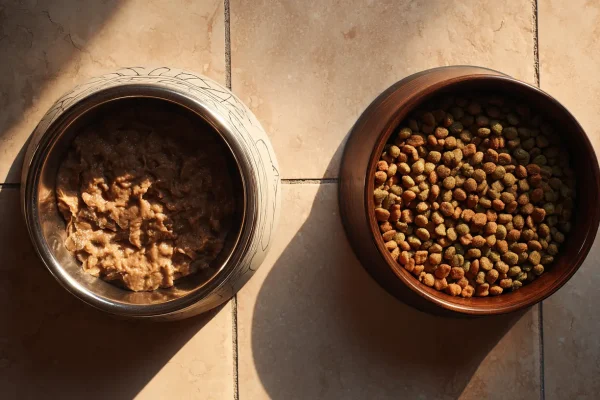
Wet food has a higher water content, which can help with hydration and makes some dogs feel fuller. For Labs prone to weight gain, mixing a small amount of wet food into kibble can sometimes stretch the meal and add satiety without dramatically increasing calories.
Raw feeding comes up in every conversation about dog nutrition. I’ll be honest: the evidence base for raw diets is weak, and the risks (bacterial contamination, nutrient imbalances) are real. I’m not saying it can never work, but the research doesn’t currently support it as clearly superior to a well-formulated commercial diet. If you go raw, work with a veterinary nutritionist — not a Facebook group.
My actual opinion: a high-quality dry kibble formulated for large breeds, measured by cup, with the occasional wet food mixed in, works well for the vast majority of Labs. The brand matters less than the habit of measuring portions consistently.
Feeding Amounts: The Part Most People Skip
Every bag has a feeding guide. Use it as a starting point, not gospel.
Labs should have a visible waist when viewed from above and you should be able to feel (but not see) their ribs. If you’re pressing hard to find ribs under a thick layer of padding, your dog is overweight — regardless of what the bag says.
Free-feeding (leaving food out all day) is a bad idea for Labs. Even without the POMC mutation, most Labs will eat continuously if given the chance.
Two meals a day works well for adults. Puppies generally need three meals a day up to around 6 months, then twice daily. Split the daily allowance — don’t give the full daily portion twice.
For Labs who eat too fast and risk bloat (a dangerous condition where the stomach can twist), consider a slow-feeder bowl or scatter feeding across a snuffle mat.
A Quick Note on Supplements
Most Labs eating a complete commercial food don’t need extra supplements. The one exception I’d consider: fish oil for joint support, especially in adult and senior Labs.
Look for fish oil with EPA and DHA specifically. Flaxseed oil contains a different form (ALA) that dogs don’t convert as efficiently. Liquid fish oil you add to their bowl works well and most Labs find it irresistible — which, given everything we know about Labs and food, tracks perfectly.
FAQ
What’s the best dog food for Labradors in the UK? The same principles apply globally — large-breed formulas, named protein first, controlled calorie density. UK-specific brands like Burns, Canagan, and Lily’s Kitchen all make quality options. Royal Canin’s Labrador Retriever formula is available widely and formulated specifically for the breed.
My Lab is always hungry — is that normal? For some Labs, yes — literally. Around 25% carry a gene mutation that keeps them feeling hungrier between meals and causes them to burn fewer calories at rest. The fix isn’t more food. It’s consistent portion control, two meals a day, and choosing a food that’s satisfying without being calorie-dense.
Can Labrador puppies eat adult dog food? Not yet. Labs are large-breed dogs, and puppy formulas for large breeds have carefully controlled calcium levels that reduce the risk of hip dysplasia. Switching too early — before 15 months at minimum, often up to 24 months — can affect skeletal development.
What’s the best dog food for Labradors with allergies? A hydrolyzed protein formula or a novel protein (one your dog has never eaten) is the starting point. Common allergens include beef, chicken, and dairy. An elimination diet run for 8–12 weeks is the most reliable way to identify the trigger. Talk to your vet before starting, because skin issues in Labs are far more often environmental than food-related.
How much should I feed my Labrador? Start with the bag’s feeding guide, then adjust based on body condition. A healthy Lab should have a visible waist from above and palpable ribs. If you can’t feel the ribs without pressing firmly, reduce portions by about 10% and reassess in four weeks.
The truth is, there’s no single best dog food for every Labrador. A 10-month-old puppy and an 8-year-old senior with hip issues have almost opposite needs. A Lab carrying the POMC mutation needs stricter portion control than a lean, active working Lab. What matters is matching food to your actual dog’s life stage, weight, and health — not just buying whatever has the fanciest bag.
Pick a food formulated for the right life stage. Measure every meal. Watch your dog’s body, not just the bowl. And maybe don’t leave the bag on the kitchen counter.