
- Why Indoor Cats Overeat in the First Place
- What Makes a Good Indoor Cat Diet
- The Wet vs. Dry Debate for Overweight Indoor Cats
- What to Look for on the Label
- Low Calorie Cat Food: What That Label Actually Means
- The Feeding Schedule Matters as Much as the Food
- A Word on Treats
- When It's Not Just About Food
- Transitioning Your Cat to a New Food
- The Best Cat Food for Indoor Cats: What to Actually Look For
- FAQ
My cat Nori used to act like she was starving. Every morning, the second my feet hit the floor, she was weaving between my ankles and crying. I’d feed her. An hour later she’d be at the bowl again, staring at me like I’d forgotten she existed. She was gaining weight every month, and I couldn’t figure out why.
Turns out, I was feeding her the wrong food. Not too much food — wrong food.
If you have an indoor cat who seems obsessed with eating, you’re probably searching for the best cat food for indoor cats right now. Good. Because the answer isn’t just “feed less.” It’s more nuanced than that, and most advice out there skips the part that actually matters.
Why Indoor Cats Overeat in the First Place
Before picking a food, it helps to understand what’s actually happening.
Indoor cats don’t hunt. They don’t climb trees, patrol territory, or chase anything more challenging than a dust bunny. That means they burn fewer calories — but it also means they’re understimulated. Bored cats eat. It’s that simple.
But there’s a second thing going on that almost nobody talks about.
Most dry cat food is high in carbohydrates. Cats are obligate carnivores, which means their bodies are built to run on protein and fat — not starch. When a cat eats a carb-heavy kibble, blood sugar spikes. The pancreas floods the body with insulin to deal with it. Then blood sugar crashes. And the cat feels hungry again.
This creates a cycle. The cat eats, feels full briefly, then gets hungry fast. Over time, the insulin response becomes blunted, and the hunger signals get louder. Some vets describe it as something close to a food addiction loop.
So when your indoor cat is begging constantly, it might not be greed. It might be that the food itself is driving hunger.
What Makes a Good Indoor Cat Diet
An indoor cat diet needs to do a few specific things.
First, it should be high in protein. Real animal protein — chicken, turkey, fish, beef. Not “poultry by-product meal” as the main protein source. Protein keeps cats full longer and supports lean muscle. Indoor cats lose muscle mass easily when they’re sedentary, and that makes the weight problem worse.
Second, it should be low in carbohydrates. Most dry food contains 25–50% carbs. Many wet foods sit between 1–10%. That difference matters a lot for a cat that overeats.
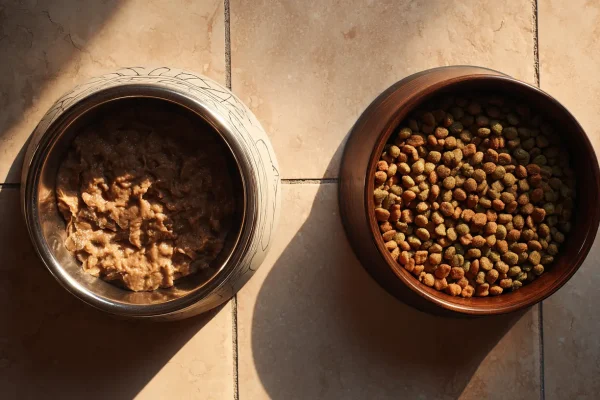
Third, moisture content matters. Cats evolved getting most of their water from prey. A dry kibble diet leaves them chronically under-hydrated. Wet food mimics that natural moisture intake and also tends to feel more satisfying per calorie.
Fourth — and this one surprises people — fiber. Not a ton of it, but enough to slow digestion and extend that feeling of fullness. Ingredients like pumpkin or chicory root do this without loading the food with empty calories.
The Wet vs. Dry Debate for Overweight Indoor Cats
Here’s my honest take: if your indoor cat is gaining weight and eating constantly, dry food is probably making it worse.
I know that’s not what the bag says. Plenty of kibble brands market themselves as “indoor formula” or “weight control.” But here’s the problem — you can’t make dry food without some kind of starch binder. That’s just how the manufacturing process works. Even the “low carb” dry options tend to run higher than any equivalent wet food.
Switching to wet food (or a mix of wet and a small amount of dry) is often the single biggest change that helps an overeating cat. Not because wet food has magic weight-loss powers. But because the macros are closer to what a cat’s body actually expects. Less blood sugar spiking. Less false hunger.
Some people worry wet food is more expensive. It is, per ounce. But when you factor in the vet bills that come from obesity-related issues like diabetes and joint problems, it starts to look like a bargain.
What to Look for on the Label
Reading a cat food label is annoying. But once you know what to look for, it takes about 30 seconds.
The first ingredient should be a named animal protein. Chicken, turkey, salmon, beef. Not “meat” or “animal digest” — those are vague and often low quality.
Check the guaranteed analysis. This is the small chart on the back with protein, fat, fiber, and moisture percentages. For an overweight indoor cat, you want:
- Protein: 35%+ on a dry matter basis (more on that in a second)
- Fat: moderate, around 10–20% dry matter
- Fiber: at least 2–3%
- Carbohydrates: as low as possible
Dry matter basis means the nutrient content if all water were removed. This matters because wet food has high water content, which makes raw percentages look lower. Most brands don’t list dry matter basis directly, but you can calculate it. Subtract the moisture percentage from 100, then divide the nutrient percentage by that number. Or just look it up — many cat nutrition sites have already done this math.
Avoid corn, wheat, and soy as the primary ingredients. These are cheap fillers that spike blood sugar and provide minimal nutrition for a cat’s body.
Low Calorie Cat Food: What That Label Actually Means
“Light” and “weight management” labels are not regulated the same way in pet food as in human food. A brand can call something “low calorie” without meeting a strict standard. So don’t rely on marketing language.
Instead, check the actual calorie count. It’s usually listed as kcal/kg or kcal per cup (for dry) or kcal per can (for wet). For a typical adult indoor cat that needs to lose weight, most vets suggest somewhere between 150–250 calories per day — but this varies by size, and your vet can give you a specific target.
For genuinely low calorie cat food, the key is caloric density. Foods with high moisture content (wet foods, especially pâté style) tend to have lower caloric density. That means your cat eats a satisfying volume of food without hitting a high calorie count. This is the same principle behind why soup fills you up more than crackers.
High fiber, high moisture, high protein with lower fat — that’s the formula that tends to work.
The Feeding Schedule Matters as Much as the Food
Choosing the right food is step one. How you feed it is step two.
Free feeding — leaving a bowl of dry food out all day — is probably the worst thing you can do for a cat that overeats. They graze constantly. Calories add up. There’s no mental reset between meals, so hunger cues never fully kick in.
Two measured meals a day works well for most adult cats. Some people do three smaller meals, which can help with hunger between feedings. The key word is measured. Not “a handful.” Weighed on a small kitchen scale or measured precisely with a measuring cup, every single time.
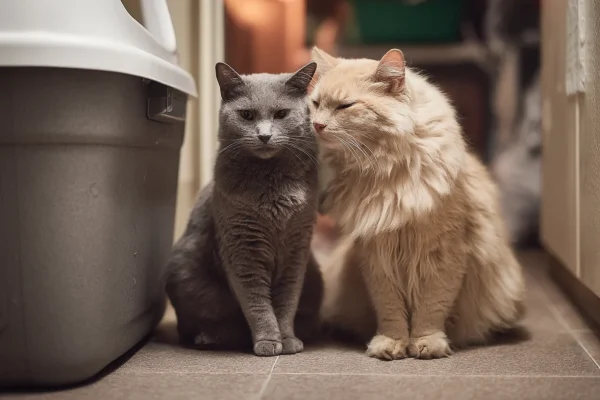
If you have multiple cats, feed them in separate spaces. One cat will absolutely eat another cat’s food if they can.
Slow feeder bowls or puzzle feeders are worth trying too. They stretch out mealtime and engage a cat’s hunting instincts. This serves two purposes: it slows down eating (which gives fullness signals time to catch up), and it provides mental stimulation that reduces boredom eating between meals.
A Word on Treats
Treats can ruin a carefully managed indoor cat diet without you even noticing.
If your cat gets treats multiple times a day, that’s adding up. Treats should stay under 10% of daily calorie intake. On a 200-calorie-a-day plan, that’s 20 calories of treats — roughly three or four small pieces of commercial treats.
Better options: small pieces of plain cooked chicken or a lick of plain canned fish (no salt, no oil). Freeze-dried single-ingredient treats (like freeze-dried chicken) tend to be high in protein and low in filler.
When It’s Not Just About Food
I want to be honest here because a lot of articles skip this part.
Sometimes a cat that’s always hungry has a medical reason. Hyperthyroidism causes constant hunger and weight loss. Diabetes causes hunger and weight gain. Parasites can drive appetite. If you’ve switched to a better food, set a proper feeding schedule, cut down treats, and your cat still acts ravenous — see a vet.
Blood work is quick and tells you a lot. Rule out the medical stuff before assuming it’s purely a food issue.
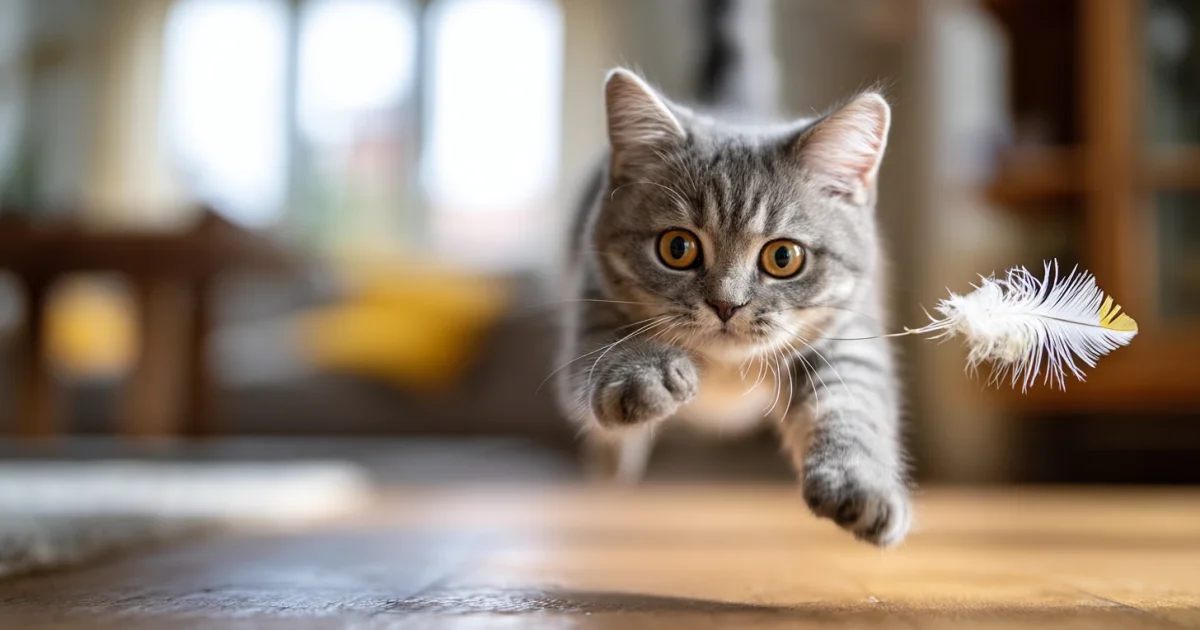
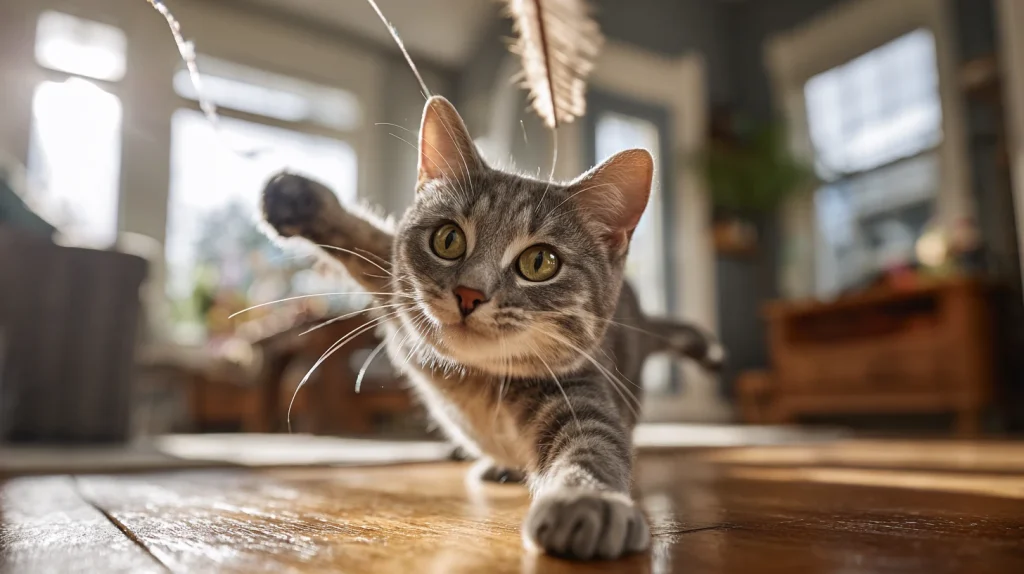
Boredom is also real. An indoor cat with no enrichment, no play, and nothing to do will often fixate on food. Adding a 10-minute play session before meals — using a wand toy or laser pointer — mimics the hunt-catch-eat sequence cats are wired for. It’s not a cure-all, but it genuinely helps.
Transitioning Your Cat to a New Food
One mistake that derails everything: switching foods too fast.
Cats have sensitive digestive systems. A sudden food change often causes vomiting or diarrhea, which makes owners assume the new food is the problem when it’s actually just the speed of the switch.
Do a slow transition over 7–10 days:
- Days 1–3: 75% old food, 25% new food
- Days 4–6: 50/50
- Days 7–9: 25% old food, 75% new food
- Day 10+: 100% new food
If your cat refuses the new food entirely, try warming wet food slightly (just a few seconds in the microwave) to release the aroma. Cats eat with their nose first.
Some cats will go on a hunger strike for a day or two. A healthy adult cat can skip a meal without harm. Don’t cave and go back to the old food after one protest session — but also don’t let a hunger strike go beyond 24–48 hours without checking in with a vet, since prolonged food refusal in cats can cause a serious liver condition called hepatic lipidosis.
The Best Cat Food for Indoor Cats: What to Actually Look For
Rather than a list of specific brand names (which change formulas and availability), here’s what to shop for:
For wet food, look for high-protein pâté or chunked varieties with a named meat as the first ingredient, low or no grain, and 75%+ moisture. Avoid foods where the first ingredient is broth or water — that’s just diluted food.
For dry food (if you still want some in the rotation), look for formulas specifically labeled for indoor or weight management cats, with protein as the first two or three ingredients, under 30% carbohydrates on a dry matter basis, and added L-carnitine — an amino acid that helps the body burn fat rather than store it.
For cats that need to lose weight more aggressively, prescription diets from your vet are worth discussing. They’re expensive, but they’re formulated with more precision than over-the-counter options.
The honest truth? There’s no single best food for every cat. A 4-year-old neutered male who sleeps 18 hours a day has different needs than a 7-year-old female who plays hard every evening. Use the criteria above as your filter, try a food for 6–8 weeks, monitor your cat’s weight, and adjust.
Weight loss in cats should be gradual — about 0.5–1% of body weight per week is considered safe. Faster than that and you’re risking muscle loss and other problems.
You’re already ahead of most cat owners just by asking the right question.
FAQ
My cat always acts hungry even after eating — is something wrong? Not necessarily, but it’s worth thinking through. If your cat is on dry food, the carb content might be driving a hunger cycle. Try switching to a high-protein wet food and see if the begging decreases. If the constant hunger continues even on a better diet, a vet checkup is a good idea — thyroid issues and diabetes can both cause this.
How do I know if my indoor cat is overweight? Run your hands along your cat’s sides. You should be able to feel the ribs with light pressure — not see them, but feel them easily. If you have to press hard, your cat is likely carrying extra weight. Also look at your cat from above: there should be a visible waist just behind the rib cage. If the sides are straight or bulging out, that’s a sign of extra weight.
Is it okay to mix wet and dry food? Yes, and for overeating indoor cats, this is often a good approach. A small amount of dry food in the morning (for the crunch cats sometimes like) and a measured portion of wet food at dinner can satisfy both nutritional goals and cat preference. Just account for calories from both.
Can I just give my cat less of the same dry food to make her lose weight? You can, but it often backfires. Reducing dry kibble dramatically leaves cats feeling genuinely hungry because the food isn’t satisfying. A hungry, food-obsessed cat is a miserable cat and a stressful experience for you. Switching to a more satisfying, protein-forward wet food often leads to better results with less suffering — for both of you.
How long does it take for an overweight indoor cat to reach a healthy weight? Safe weight loss is slow — expect about 1–2% of body weight per month. A cat that needs to lose a pound might take 3–4 months to get there safely. Don’t try to rush it. Rapid weight loss in cats is genuinely dangerous.