
- Best Picks at a Glance
- What Makes a Cat Toy "Interactive"?
- Detailed Reviews
- Cat Dancer / Feather Wand
- Ripple Rug (Tunnel + Play Mat)
- Trixie 5-in-1 Activity Center
- SmartyKat Hot Pursuit
- Cardboard Box Setup
- Cheerble Ball (or similar smart ball)
- 🏆 Editor's Pick
- Matching Toys to Your Cat's Situation
- Indoor Cats
- Bored Cats
- Kittens
- High-Energy Cats
- Practical Buying Advice
- Food Puzzles and Mental Stimulation
- A Daily Play Routine That Fits Real Life
- How Many Toys Does One Cat Actually Need?
- Safety Tips Before Leaving a Toy Out
- One Toy Worth Skipping: Automatic Lasers
- What to Actually Check Before Buying
- FAQ
- Choosing With Confidence
The toy that finally saved my ankles was a $9 wire with cardboard bits on the end.
I’d bought the fancy spinning toys first. The blinking ones. The rechargeable ball that rolled under the sofa in six minutes and stayed there like it had chosen retirement. So yes, the best interactive cat toys aren’t always the newest or loudest ones. They’re the toys that make your cat feel like a tiny hunter with a job to do.
That’s the whole trick. Your cat doesn’t want “a toy.” Your cat wants prey. Or a puzzle. Or a thing that hides. Or something that moves just wrong enough to be worth chasing. And sometimes your cat wants the box. Which is annoying. But also kind of fair.
“If you’re short on time: buy a feather wand or Cat Dancer first — it’s cheap and teaches you what movement your cat actually likes. Add a puzzle feeder like the Trixie 5-in-1 for food-motivated cats, and a hidden-motion toy like SmartyKat Hot Pursuit for solo play. Skip automatic lasers unless you end the session with something your cat can actually catch.”
Best Picks at a Glance
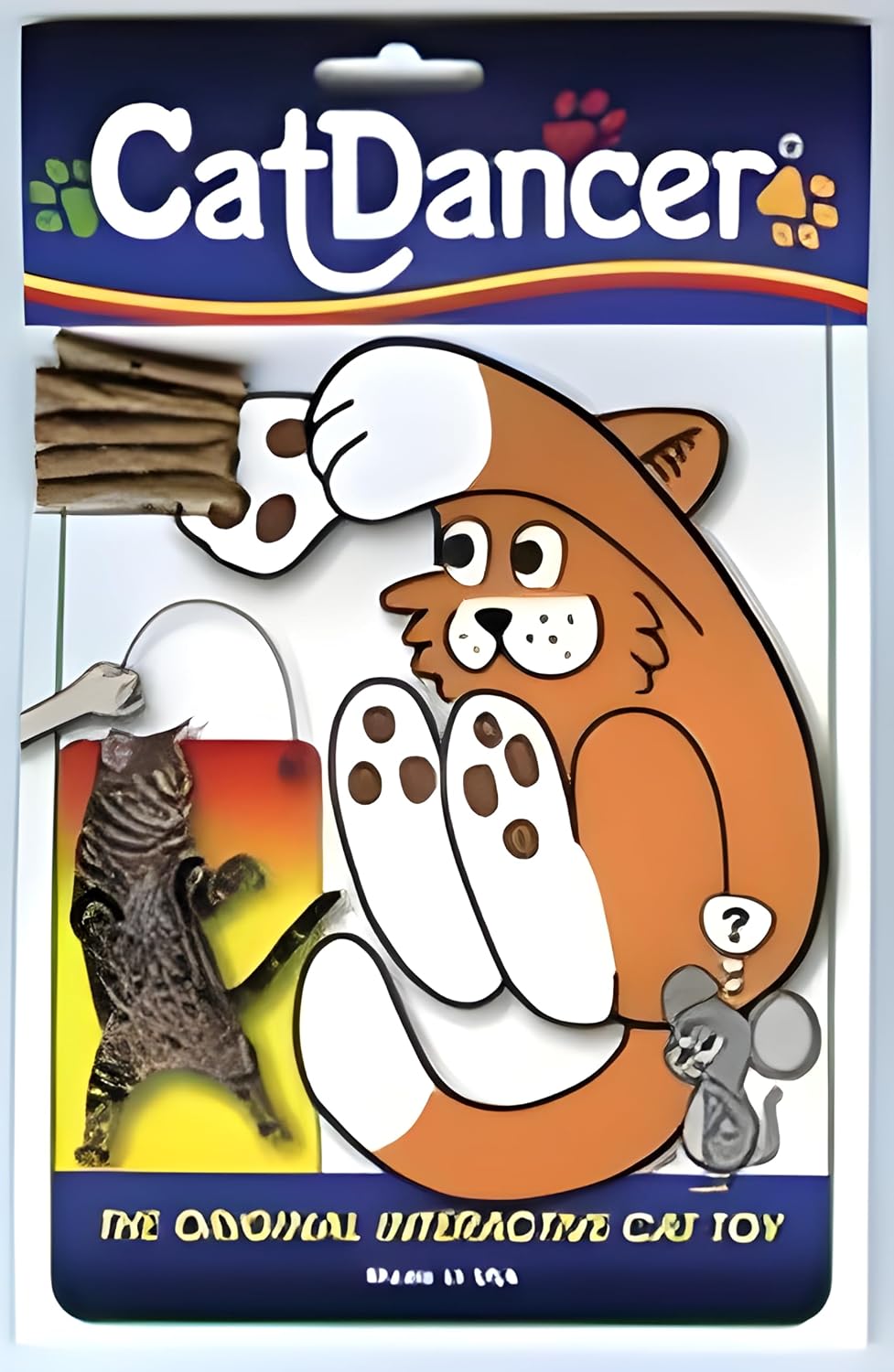
Cat Dancer / Feather Wand – 9.5/10 The best first buy, full stop. It’s cheap, it’s simple — wire and cardboard, nothing more — and it works on an enormous range of cats. More than that, it teaches you what kind of movement your specific cat responds to, which makes every future toy purchase a better guess. The only catch: it needs a human on the other end.
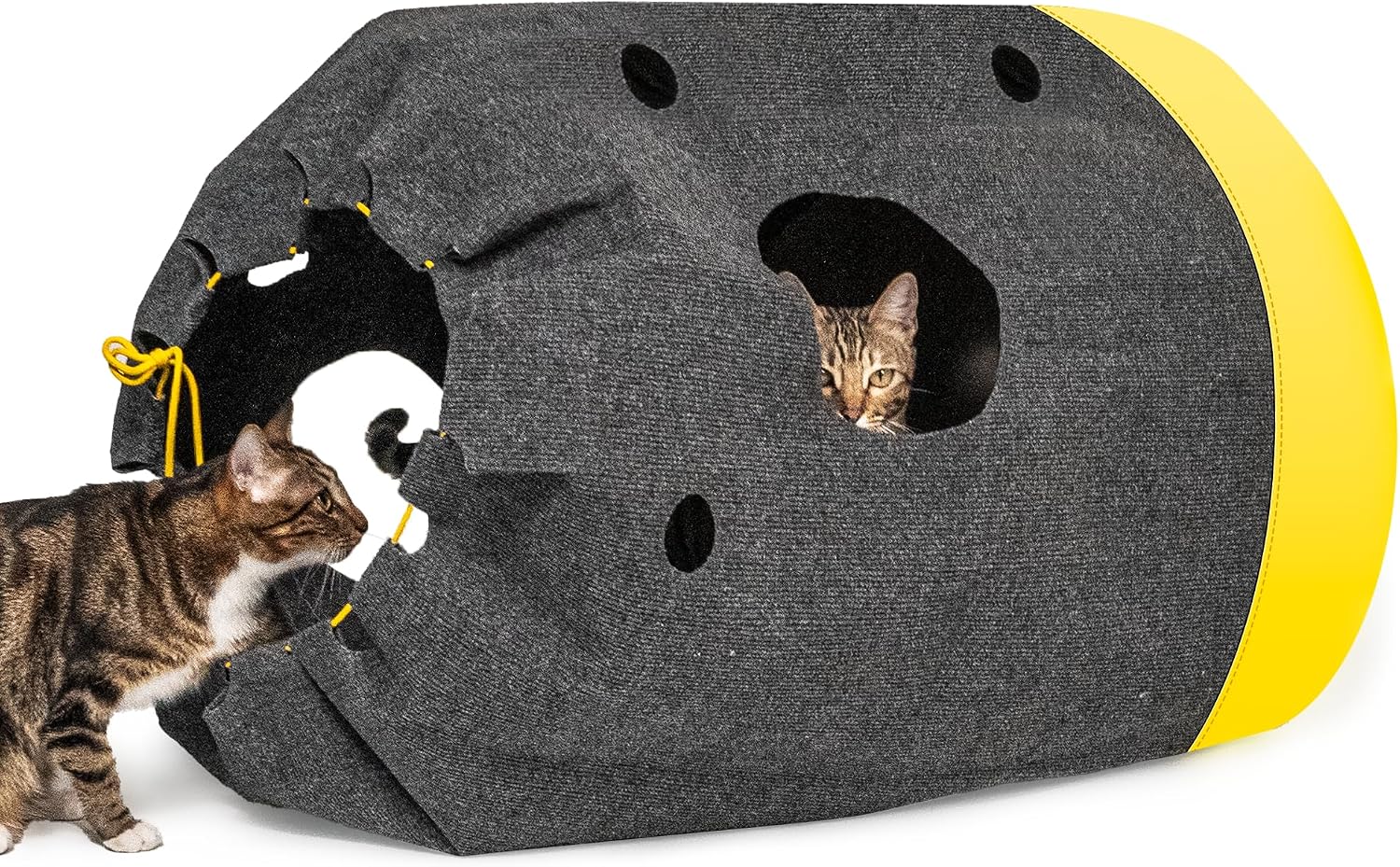
Ripple Rug (Tunnel + Play Mat) – 8.9/10 The toy that makes every other toy better. It gives a cat cover to stalk from, which turns ordinary wand play into something closer to real ambush behavior. Great for shy cats, kittens, and multi-cat homes — less essential if your cat already has plenty of furniture to hide behind.
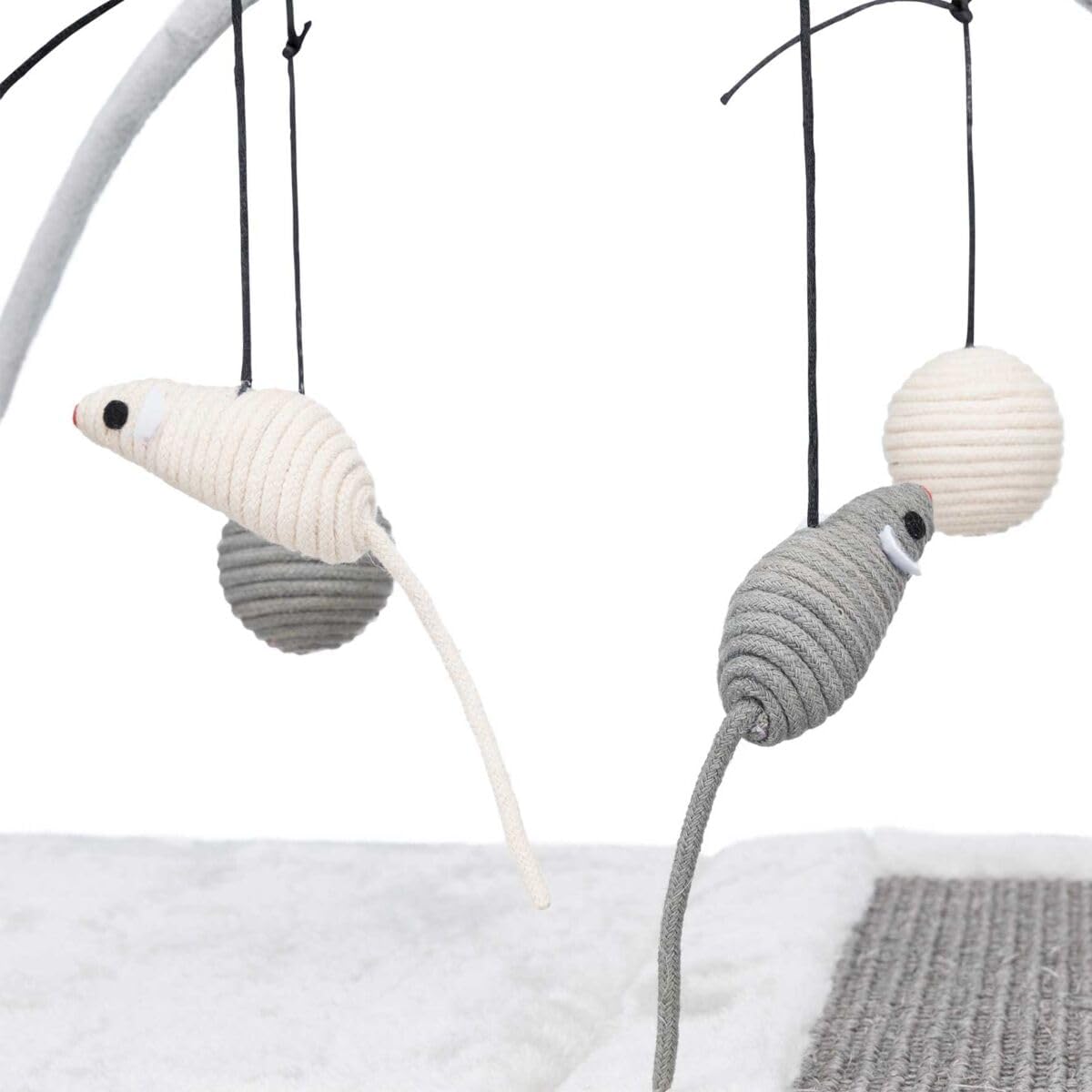
Trixie 5-in-1 Activity Center – 8.8/10 The best pick for food-motivated cats who need a reason to slow down and work for a snack. Multiple puzzle zones give a cat several ways to solve the same problem, which keeps it interesting longer than a single-mode feeder. Some cats need help figuring it out the first time.
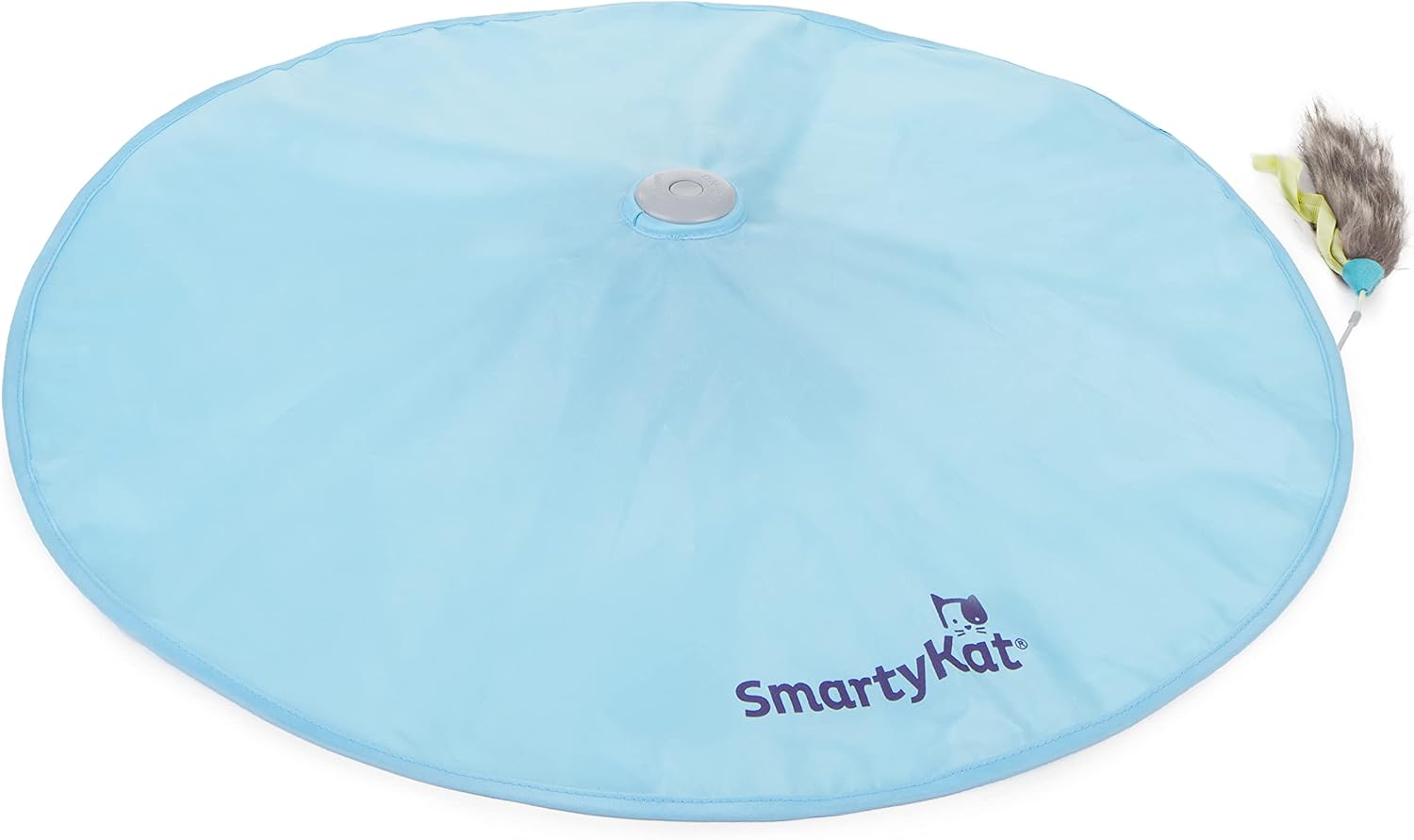
SmartyKat Hot Pursuit – 8.7/10 Best for cats who get bored during the day and need a solo option. The prey stays partly hidden under fabric, which keeps the mystery going — cats see movement without seeing the whole picture, and that’s the hook. Some cats crack the pattern within days and the drama fades, though most keep playing anyway.
Cardboard Box Setup – 8.5/10 The cheapest win on this list, and genuinely one of the best. Two paw holes, a toy mouse, some crumpled paper, and a wand dragged past the opening turns a free box into a cave, a hunting blind, a puzzle, and a scratching post all at once. It won’t last as long structurally as a purpose-built toy, but the cost makes that irrelevant.
Cheerble Ball (or similar smart ball) – 8.3/10 Good for high-energy cats who like chasing movement across open floor. It rolls, pauses, shakes, and changes direction on its own, which suits cats who want solo chase play. It performs worse in cluttered rooms or under furniture, and a few cats treat it with outright suspicion rather than excitement.
What Makes a Cat Toy “Interactive”?
A toy is interactive if it makes your cat react, think, chase, paw, stalk, grab, or solve a small problem. It doesn’t have to be electronic — and this is where a lot of product pages get it wrong, treating “interactive” as a synonym for “battery-powered.” A feather wand in your hand is more interactive than half the motorized toys on the market.
A good interactive toy usually does at least one of these: moves like prey, hides and reappears, makes the cat work for food, or lets the cat grab, bite, and kick something without consequence. Cats are picky because they’re wired that way — a mouse doesn’t roll in perfect circles forever, a bird doesn’t blink red lights and hum, and bugs don’t sit in the middle of the floor waiting to be played with. The closer a toy gets to real prey behavior, the better its odds. Not always, though — cats love making us look foolish regardless of how well-researched the toy is.
Detailed Reviews
Cat Dancer / Feather Wand
Rating: 9.5/10
This is still the number one pick, and the toy itself matters less than how you move it. Don’t wave it in your cat’s face like a windshield wiper — drag it behind a chair, let it vanish around a corner, make it pause, let your cat stare for a few seconds, then twitch it once. That tiny pause can turn a bored stare into a full-body launch.
Pros
- Cheap and durable
- Works on an unusually wide range of cats and coat/breed types
- Teaches you your specific cat’s play style fast
Cons
- Requires a person actively playing — no solo mode
Best for: nearly every cat, as a first purchase. Five minutes of good wand play beats thirty minutes of a cheap robot toy buzzing around the room unsupervised.
Ripple Rug (Tunnel + Play Mat)
Rating: 8.9/10
A tunnel looks simple, but it changes the whole feel of a room. It gives a cat cover, and cover makes stalking dramatically more fun — a wand toy dragged past a tunnel opening suddenly becomes prey crossing dangerous territory instead of just fabric on a stick.
Pros
- Adds cover that upgrades every other toy used near it
- Especially good for shy cats, kittens, and multi-cat households
- Changes shape/configuration, so it stays novel longer than static toys
Cons
- Some cats dislike the crinkle sound in certain tunnel materials — a soft fabric option may work better for nervous cats
Best for: shy cats, kittens, multi-cat homes, and any cat who ignores toys used out in the open.
Trixie 5-in-1 Activity Center
Rating: 8.8/10
Puzzle feeders don’t look as exciting online as spinning butterflies, and they don’t make flashy videos — but they make a cat work for food, which matters more for indoor enrichment than almost anything else on this list.
Pros
- Multiple puzzle zones keep the challenge varied
- Slows down treat time and adds a small daily task
- Reusable indefinitely, unlike consumable toys
Cons
- Some cats need help figuring out the mechanism at first
Setup tip: start easy. If the puzzle is too hard on day one, a cat may quit on it entirely — make it almost too easy at first, let the cat win, then increase difficulty gradually.
SmartyKat Hot Pursuit
Rating: 8.7/10
This one works specifically because part of the “prey” stays hidden under fabric. Cats like mystery — they see movement without seeing the whole thing, which gives them a reason to wait, plan, pounce, miss, and try again. It’s a solid pick for a cat who stares out the window all day and then ambushes the laundry basket out of frustration.
Pros
- Genuinely effective for solo play during the day
- The hidden-movement mechanic sustains interest well
Cons
- Some cats learn the movement pattern within a couple of days and lose some enthusiasm, though most keep playing anyway
Cardboard Box Setup
Rating: 8.5/10
Say what you want about the fancy toy industry — a cardboard box, properly set up, is one of the best interactive toys a cat can own. Cut two paw holes in the side, toss in a toy mouse, add some crumpled paper, drag a wand past one opening, hide a treat under a paper ball. Now the cat has a cave, a hunting blind, a puzzle, and a scratching surface, and it cost nothing.
Pros
- Free or nearly free
- Combines hiding, hunting, and scratching in one setup
- Works for shy cats and bold cats alike
Cons
- Doesn’t hold up structurally as long as a purpose-built product
Cheerble Ball (or similar smart ball)
Rating: 8.3/10
Smart balls roll, pause, shake, and change direction on their own, which some cats find genuinely thrilling and others regard with deep suspicion, like you’ve brought home a haunted golf ball. It’s a legitimately good tool for high-energy cats who like chasing floor-level movement.
Pros
- Good solo-play option for cats that like fast floor chasing
- Automatic movement variation keeps it from feeling repetitive
Cons
- Underperforms in cluttered rooms or near gaps it can roll under and get stuck in
- Not every cat’s temperament suits it
Use it in a hallway or open room first, and block the classic sofa gap — you know the one — before trusting it for unsupervised solo play.
🏆 Editor’s Pick
If you’re only buying one thing, buy the Cat Dancer or a basic feather wand. It’s the cheapest item on this list and the one that teaches you the most about your specific cat — whether they jump, hide, chase low, or watch from a distance before committing. That information makes every toy you buy afterward a better-informed choice.
Pair it with a Trixie 5-in-1 Activity Center if your cat is food-motivated, or a Ripple Rug if your cat likes to hide and ambush. Between the three, you’ve covered human play, solo mental work, and environmental enrichment — which is a more complete setup than any single “best toy” could offer on its own.
Matching Toys to Your Cat’s Situation
Indoor Cats
Indoor cats need more than a cute plush mouse — they need chances to hunt, climb, scratch, hide, chase, and “win.” That last part matters: a cat that never catches anything can get bored or genuinely worked up over time. Start with a wand toy for daily human-led play, add a hidden motion toy like SmartyKat Hot Pursuit for solo entertainment, and bring in a puzzle feeder to slow down treat time and give the day some structure.
Bored Cats
A bored cat doesn’t always look sad — sometimes it looks busy. Knocking pens off the desk, scratching the couch arm, attacking feet, yelling at a full food bowl like the household has failed somehow. That’s not bad behavior in the human sense; it’s unused energy looking for somewhere to go.
For bored cats, toys that create a small routine work best: a moving ball for cats that like chasing floor-level movement, a tunnel for cats that like cover and ambush games, and a cardboard box setup because it combines nearly everything for free.
Kittens
Kittens need toys that help them chase, pounce, bite, and learn bite control, along with genuinely safer designs, since they chew first and ask questions never. Skip small loose parts, watch strings closely, and put wand toys away after each session rather than leaving them accessible.
Good picks include a soft feather wand, a Cat Dancer, a small crinkle tunnel, a ball track, a soft kicker toy, and a window teaser under supervision. Kittens need wins — don’t make the toy too hard to catch, let them grab it often, and that teaches good play patterns while keeping your hands from becoming the default toy. A simple “mini hunting route” — tunnel, small box, wand moved from one to the other — works well precisely because it’s simple.
High-Energy Cats
Bengals, Siamese, Abyssinians, young rescues, and the occasional orange cat with no respect for gravity often need more active play than a small toy on the floor can provide. Distance and movement matter more here than for a mellow cat.
A long wand toy is the best first choice — it gives a cat room to sprint without turning your arm into a climbing wall. Cat wheels can help some high-energy cats, but they’re not universal: they take real space, cost more, and some cats need slow training to use one while others never care about it at all. Good for the right cat; not a sensible first purchase.
Practical Buying Advice
Food Puzzles and Mental Stimulation
Mental stimulation just means giving the cat’s brain something to do. Indoor life is safe and comfortable, but it can be a little too easy — food appears, water appears, the couch doesn’t run away — so small problems are worth adding deliberately.
A good starter method costs almost nothing: a few treats in a shallow muffin tin, some cups covered with paper balls, and let the cat work out how to get to the food. From there, a real puzzle board like the Trixie or Nina Ottosson Buggin’ Out adds more complexity. If your cat walks away from a puzzle, it’s usually too hard, the treat isn’t interesting enough, or the cat simply has other plans — cats do that.
Treat balls work well for cats that like batting things around — the ball rolls, food drops out, cause and effect gets reinforced. Keep the treat count modest, since a puzzle toy is still a feeder and “enrichment” can quietly turn into extra calories. Using part of a cat’s normal kibble ration works fine here.
Lick mats, more commonly associated with dogs, work for some cats too — a thin smear of wet food or a lickable treat gives a calmer, slower form of engagement that suits older cats or ones who get overstimulated by chase play.
A Daily Play Routine That Fits Real Life
Short play done daily beats one long session on a Sunday. A workable routine: two minutes of wand play in the morning, a food puzzle or treat ball in the afternoon, and five to eight minutes of chase play in the evening before dinner. Kittens and high-energy cats may need a few more short bursts through the day, but the basic shape holds.
Try to end chase play with an actual catch — let the cat grab the toy, then follow with a meal or small treat. That “hunt, catch, eat, rest” rhythm feels natural to cats and tends to make bedtime noticeably less dramatic.
How Many Toys Does One Cat Actually Need?
Three to five good toys are enough for most cats — not a giant basket of guilt purchases. A reasonable kit: one wand toy for human play, one puzzle feeder, one solo chase toy, one kicker toy, and one tunnel or box setup. Rotate them rather than leaving everything out all day; toys lose their appeal once they become part of the furniture. Put some away and bring them back later — it works better than it has any right to.
Safety Tips Before Leaving a Toy Out
Wand toys with string shouldn’t stay out unsupervised — loose feathers can detach, small bells can break loose, and battery-powered toys can startle a cat if they activate unexpectedly. Before leaving anything out, check for loose strings, broken plastic, small parts that could come free, sharp edges, or a battery cover the cat could pry open.
Watch a new toy closely the first few times regardless of how safe it looks on paper. A toy that’s fine for one cat can be a bad fit for another — the same household can have one cat who paws at toys like a polite librarian and another who tries to destroy the evidence.
One Toy Worth Skipping: Automatic Lasers
Automatic laser toys aren’t a strong first choice. Some cats enjoy them, but the cat can never actually grab the dot, which can leave them wound up rather than satisfied. If you do use one, end the session with a real toy or treat the cat can actually catch — that closes the loop the laser itself never can.
What to Actually Check Before Buying
Three questions are worth asking before any purchase: can the cat catch part of it, can it survive real biting and kicking, and will it actually work in your specific room? That third one gets skipped constantly — a rolling ball isn’t great in a cluttered room, a long wand isn’t great next to a shelf of breakables, and a treat puzzle is useless if your particular cat doesn’t care much about treats.
FAQ
What are the best interactive cat toys? Wand toys, hidden motion toys, puzzle feeders, treat balls, tunnels, and kicker toys cover most of what a cat actually wants. For most households, starting with a wand toy, a puzzle feeder, and one solo toy like a track toy or moving ball is a solid base.
What are the best interactive cat toys for indoor cats? Toys that create real hunting opportunities — a feather wand, SmartyKat Hot Pursuit, a Trixie activity board, a Ripple Rug, a Cat Dancer, or a cardboard box with hidden treats or toy mice inside.
Are laser toys bad for cats? Not inherently bad, but not the strongest first choice either. Some cats enjoy them, but since the dot can never actually be caught, sessions can end in frustration rather than satisfaction. Ending with a real, catchable toy or treat helps close that gap.
What interactive toys are best for bored cats? Hidden motion toys, tunnels, puzzle feeders, moving balls, and consistent daily wand play tend to work well. The right choice depends on whether the cat prefers chasing, hiding, eating, or solving small problems.
What are the best interactive cat toys for kittens? Soft wand toys, small tunnels, ball tracks, and light teaser toys, while avoiding tiny loose parts and putting string toys away after each session. Kittens need toys they can catch often, not ones that frustrate them early on.
Choosing With Confidence
The best toy is the one your cat actually keeps choosing — which might be a $30 rechargeable ball, might be a puzzle feeder, or might just be a bent piece of wire with cardboard on the end. Buy one good toy for chase, one for brain work, and one for solo play, then watch what your cat gravitates toward. They’ll tell you what’s working, usually by ignoring the thing you were most excited about.