
- Best Picks at a Glance
- What Actually Makes a Cat Drink More?
- The Cleaning Test I Use Before Buying
- Stainless Steel vs. Ceramic vs. Plastic
- Petlibro Stainless Steel Water Fountain — Best Easy-Clean Pick
- Pros
- Cons
- PetSafe Drinkwell 360 Stainless Steel — Best for Multiple Cats
- Pros
- Cons
- Petlibro Dockstream 2 Smart Cordless — Best for Smart Tracking
- Pros
- Cons
- Pioneer Pet Raindrop Stainless Steel — Best for Quiet Homes
- Pros
- Cons
- Oneisall Wireless Stainless Steel Fountain — Best Cordless Pick
- Pros
- Cons
- Catit PIXI / Catit Flower — Best First Fountain for Picky Cats
- Pros
- Cons
- Veken 2.8L Fountain — Budget Pick
- Pros
- Cons
- 🏆 Editor's Pick
- Best Cat Water Fountain, No Mold: The Honest Answer
- Best Cat Water Fountain, No Filter
- Practical Buying Advice
- How to Help Your Cat Accept a New Fountain
- FAQ
- My Buying Rule
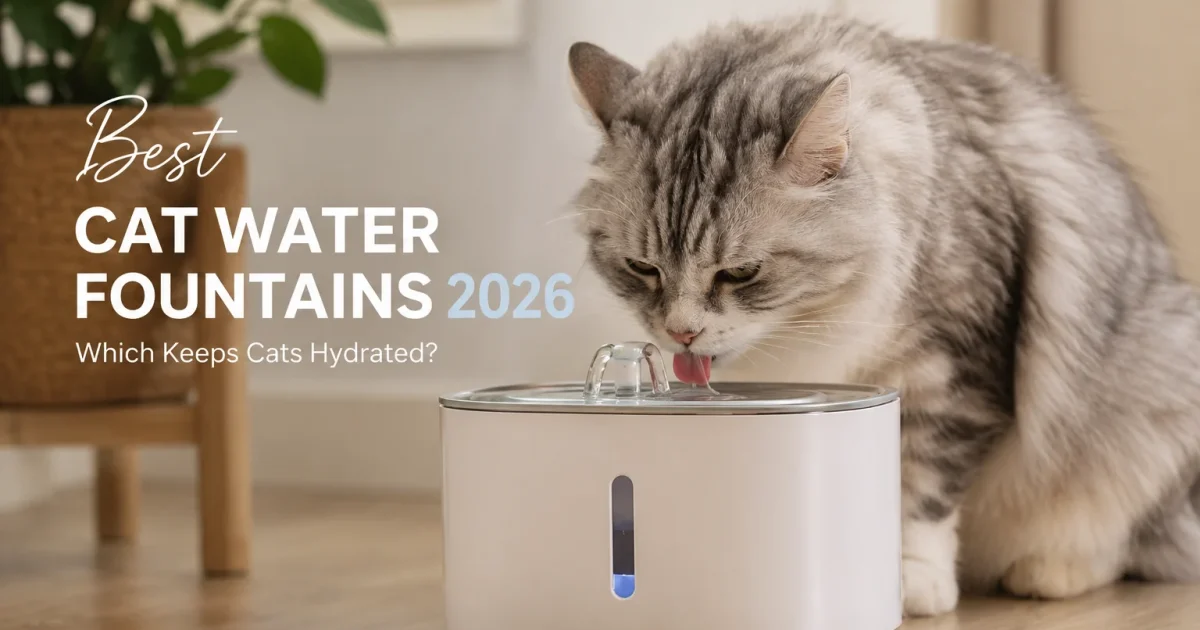
The grossest part of a cat fountain is never the water you can see. It’s the slick film hiding under the lid, around the pump, and in that tiny corner your sponge cannot reach. That’s why the best cat water fountain is not always the cutest one, the smartest one, or the one with the most streams. It’s the one your cat will use and you will clean without silently resenting it every Sunday night.
I’ve owned enough pet gadgets to know the pattern. The box makes it look simple. Your cat sniffs it. You feel proud. Then two weeks later, you’re on your knees with a toothbrush, scraping mystery slime from a plastic flower.
Which is frustrating. But also kind of makes sense. Cat fountains sit there all day with water, hair, dust, saliva, and tiny food crumbs moving through the same parts. A filter helps. It does not make the fountain clean by magic.
So for 2026, I’d choose a cat water fountain in this order: easy to clean first, cat-friendly second, fancy features third.
If you’re short on time: stainless steel wins for most homes — it resists smell and scratches better than plastic, and it’s easier to actually keep clean long-term. The Petlibro Stainless Steel Water Fountain is my starting point for most single-cat homes; the PetSafe Drinkwell 360 is the better call if you have more than one cat sharing water.
Best Picks at a Glance
Petlibro Stainless Steel Water Fountain – 9.0/10 My starting point for most homes. Stainless steel top, simple shape, fair price — it still relies on filters, but the cleaning experience beats most fountains at this price.
PetSafe Drinkwell 360 Stainless Steel – 8.8/10 The right pick for multiple cats. Several drinking spots around the bowl mean cats don’t have to share face space — the tradeoff is a larger footprint that needs real counter or floor space.
Petlibro Dockstream 2 Smart Cordless – 8.7/10 The smart-tracking option, and a genuinely clean cordless design with app alerts. Costs more, and I’d only pay the premium if tracking actually matters for your cat’s health.
Pioneer Pet Raindrop Stainless Steel – 8.6/10 Best for quiet homes. Low splash and a simple bowl shape that looks more like furniture than a gadget — just expect smaller capacity than the bigger models.
Oneisall Wireless Stainless Steel Fountain – 8.5/10 A strong cordless pick with a big tank and easy access. Check filter cost before buying, since that’s where the ongoing expense hides.
Catit PIXI or Catit Flower – 7.8/10 A good first fountain for picky cats, with a flow style that tends to grab their attention. More plastic parts means more detail-cleaning down the line.
Veken 2.8L Fountain – 7.5/10 The budget starter. Cheap and popular, but plastic needs more frequent cleaning to avoid the slime problem this whole guide is about.
What Actually Makes a Cat Drink More?
A fountain can help, but it’s not a magic trick.
Some cats love moving water. They hear the little stream and act like you installed a private mountain spring in your kitchen. Other cats stare at the fountain like it owes them money.
I’m not 100% sure every cat drinks more from a fountain. In fact, I don’t believe the common advice that “all cats prefer running water.” Some do. Some prefer a wide still bowl. Some drink from both. One of my cats once ignored a fancy fountain and drank from a measuring cup I’d left in the sink.
So yes, a fountain can help. But the goal isn’t “running water.” The goal is easier, cleaner, more tempting water. A fountain may help most if your cat eats mostly dry food, likes faucets, paws at water bowls, shares water with other cats, or avoids water that has hair or food bits floating in it.
Wet food still matters here. A cat eating canned food gets a lot of moisture from meals already. A dry-food cat needs to drink more from somewhere — that “somewhere” might be a fountain, a wide bowl, or both. My best setup is simple: one fountain and one backup bowl. Yes, even if the fountain is great.
The Cleaning Test I Use Before Buying
Before I care about flow modes, apps, lights, or cute little cat-ear designs, I look at one thing: can I clean this without hating my life?
You can usually tell from the product photos. Look for wide openings, smooth bowls, a pump you can remove, few tiny tunnels, and no fake flowers with five little parts unless you enjoy detail cleaning. I don’t.
A good easy-clean fountain should have a wide drinking tray, few sharp corners inside, a pump that lifts out without tools, dishwasher-safe parts where possible, and filters you can buy without hunting for a mystery size.
This is where a lot of fountain reviews miss the real pain. They say “easy to clean” after one test wash. That’s not the same as living with it. A fountain is easy to clean only after week six — by then, cat hair has found every gap, hard water has started leaving marks, and the pump is making a tiny hum it didn’t make before. That’s the moment the design tells the truth.
Stainless Steel vs. Ceramic vs. Plastic
This is where I get a little stubborn.
Stainless steel is usually the safest bet for busy homes. It doesn’t hold smells the way plastic can, it’s strong, it’s easier to scrub, and it feels less fussy overall.
Ceramic fountains can be great too. They look nicer, they feel stable, and a heavy ceramic fountain is hard for a dramatic cat to shove across the floor — you know the type, the one who thinks gravity is a hobby. But ceramic has two downsides: it can crack, and some designs have awkward shapes. If a ceramic fountain has a smooth open bowl, I like it. If it has a cave-like base with tiny hidden spots, no thanks.
Plastic isn’t always bad. I know people like to say “never buy plastic,” but that’s too simple. Plastic fountains are cheaper, lighter, and some cats love the flow designs, like the Catit Flower. They can be a good first try if you’re not sure your cat will use a fountain at all. But plastic asks more from you — you need to clean it often, check for scratches, and replace it sooner if it starts to smell, cloud, or grow slime fast. For me, plastic is a starter fountain. Stainless steel is the long-term choice.
Petlibro Stainless Steel Water Fountain — Best Easy-Clean Pick
Rating: 9.0/10

This is the kind of model I’d look at first. It’s not trying to be a spaceship — it has a stainless steel drinking surface, a clean shape, and enough capacity for most single-cat homes.
Pros
- Simple stainless steel tray with few tiny tunnels to scrub
- Fair price for the build quality
- Solid capacity for single-cat households
Cons
- Still relies on filters, which is an ongoing cost
That matters because the fountain that’s genuinely easy to clean is rarely the one with the most parts. A cleaning-first fountain should feel boring in a good way — you should be able to take it apart in under a minute, without watching a video every time the pump acts weird, and without needing a special brush shaped like a noodle just to reach the back corner. That sounds dramatic. It isn’t. If cleaning is annoying, you’ll clean it less, and then the fountain becomes worse than a plain bowl.
PetSafe Drinkwell 360 Stainless Steel — Best for Multiple Cats
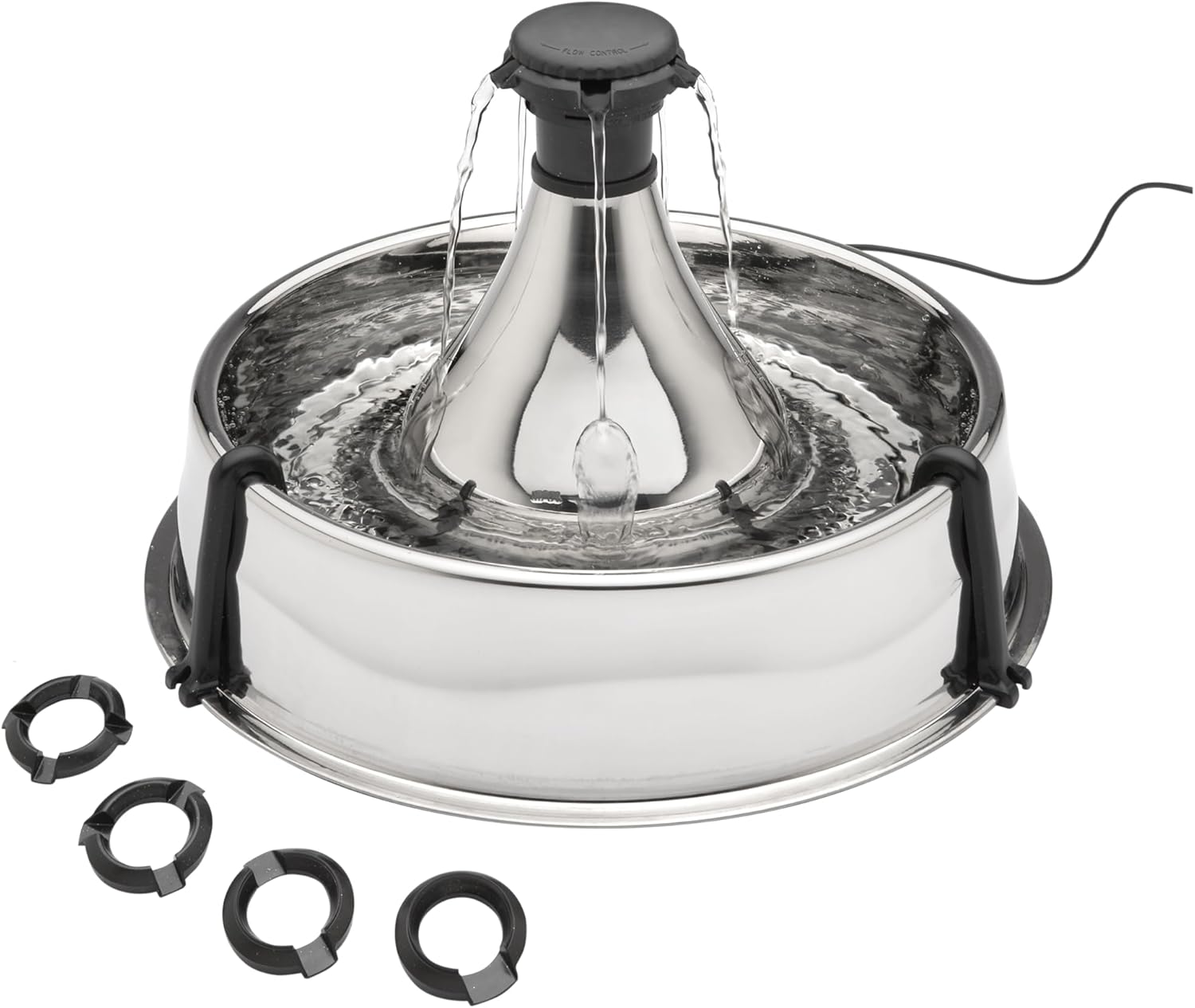
Rating: 8.8/10
Multiple cats change the rules entirely. One small fountain in a hallway can cause traffic — some cats don’t like drinking shoulder-to-shoulder, some will wait until the other cat leaves, and some will bully the water station because cats enjoy making home life weird.
Pros
- Several streams around the bowl, so cats can drink from different sides
- Good capacity for households sharing one water source
Cons
- Larger footprint that needs real counter or floor space
For two or more cats, I want more capacity and more drinking space, and that’s exactly the idea behind this one. I’d still keep at least one plain bowl in another room — in a multi-cat home, water shouldn’t be a single-location event. Put one source near the food area if your cat likes that, and another in a quiet spot, but avoid placing water right beside the litter box. Most cats do not love drinking next to toilet business. Fair.
Petlibro Dockstream 2 Smart Cordless — Best for Smart Tracking
Rating: 8.7/10

If you want app alerts, water tracking, and a cordless setup, this is the one to look at. It’s a genuinely clean design.
Pros
- App alerts and water tracking in one cordless unit
- Clean, minimal aesthetic
Cons
- Costs more than simpler stainless steel options
Smart tracking can help if your cat has urinary problems, kidney concerns, or a history of drinking changes. But for a healthy cat, I wouldn’t pay more just to see a graph — I’d pay more for better cleaning instead. That may be my most boring opinion in this whole guide. Still true.
Pioneer Pet Raindrop Stainless Steel — Best for Quiet Homes

Rating: 8.6/10
This one looks more like a normal bowl than a gadget, which helps shy cats and helps humans who don’t want a glowing plastic fountain sitting in the living room.
Pros
- Low splash and quiet operation
- Simple, low-profile bowl shape
Cons
- Smaller capacity than bigger multi-cat fountains
If low fuss and quiet operation matter more to you than capacity, this is a strong option — just plan around the smaller tank if you have more than one cat drinking from it.
Oneisall Wireless Stainless Steel Fountain — Best Cordless Pick

Rating: 8.5/10
A larger cordless fountain makes sense if you want placement flexibility, since the best water spot in a home isn’t always beside an outlet.
Pros
- Big tank and cordless placement
- Easy access for cleaning and refilling
Cons
- Filter cost is worth checking before you commit — it varies more than you’d expect
That cordless detail is a small thing until you actually live with it, and then it becomes one of the more genuinely useful features on this list.
Catit PIXI / Catit Flower — Best First Fountain for Picky Cats
Rating: 7.8/10

Some cats need a flow style that grabs their attention before they’ll touch a fountain at all, and this is where the Catit Flower earns its spot.
Pros
- Flow design that tends to engage picky or hesitant cats
- Easy to find replacement parts
Cons
- More plastic parts, which means more detail-cleaning over time
This is a good “test the waters” fountain — literally — before committing to a pricier stainless steel setup.
Veken 2.8L Fountain — Budget Pick

Rating: 7.5/10
Cheap, popular, and a reasonable starter if budget is the main constraint.
Pros
- Low price point
- Widely available and well-reviewed as an entry option
Cons
- Plastic construction needs more frequent cleaning to avoid slime buildup
Treat this as a starter fountain rather than a long-term investment, and budget in the extra cleaning time that comes with plastic.
🏆 Editor’s Pick
For most homes, the Petlibro Stainless Steel Water Fountain is where I’d start. It’s not the flashiest option here, and that’s exactly the point — it gives you a clean stainless steel surface, a shape with few hiding spots for grime, and a price that doesn’t ask you to pay extra for features you won’t use. If you have multiple cats, the PetSafe Drinkwell 360 is worth the larger footprint. If tracking genuinely matters for a health condition, the Petlibro Dockstream 2 earns its higher price. For everyone else, the boring stainless steel option wins.
Best Cat Water Fountain, No Mold: The Honest Answer
There is no true no-mold fountain. Sorry — I wish there was. Any fountain can grow biofilm, slime, or mold if water sits, filters clog, and parts stay dirty. Stainless steel and ceramic can slow the problem because they’re smoother and easier to scrub, but they don’t cancel out cleaning.
A “no mold” fountain is really a “less annoying to clean” fountain. That means using stainless steel or ceramic where you can, rinsing and refilling often, deep cleaning weekly, cleaning the pump specifically, and replacing filters on time.
The pump is the sneaky part. People clean the bowl and forget the pump, then wonder why the water still smells off. The pump has tiny parts where hair and film collect, and a filter does not save a dirty pump. I would rather own a simple fountain and clean it every week than own a fancy one and pretend the filter is doing all the work.
Best Cat Water Fountain, No Filter
A no-filter search sounds smart because filters cost money, and I get it — those little packs add up. But no-filter fountains are trickier than they sound.
Some are more like fresh-water dispensers that separate clean and used water. Some use schedules instead of constant flow. Some reduce pump cleaning because the water system is built differently. That can be great, but you still have to clean the bowl, tray, and tank. No filter does not mean no work.
For a no-filter model, I’d look for clean and used water kept apart, a stainless steel drinking surface, no hidden tubes, a clear tank, and easy access for hand washing. If your tap water has a strong taste or your cat is picky, a filter may help. If your cat doesn’t care and you already use filtered water, a no-filter fountain might be fine. This is one of those “depends on your home” choices — too clean and simple an answer here would be fake.
Practical Buying Advice
What actually matters: wide openings, a removable pump, few tiny tunnels, and easily available replacement filters or parts.
What matters less than people think: app tracking and smart features, unless your cat has an actual health condition that makes monitoring useful.
Common mistakes: trusting a “no mold” claim at face value, forgetting to clean the pump specifically, and buying based on star ratings alone without reading the one- and three-star reviews for patterns.
Reading listings before buying: check whether replacement filters are easy to find, whether pump replacements are sold separately, whether the brand shows cleaning steps clearly, whether the tank size is clearly stated, and whether the photos show real parts rather than just beauty shots. I’d also compare pricing across Chewy, the brand’s own site, and Amazon — sometimes filter packs are cheaper on one, sometimes the fountain itself is cheaper on another, and Amazon in particular has a lot of lookalike fountains with weird brand names and no spare parts available. Those make me nervous. A cheap fountain isn’t cheap if you throw it away after one filter cycle.
On USA-made options: if you want a US-made fountain specifically, look at handmade ceramic brands and small makers — some advertise handmade USA production, and they can be beautiful and long-lasting, but they often cost more than mass-market fountains. I’d still check the pump, cleaning access, return policy, and replacement parts before buying one just for the label. A USA-made ceramic fountain with a hard-to-clean shape is still a hard-to-clean fountain. The material and design matter more than the marketing line.
What changed for 2026: older reviews focused on basic flow, filter style, and whether cats liked the sound. More recent posts pushed smart models harder — app alerts, water tracking, cordless bases, motion sensors, cleaner-looking designs. My take for 2026 is that the best change isn’t the app. It’s the wireless pump. A wireless or easy-remove pump makes cleaning less annoying, and that’s a bigger win than a phone alert telling you what your nose already knows.
How to Help Your Cat Accept a New Fountain
Do not remove the old bowl right away. That’s the mistake I see people make constantly — they buy the fountain, plug it in, take away the bowl, and expect the cat to be grateful. Cats are not grateful. Cats are suspicious interior designers.
Put the fountain near the old bowl for a few days. Let your cat inspect it while it’s off. Then turn it on for short periods, keeping the flow low at first if the fountain allows it. You can try a tiny bit of tuna water near the fountain as a short intro trick, but don’t turn the tank into soup — that gets gross fast, and it should stay a one-time nudge, not a daily plan.
Give it time. Some cats use a fountain in ten minutes. Some take a week. Some never care. That doesn’t mean you failed. It means you live with a cat.
FAQ
What is the best cat water fountain to buy? For most homes, I’d start with a stainless steel model like the Petlibro Stainless Steel Water Fountain — it gives you the best mix of clean surface, fair price, and simple upkeep. If you want app tracking, look at the Petlibro Dockstream 2.
Do cats really drink more from water fountains? Some do, some don’t. Cats who like faucets or moving water may drink more from a fountain. Cats who eat wet food may not show a big change, since they already get water from meals.
How often should I clean a cat water fountain? Clean it once a week at minimum, sooner if you see slime, hair, cloudy water, or a weak stream. Don’t forget the pump — that’s where the sneaky gunk hides.
Is stainless steel better than plastic for cat fountains? Usually, yes. Stainless steel is easier to scrub and doesn’t scratch as easily as plastic. Plastic can still work, but it needs more careful cleaning and may not last as long.
Can I use a cat water fountain without a filter? Yes, but only if the fountain is designed for it, or you use clean water and wash it often. A filter helps catch hair and bits of food, but it doesn’t replace cleaning.
My Buying Rule
Choose the fountain you will clean. That’s the whole trick.
The best pick for most homes is probably stainless steel, simple, quiet, and easy to open. If you want smart tracking, the Petlibro Dockstream 2 makes sense. If you want low fuss, a stainless steel Petlibro or Pioneer-style fountain is the safer bet. If you have multiple cats, go bigger and wider. If you want cheap, Veken or Catit can work, but accept the extra cleaning that comes with it.
The best fountain is not the one your cat uses once for a cute video. It’s the one still running clean three months later.