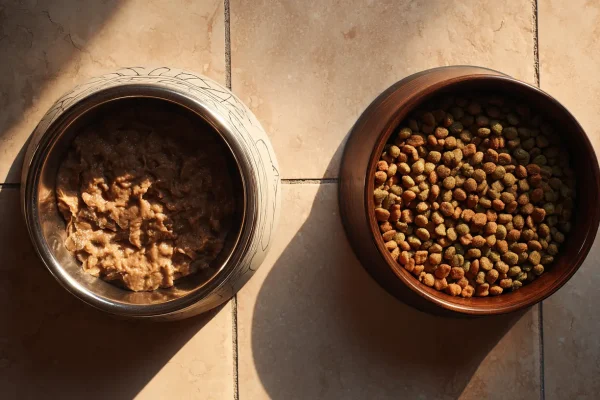


My friend called me last summer, panicking. Her two-year-old Golden, Biscuit, had chewed a patch of fur off his back leg and the skin underneath looked raw and angry. She’d already tried two different shampoos. She hadn’t touched his food.
That’s where most Golden owners get stuck.
The best dog food for golden retrievers isn’t just about protein percentages. It’s about understanding what this specific breed is up against — and feeding around it. Goldens get skin issues, joint problems, and weight gain more than most breeds. A lot of that starts in the bowl.
What Makes Goldens Different From Other Large Breeds
Golden Retrievers look sturdy. They are. But their immune and skin systems are more reactive than their size suggests.
Somewhere between 15 and 20 percent of Golden Retrievers develop food allergies during their lifetime — one of the highest rates of any breed. The most common triggers? Chicken, beef, dairy, and wheat.
That matters because chicken and beef are the first ingredient in most mainstream dog foods.
They’re also a large breed that grows fast as puppies. Too much calcium can cause bones to grow too fast in large-breed puppies, putting stress on developing joints. And adult Goldens are prone to hip dysplasia — a joint condition where the hip socket doesn’t fit properly — which good food can help slow down but not prevent entirely.
Then there’s the coat. That thick, double-layered fur needs fatty acids to stay healthy. Without enough omega-3s in the diet, the coat gets dull. The skin gets dry. Dry skin itches. Itching leads to hotspots — those red, moist, infected patches that vets see constantly on Goldens.
It’s a cycle. And it often starts with food.

The Coat-Allergy-Hotspot Loop (And How Food Breaks It)
Here’s the thing nobody explains in most dog food roundups.
Hotspots aren’t just a grooming problem. They’re usually the end result of a longer chain: low-quality fats in the food → dry, inflamed skin → scratching → broken skin → bacterial infection → hotspot.
Omega-3 and omega-6 fatty acids from fish oil or flaxseed support heart health, joint function, and that iconic Golden coat. When those are missing or low in the food, the skin barrier weakens. A weak skin barrier means allergens get in more easily. More allergens, more itching, more hotspots.
This is why switching food often does more for a hotspot-prone Golden than any medicated shampoo.
What to look for in the ingredient list:
- Fish oil or salmon oil — the best source of EPA and DHA (omega-3s that fight skin inflammation)
- Flaxseed — a plant-based omega-3 backup, good but less potent than fish
- Zinc — supports skin repair; many cheap kibbles are low in it
- Biotin — a B vitamin that helps with fur growth and thickness
What to avoid if your Golden has skin issues or hotspots:
- Chicken meal or chicken by-product as the primary protein (very common trigger)
- Corn, wheat, soy
- Artificial preservatives like BHA, BHT, and ethoxyquin
- “Meat by-products” — vague ingredient, often inflammatory
The 7 Best Dog Foods for Golden Retrievers
1. Royal Canin Golden Retriever Adult
This one gets my top spot for adult Goldens — not because it’s cheap (it isn’t) but because it’s actually built for the breed, not just relabeled large-breed food.
Royal Canin’s formula is specifically formulated to meet the nutritional needs of purebred Golden Retrievers aged 15 months and older, with a unique kibble shape designed around the Golden’s straight muzzle and scissor bite, encouraging thorough chewing and aiding digestion. It also focuses on the skin barrier — which, as I said above, is the Golden’s real weak spot.
It does contain grains. If your Golden has a grain sensitivity, skip this one. But for most adult Goldens without allergies, it’s a strong daily driver.
Best for: Healthy adult Goldens, owners who want breed-specific formulation
2. Merrick Limited Ingredient Diet (LID) — Chicken & Brown Rice with Healthy Grains
If your Golden is scratching constantly and you haven’t changed their food in a year, try a limited ingredient diet first before spending money on allergy testing.
LID foods keep the ingredient list short on purpose. Fewer ingredients means fewer potential triggers. Real salmon as the first ingredient provides high protein for muscle maintenance, oatmeal for gentle digestibility, and live probiotics to support immune and digestive health — helping reduce allergic reactions from food sensitivity.
Merrick’s version specifically targets sensitive stomachs. Clean formula. No artificial anything.
Best for: Goldens with mystery scratching, sensitive stomachs, first-time allergy management
3. Taste of the Wild — Southwest Canyon
Grain-free, novel proteins, solid omega content.
Taste of the Wild uses proteins like bison and venison — novel proteins that many allergy-prone dogs haven’t been exposed to, making them less likely to trigger immune reactions.
Novel protein means your dog’s immune system hasn’t built up a reaction to it yet. It’s a common recommendation when standard proteins like chicken and beef have been ruled out.
One honest note: grain-free diets were flagged a few years back for a potential link to a heart condition called DCM (dilated cardiomyopathy). The research is still ongoing and inconclusive. I’d talk to your vet before committing to grain-free long-term, especially for young dogs.
Best for: Goldens with known chicken or beef allergies, owners wanting grain-free with novel proteins
4. Wellness CORE Large Breed Adult
High protein, no fillers, good fat profile.
This is the food I’d recommend if your Golden is active and on the leaner side. The protein percentage is higher than average — around 34% — which supports muscle mass. Goldens that run, swim, or hike regularly burn through protein fast.
The omega-3 content is solid, coming from salmon oil. The coat results on this food are genuinely noticeable within 6–8 weeks.
Best for: Active adult Goldens, dogs that swim regularly, owners prioritizing coat quality
5. Hill’s Science Diet Large Breed Puppy
For puppies specifically, this one earns its place.
Large-breed puppy formulas are specially balanced to prevent bones from growing too fast — always choose food labeled for “large breed puppies.” Hill’s has spent decades on this research and their calcium-to-phosphorus ratios are dialed in.
Golden Retrievers usually transition to adult food somewhere between 12 and 15 months. Switching too early can interfere with proper development.
Keep them on puppy food longer than you think you need to. Growth plates don’t close overnight.
Best for: Golden puppies from 8 weeks to 12–15 months

6. Purina Pro Plan Large Breed Adult (Chicken & Rice)
I know some people roll their eyes at Purina. I get it.
But Pro Plan is one of the most studied dog foods on the market, backed by actual feeding trials (not just nutrient analysis). The chicken and rice formula is easy on digestion, the protein level is appropriate for large breeds, and it contains guaranteed live probiotics.
Real chicken is the primary ingredient, combined with a high-protein formula designed to support muscle development, plus guaranteed live probiotics for digestion and gut health
It’s also widely available and mid-range in price. For owners who go through 30-pound bags every few weeks, that matters.
Best for: Budget-conscious owners, dogs without allergies, easy digesters
7. Holistic Select Senior Health
Goldens hit senior territory around age 7. Their calorie needs drop. Their joint needs rise. Most foods don’t adjust for both at once.
Holistic Select uses digestive enzymes and probiotics alongside glucosamine — the nutrient that supports cartilage health in joints. The formula is lower in calories than adult versions, which helps prevent the weight gain that speeds up joint breakdown in older dogs.
Senior Goldens need fewer calories but similar protein levels to maintain muscle mass. This formula gets that balance right.
Best for: Goldens 7 years and older, dogs with early joint stiffness, weight management in seniors
How Much Should You Feed a Golden Retriever?
The bag guidelines are a starting point, not a rule.
They’re calculated for the average dog. Your Golden may be more or less active than average. Most bags slightly overestimate portion sizes — which is how dogs end up overweight while “following the instructions.”
A fit Golden should have ribs you can feel but not see. Run your hands along their side. If you have to press hard to feel the ribs, they’re carrying too much weight. If the ribs stick out visually, they need more food.
Many Golden Retrievers suffer from obesity, especially in their later years — high-quality food helps manage weight by being nutrient-dense without packing in excess calories.
Weigh your dog every few months. Adjust by 10% up or down. Watch the ribs. That’s the whole system.
One Ingredient Worth Checking Right Now
Flip over your Golden’s current food bag. Find the fat source.
If it says “chicken fat” or “animal fat” with no specifics — that’s vague. It could be fine. It could be low quality. The better bags say “salmon oil,” “herring oil,” or “flaxseed.”
That fat source is where your Golden’s coat health comes from. If the first fat listed isn’t a named omega-3 source, that might explain a dull coat or dry skin.
FAQ
My golden retriever keeps getting hotspots. Could it be the food?
Possibly, yes. Hotspots are often the end result of dry, inflamed skin — which is frequently tied to poor fat quality in the diet. If you’ve been on the same food for a while and hotspots keep coming back, try switching to a food with named fish oil in the first five ingredients. Give it 8–10 weeks before judging.
What’s the best dog food for golden retrievers with allergies?
Start with a limited ingredient diet (LID) using a novel protein — something your dog hasn’t eaten before, like salmon, duck, or venison. The most common allergy triggers in Goldens are chicken, beef, dairy, and wheat. Elimination means cutting all of those at once, which means reading every label carefully, including treats.
Is grain-free better for golden retrievers?
Not automatically. Grain-free is useful if your Golden has a confirmed grain sensitivity. But most Goldens don’t. The grain-free/DCM link hasn’t been fully resolved by research, so I’d only go grain-free with a specific reason — not just because it sounds healthier.
How do I know if my golden retriever’s food is causing their itching?
The clearest signal is seasonal pattern. If the itching is year-round (and worse after meals), food is more likely the trigger. If it only spikes in spring or fall, environmental allergens (pollen, grass) are probably the cause. Either way, a vet visit to rule out secondary infections is worth it before changing food.
When should a golden retriever puppy switch to adult food?
Between 12 and 15 months. Don’t rush it. Large-breed puppies have slower bone development than smaller breeds, and adult food isn’t formulated for that growth phase. Switching too early can affect joint development.
Biscuit, by the way, is fine now. My friend switched him to a salmon-based limited ingredient food. Hotspot cleared in three weeks. Vet confirmed it was almost certainly a chicken sensitivity the whole time.
Sometimes the answer really is that simple. You just have to look in the bowl first.