
- If You're Short on Time
- Best Picks at a Glance
- Detailed Reviews
- Homemade 4:1 Nectar (White Sugar + Water)
- Nature's Nectar Premium (Dye-Free)
- Perky-Pet Hummingbird Nectar Concentrate
- Pennington Hummingbird Nectar
- Kaytee Electro Nectar Ready to Use
- 🏆 Editor's Pick: Homemade 4:1 Nectar
- Practical Buying Advice
- When Commercial Nectar Actually Makes Sense
- The Homemade Recipe
- Should You Ever Change the Ratio?
- Storing Homemade Nectar
- What Hummingbirds Actually Prefer
- How to Buy Commercial Nectar (If You Do)
- The Red Dye Question, In Plain Terms
- FAQ
- Bottom Line
Pour a bottle of red hummingbird nectar into your feeder and you’re doing something no hummingbird actually needs. The red color isn’t for them — it’s for you. Hummingbirds find a feeder by the color of the feeder itself, not the liquid inside it. So why is nearly every bottle on the shelf dyed bright red?
Because it sells. Not because it works better, and not because anyone has ever proven it’s safe for the bird drinking it.
That single fact — no proven benefit, no safety data — is reason enough to make your own nectar instead of buying it. But it’s not the only reason. Homemade nectar is also cheaper, just as effective at drawing birds to your yard, and takes about ten minutes to prepare a week’s worth.
If You’re Short on Time
“If you’re short on time: skip the dyed commercial nectar and mix your own using a 4:1 ratio of water to plain white sugar. It’s the concentration hummingbirds actually prefer, it costs a fraction of store-bought options, and it takes about 10 minutes. If you need commercial nectar for travel or convenience, choose a dye-free brand like Nature’s Nectar Premium.”
Best Picks at a Glance
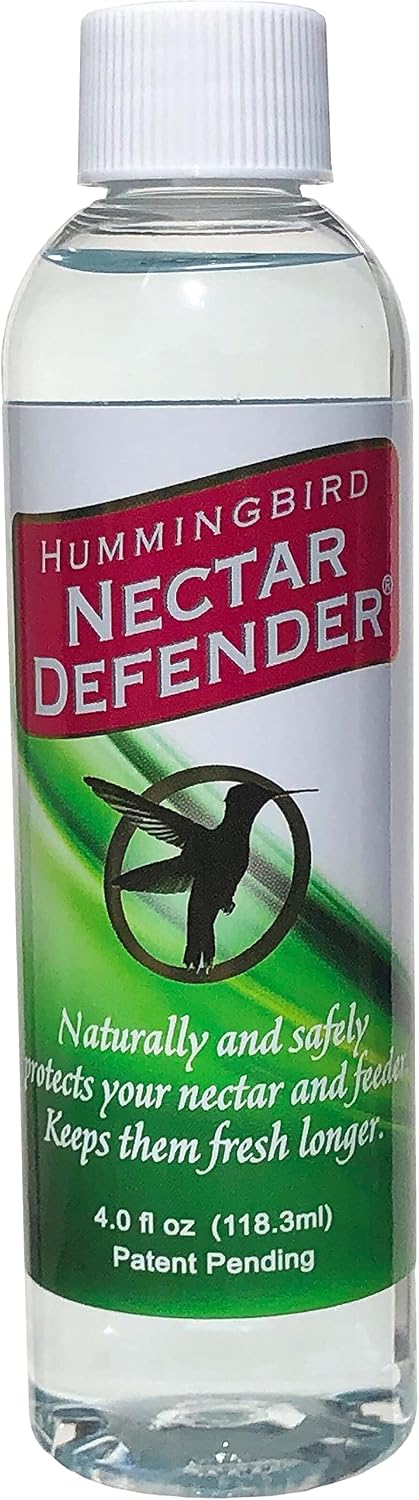
Homemade 4:1 Nectar (White Sugar + Water) – 9.8/10
The best option for almost everyone — dye-free, mixed to the exact concentration hummingbirds prefer, and costs pennies compared to anything on a shelf. The only real downside is that you have to make it yourself.
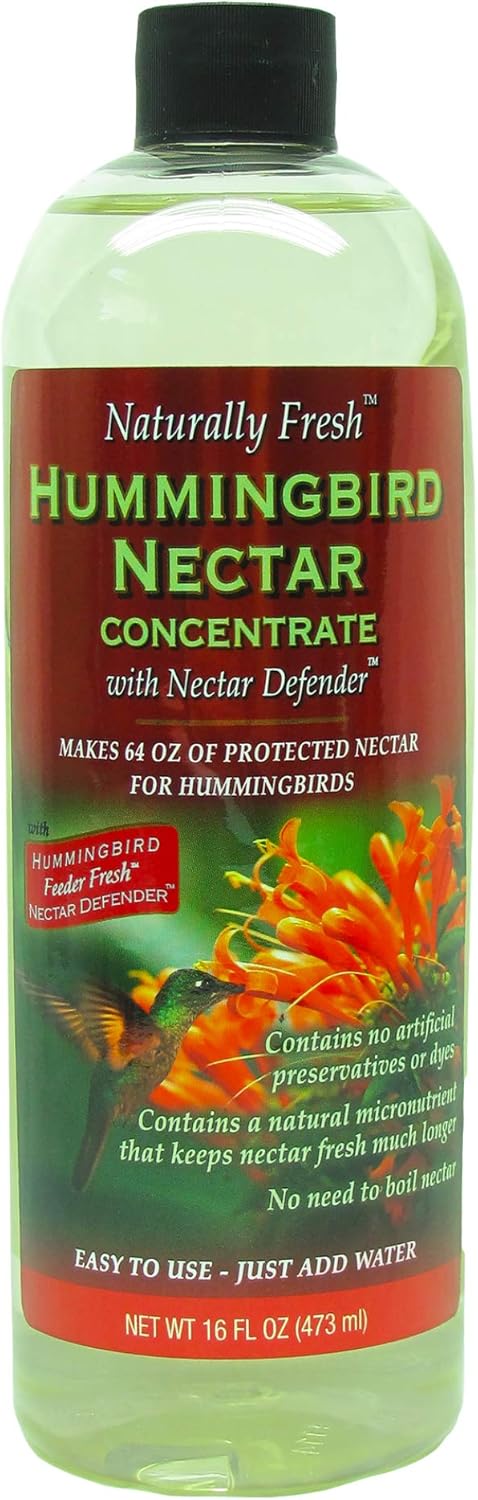
Nature’s Nectar Premium (Dye-Free) – 8.3/10
The best commercial pick if you want convenience without the dye, with the closest ingredient profile to homemade of any bottled option. It costs more and isn’t stocked everywhere, but it’s the right call when commercial nectar makes sense.
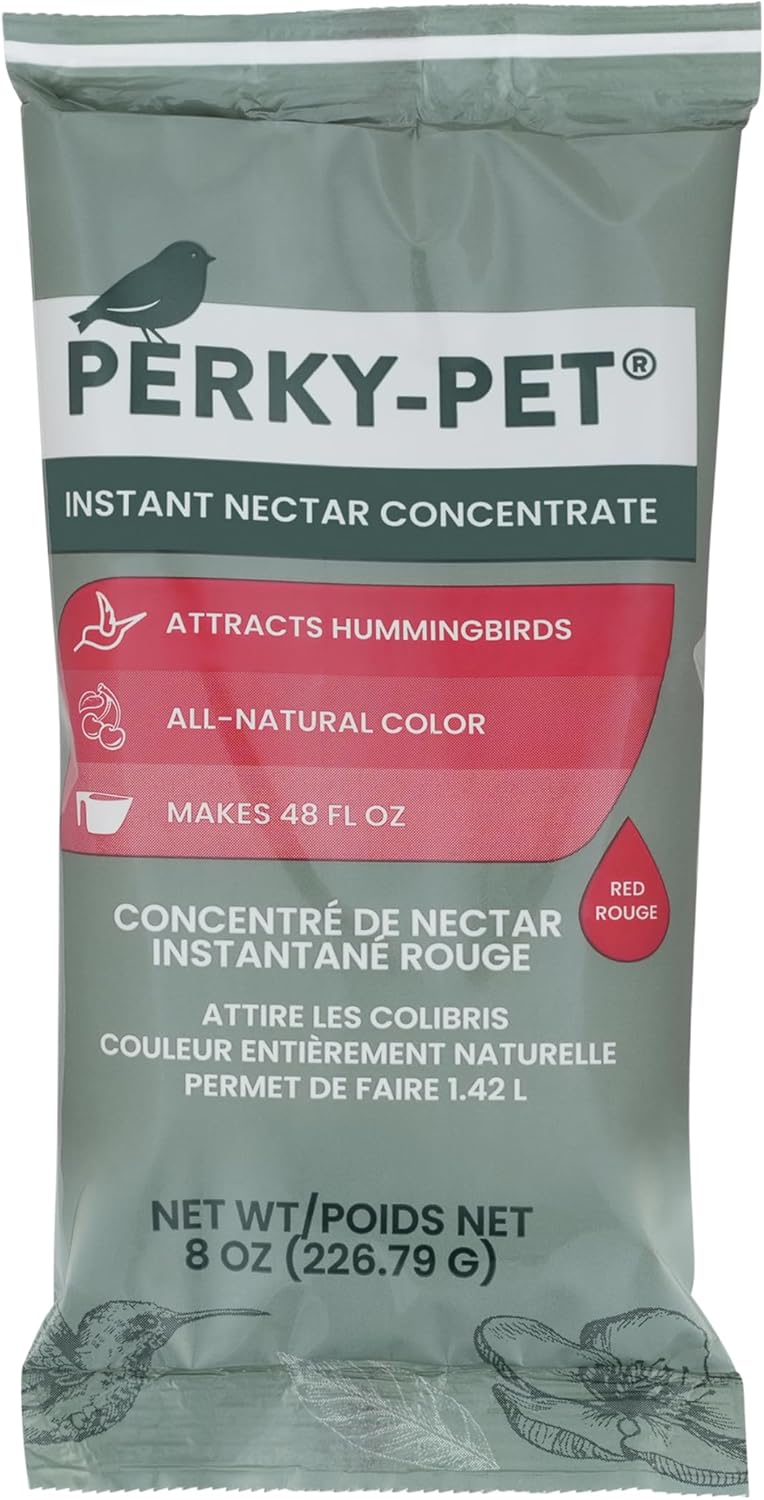
Perky-Pet Hummingbird Nectar Concentrate – 6.5/10
Best for people running several feeders who want a concentrate they can mix into large batches. Convenient, but it still contains Red 40.
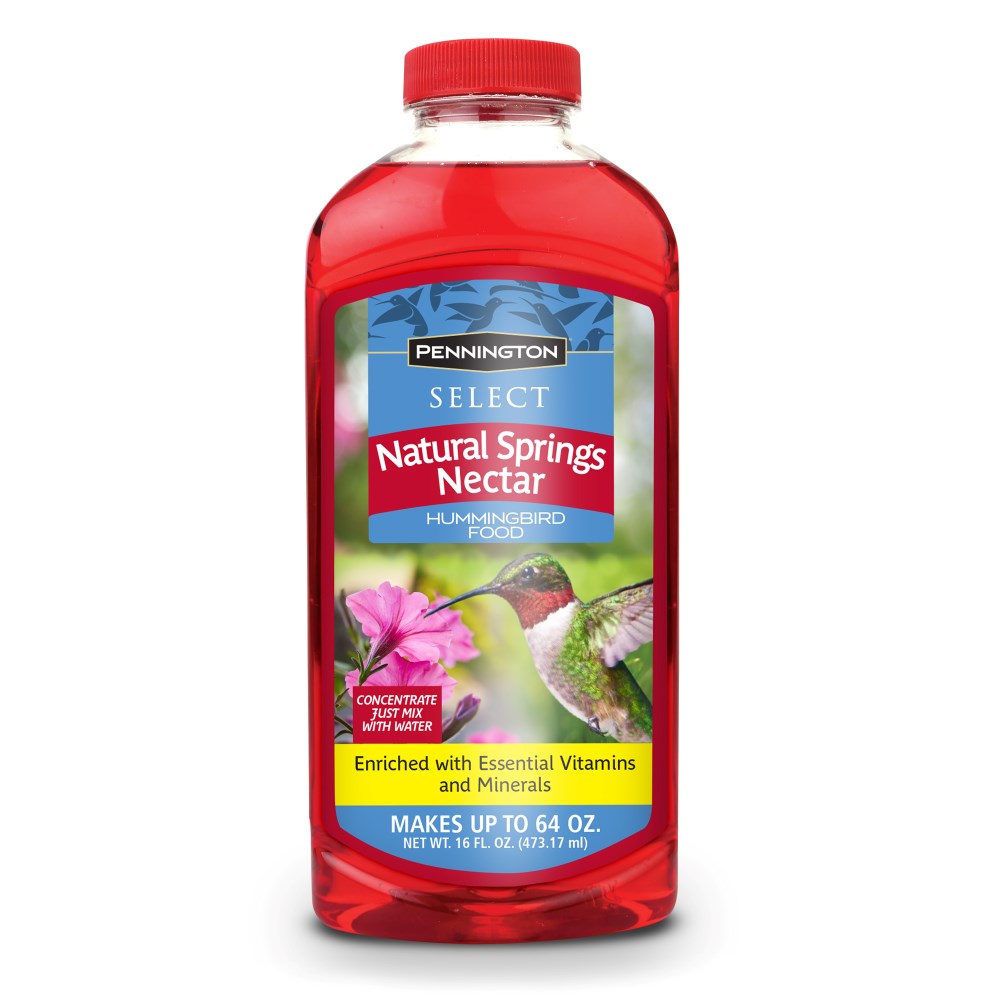
Pennington Hummingbird Nectar – 6.3/10
Best for grab-and-go convenience at a garden center — widely available with no mixing required. It carries the same dye issue as most of its competitors.
Kaytee Electro Nectar Ready to Use – 5.8/10
Best only if you want zero measuring and don’t mind paying the most per ounce. No nutritional edge over anything else on this list, and it still contains dye.
Detailed Reviews
Homemade 4:1 Nectar (White Sugar + Water)
Rating: 9.8/10
This isn’t really a “product” so much as the benchmark everything else on this list gets measured against — and it wins by a wide margin.
Pros
- No artificial dye of any kind
- Costs a fraction of any bottled alternative
- You control the concentration exactly
- Takes about 10 minutes to make a batch that lasts up to two weeks refrigerated
Cons
- Requires you to actually mix it (a five-minute task, but a task)
- Needs refrigerator space for storage
The math behind this recipe isn’t guesswork. One part sugar dissolved in four parts water produces a solution that’s roughly 20% sucrose — squarely inside the 15–35% range found in natural flower nectar depending on species. Behavioral studies on feeding hummingbirds show they actively seek out concentrations in this range over more dilute solutions, which is why this ratio has been the standard recommendation from ornithologists for decades. It’s not tradition for tradition’s sake — it’s what the data on feeding preferences actually shows.
Strip the marketing off any bottle of commercial nectar and you’ll find the same thing: sugar and water. The difference is the concentration isn’t always tuned the same way, and you’re paying a premium — sometimes a steep one — for water you could add yourself.
Nature’s Nectar Premium (Dye-Free)
Rating: 8.3/10
Pros
- No artificial dyes
- Ingredient profile closest to homemade among bottled options
- No mixing required
Cons
- Higher price than dye-containing competitors
- Less widely stocked than the big-name brands
Best for: health-conscious buyers who want the convenience of a bottle without the dye question hanging over it.
If you’ve decided commercial nectar makes sense for your situation — more on when that’s actually true below — this is the one to reach for. It’s the most commonly recommended dye-free commercial product for a reason: it gets you most of the way to homemade without any mixing.
Perky-Pet Hummingbird Nectar Concentrate
Rating: 6.5/10
Pros
- Concentrate format saves on shipping weight and storage space
- One bottle mixes into multiple gallons
Cons
- Contains Red 40 dye
- Not the choice for anyone trying to avoid artificial coloring
Best for: people running several feeders through a heavy migration season who want to mix large batches without buying case after case of ready-to-use bottles.
The concentrate format is genuinely useful if you’re maintaining five or six feeders and don’t want to prep homemade nectar daily. The dye is the sticking point — if that’s a dealbreaker, look at a dye-free concentrate instead, or just batch homemade nectar in a large pitcher.
Pennington Hummingbird Nectar
Rating: 6.3/10
Pros
- Available at most garden centers
- No mixing required — pour and go
Cons
- Contains Red 40 dye
- Moderate cost premium over homemade with no performance benefit
Best for: someone who needs nectar right now and is already standing in a garden center aisle.
There’s nothing wrong with this product functionally — birds will drink it. But you’re paying more for a dye that does nothing for the bird and exists purely to make the liquid look appealing on a store shelf.
Kaytee Electro Nectar Ready to Use
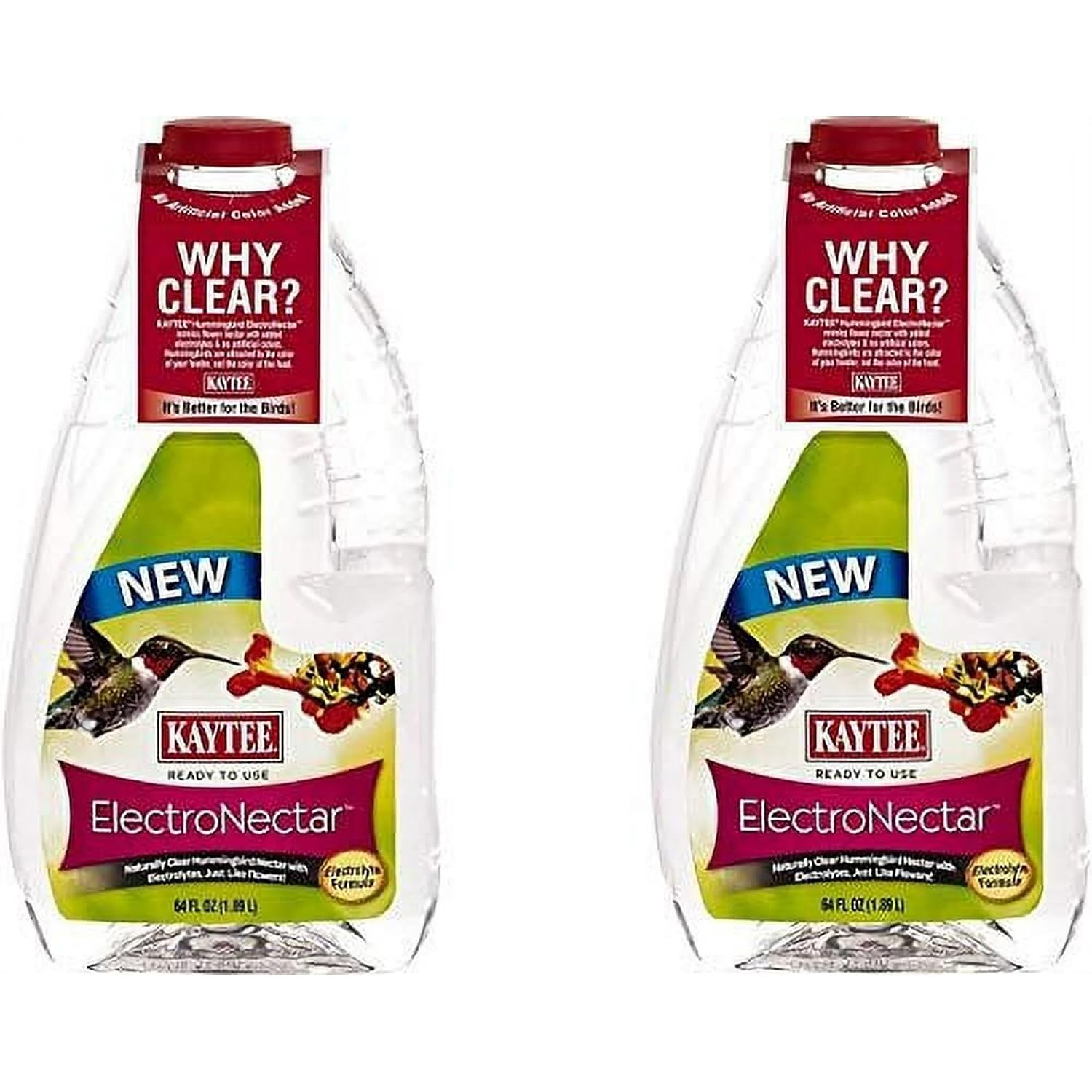
Rating: 5.8/10
Pros
- Zero measuring, zero mixing
- Simple for a first-time feeder owner who wants to eliminate every possible step
Cons
- Highest cost per ounce on this list
- Contains dye
- No nutritional advantage over any cheaper option
This is the “buy it and forget it” option, and it’s fine as a stopgap. But it’s hard to justify long term once you realize the same result — a bird happily feeding — costs a fraction as much with a bag of sugar and a measuring cup.
🏆 Editor’s Pick: Homemade 4:1 Nectar
Homemade 4:1 nectar wins, and it isn’t close.
Every other product on this list is trying to approximate what a cup of sugar and four cups of water already does perfectly: hit the concentration hummingbirds prefer, without unnecessary additives. None of the bottled options improve on that formula. The best ones, like Nature’s Nectar Premium, simply avoid making it worse.
If your priority is convenience for a specific situation — travel, a helper who’s unfamiliar with the recipe, an unrefrigerated cabin — a dye-free commercial product is a reasonable trade-off. For everyday feeding, homemade is cheaper, just as effective, and free of an ingredient that’s never been tested for safety in the animal actually drinking it.
Practical Buying Advice
When Commercial Nectar Actually Makes Sense
Commercial nectar isn’t pointless. A few situations make it the more practical choice:
- Travel and away-from-home feeding. If a neighbor is covering your feeders while you’re gone, a ready-to-use bottle removes any chance they get the recipe or ratio wrong.
- Getting started for the first time. If you’re buying a complete starter setup — feeder, hanger, nectar — grabbing commercial nectar to get going is completely reasonable. Switch to homemade once the routine is established.
- Large-scale setups during migration. Running five or six feeders through peak migration, a concentrate you mix in bulk can be more practical than batching homemade nectar every day or two. Choose a dye-free concentrate if one’s available.
- Off-grid or unrefrigerated storage. Camping trips or cabins without power benefit from the preservatives in commercial nectar, which extend shelf life at ambient temperature. Whether you want preservatives in your birds’ food at all is a separate question, but the practical use case is real.
The Homemade Recipe
Hummingbird Nectar
- 1 cup plain white granulated sugar
- 4 cups water
Bring the water to a boil. Add the sugar and stir until fully dissolved. Remove from heat and let it cool to room temperature before filling feeders. Refrigerate any unused nectar for up to two weeks.
That’s the entire recipe — no additions, no substitutions.
What to avoid:
- Honey — ferments quickly in a feeder and can trigger fatal fungal infections in hummingbirds
- Brown sugar — the molasses content can harm birds and speeds up bacterial growth
- Raw or turbinado sugar — similar issue to brown sugar; trace minerals can cause digestive problems
- Artificial sweeteners — zero calories, meaning zero fuel for a hummingbird’s extreme metabolic needs
- Organic cane sugar — not harmful, but unrefined sugar can carry trace compounds; plain refined white sugar is simpler and cheaper
Should You Ever Change the Ratio?
The standard 4:1 ratio (water to sugar) is correct for most feeding situations and most North American hummingbird species. Two scenarios are worth knowing as exceptions.
Cold weather. Some birders feeding through winter or early spring in cold climates switch to a slightly richer 3:1 ratio. The added sugar lowers the freezing point a bit, keeping nectar liquid longer overnight and giving birds a denser calorie source during cold snaps. It’s not a dramatic difference, but it’s worth doing if you’re feeding through near-freezing nights.
Peak migration. During fall migration, when hummingbirds are building fat reserves for long flights, the standard 4:1 ratio is still correct. Going richer than 4:1 in warm weather (above 70°F) can actually backfire — the thicker solution puts off birds with clear preference ranges. Stick with 4:1 when it’s warm.
Most nectar guides skip this nuance entirely and just say “always use 4:1.” That’s fine most of the year, but it doesn’t explain why birds sometimes ignore a feeder in March when the ratio “should” be right.
Storing Homemade Nectar
Sealed and refrigerated, homemade nectar keeps for up to two weeks. A 2-liter batch takes the same 10 minutes to prepare as a small one and covers several days of refills.
A recycled soda bottle or a lidded pitcher works well for storage — the narrow opening pours cleanly into most feeder designs without a funnel. Label it with the date you made it.
Never leave prepared nectar at room temperature for more than a few hours. Airborne yeast colonizes the solution much faster outside the fridge — the same process that spoils nectar sitting in a feeder during hot weather. Refrigeration doesn’t stop fermentation; it just slows it down dramatically.
What Hummingbirds Actually Prefer
Feeding studies that gave hummingbirds simultaneous access to multiple sugar concentrations found clear, consistent preferences.
At roughly 20–25% concentration — close to the standard 4:1 ratio — birds feed readily. Drop to around 10% (closer to a 9:1 dilution) and visits drop off, sometimes to the point of abandoning the feeder entirely. Push concentration above 40% (richer than 2:1) and the solution gets thick enough that birds cut visits short or avoid the feeder altogether.
The 4:1 ratio sits right in the middle of that range: dense enough in calories to be worth a bird’s time, dilute enough to stay easy to drink. It’s the standard recommendation because it’s what hummingbirds consistently choose in behavioral testing, not because it’s a ratio someone picked decades ago and nobody questioned since.
How to Buy Commercial Nectar (If You Do)
If convenience or travel makes commercial nectar the right call, shop with a short checklist:
- Check the ingredient order. Water should be listed first, sugar second. If Red 40 (or FD&C Red 40) shows up anywhere on the label, skip it — look instead for “dye-free” or “no artificial colors.”
- Check whether it’s a concentrate. Some products come pre-diluted to a 4:1 ratio; others are concentrates you mix yourself. Concentrates tend to be the more economical choice if you’re buying commercial at all.
- Default to Nature’s Nectar Premium if you want a name to start with. It’s the most commonly recommended dye-free commercial nectar, and while it costs more than the dyed alternatives, it’s the closest bottled product to homemade.
The Red Dye Question, In Plain Terms
Red Dye #40 — also labeled FD&C Red #40 or Allura Red — is what colors most commercial hummingbird nectars. It’s a petroleum-derived synthetic dye approved for use in human food by the FDA.
That approval doesn’t extend to birds. No study has tested Red 40’s safety specifically in hummingbirds, and the leap from “safe for humans in food-level amounts” to “safe for a hummingbird” isn’t a straightforward one. Birds process compounds differently than humans do, with different liver detoxification pathways, and a hummingbird drinking one to three times its body weight in nectar daily has a dramatically different relative exposure than a person eating trace amounts of dye in processed food.
Most ornithologists and bird rehabilitation specialists land in the same place: there’s no demonstrated benefit to the dye, and the risk — while unquantified — hasn’t been ruled out either. Since homemade nectar performs just as well and costs less, avoiding the dye isn’t really a sacrifice.
To be clear: there’s no confirmed evidence the dye causes harm — the research to prove or disprove that simply doesn’t exist yet. But “unknown risk” paired with “zero benefit” is a reasonable argument for choosing the option that skips it entirely.
FAQ
Is store-bought hummingbird nectar safe? The sugar-water base is safe. The red dye used in most commercial products hasn’t been tested in hummingbirds specifically, and no research confirms it’s safe at the exposure levels birds get from multiple feeder visits a day. Most ornithologists recommend dye-free nectar — homemade or one of the few dye-free commercial options — as the precautionary choice.
Can I use organic sugar for hummingbird nectar? Plain white refined sugar is the better choice over organic alternatives. Organic cane sugar, and raw or turbinado sugars, carry trace minerals and compounds left over from incomplete refining, which may be harder for hummingbirds to process. Refined white sugar gives a clean sucrose solution without those variables.
Does hummingbird nectar need to be refrigerated? Yes, between batches and uses. Homemade nectar keeps for up to two weeks refrigerated. Once it’s in the feeder, change it every 2–3 days in moderate temperatures (70–80°F) and every 1–2 days above 85°F. Refrigerated storage doesn’t replace the need to change feeder nectar on schedule.
Why are my hummingbirds avoiding a full feeder? The most likely cause is fermentation. Nectar can look perfectly clear and still have yeast activity producing ethanol and off-flavors that birds detect and avoid. Discard it, clean the feeder thoroughly (especially the ports), and refill with fresh nectar. If birds still avoid it, consider moving the feeder — placement near high foot traffic, AC units, or wind chimes can be the actual issue.
Can I make hummingbird nectar without boiling the water? Yes. Boiling helps the sugar dissolve fully and reduces the initial microbial load, but it’s not strictly necessary if you’re using hot tap water and stirring until the sugar is completely dissolved. Fermentation rate is driven by the feeder environment, not whether the water was boiled beforehand — boiling is a minor extra step that may marginally extend refrigerator freshness, but it isn’t a requirement.
Bottom Line
If you’re choosing between a bottle of dyed commercial nectar and a cup of sugar dissolved in four cups of water, the second option wins on every measure that matters: cost, concentration accuracy, and the simple fact that it skips an additive with no proven benefit. Keep a batch in the fridge, change your feeder nectar on schedule, and adjust toward 3:1 only if you’re feeding through genuinely cold nights. Save commercial nectar — ideally a dye-free one — for the specific situations where convenience actually outweighs the trade-offs: travel, a first-time setup, or feeding at an off-grid site without a fridge nearby.