
- If you're short on time:
- What counts as "cheap" here?
- Quick Picks: Best Cheap Automatic Litter Boxes Under $100
- Detailed Reviews
- PetSafe ScoopFree Crystal Classic
- LitterMaid Multi-Cat Self-Cleaning Box
- Used or Open-Box PetSafe ScoopFree
- Manual Rolling or Sifting Self-Cleaning Box
- The Refill Trap Matters More Than the Sticker Price
- Safety: Where I Get Picky
- Which Cats Should Skip Cheap Automatic Boxes?
- What About Random Amazon Automatic Litter Boxes Under $100?
- How to Switch Without Causing a Litter Box Protest
- How Often Do You Still Clean It?
- 🏆 Editor's Pick
- Best Picks By Situation
- FAQ
- So, Should You Buy One?
A $99 litter box can turn into a tiny subscription plan with poop attached.
That is the weird trap with the best cheap automatic litter box search. You start looking for a way to stop scooping, then realize half the “budget” picks cost $170, need special trays, or ask your nervous cat to trust a plastic machine with a motor.
I love the idea. I also distrust it a little.
Cheap pet tech can be clever. It can also be a box that beeps, jams, and makes your cat stare at you like you caused a personal insult.
If you’re short on time:
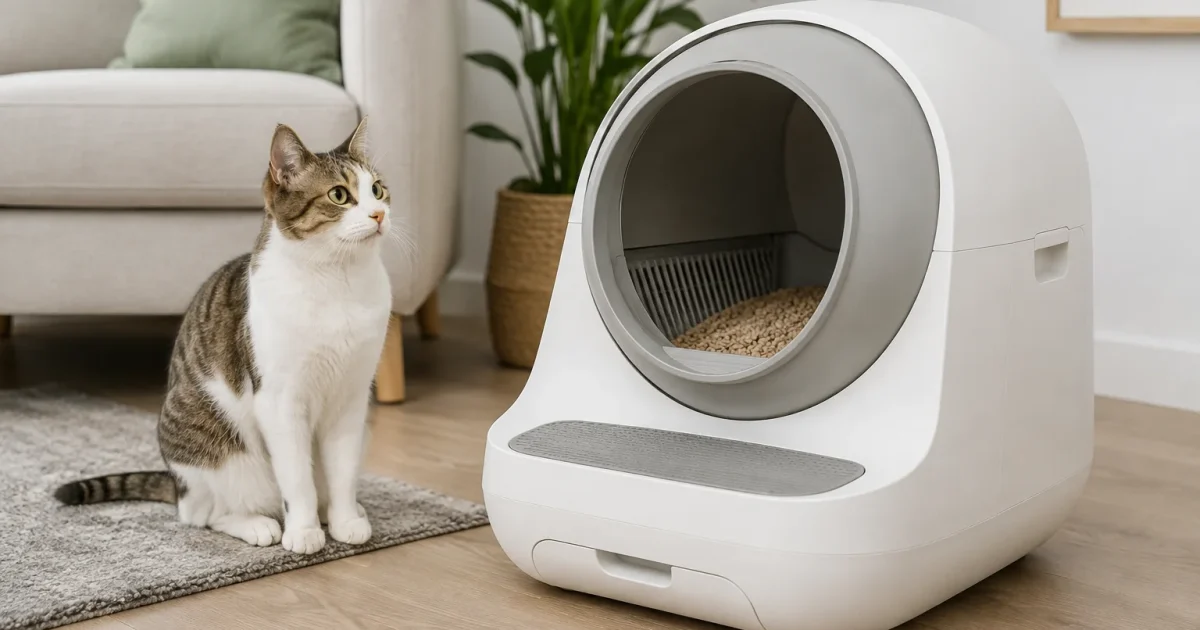
I’d pick the PetSafe ScoopFree Crystal Classic first — not because it’s perfect, but because it’s a known brand with a simple rake system and a real track record, and it stays right around the $100 line when it’s on sale. Just budget for the crystal refill trays, since that’s where the real ongoing cost lives. Under $100, I’d rather recommend a boring rake box or even a manual rolling box than a mystery closed-robot with no track record.
What counts as “cheap” here?
For this post, cheap means under $100 for the box itself. That knocks out most popular automatic litter boxes right away — Litter-Robot, PETKIT, Neakasa, Catlink, PetSafe SmartSpin, and most app-connected boxes cost far more. Some guides call a $166 box “budget.” I get why — in the auto litter box world, $166 is cheaper than $699. But that is not under $100.
A real under-$100 shopper is usually asking one of three things:
- Can I stop scooping without spending rent money?
- Is the cheap one safe?
- Will it cost more later because of refills?
Those are the questions that matter.
Quick Picks: Best Cheap Automatic Litter Boxes Under $100
PetSafe ScoopFree Crystal Classic – 8.8/10
Best overall under $100. A known brand with a simple rake system and genuinely good odor control from crystal litter — just watch the ongoing tray cost.
LitterMaid Multi-Cat Self-Cleaning Box – 6.8/10
Cheapest true automatic option, but I have real doubts. Very low upfront price when in stock, though it can jam, miss clumps, and needs a forgiving return policy.
Used or Open-Box PetSafe ScoopFree – 7.5/10
Best for tight budgets. May get you a better model than $100 buys new, as long as you check for missing parts and lingering smell first.
Manual Rolling or Sifting Self-Cleaning Box – 7.2/10
Best if you want less scooping without a motor. No plug, no sensor to worry about, and no automation — which for some cats and owners is exactly the point.
That last one may annoy people — I know the title says automatic. But under $100, I would rather mention a good manual self-cleaning option than pretend five bad automatic boxes are worth your money.
Detailed Reviews
PetSafe ScoopFree Crystal Classic

Rating: 8.8/10
This is the one I would tell a friend to try first. It has the least exciting design in the room, and that is part of the appeal. It does not try to weigh your cat, send you app alerts, or look like a space capsule. It rakes. It traps waste. It uses crystal litter. That is the job.
Pros
- Known brand with a real track record
- Simple rake mechanism
- Crystal litter genuinely helps with odor control
- Stays near the $100 line when on sale
Cons
- Refill trays and crystal litter aren’t cheap, and the cost adds up faster with more than one cat
- Not roomy — larger cats may feel cramped, and diggers may kick crystals out
- Crystal litter texture isn’t loved by every cat
Best for one small-to-medium cat, people who hate daily scooping, and people who want better odor control and don’t mind buying crystal trays regularly. If your cat already hates crystal litter, don’t force this box — you may end up with pee on the bath mat and a new personal problem. I would not call it no-maintenance. I would call it less daily work. That is a big difference.
LitterMaid Multi-Cat Self-Cleaning Box
Rating: 6.8/10
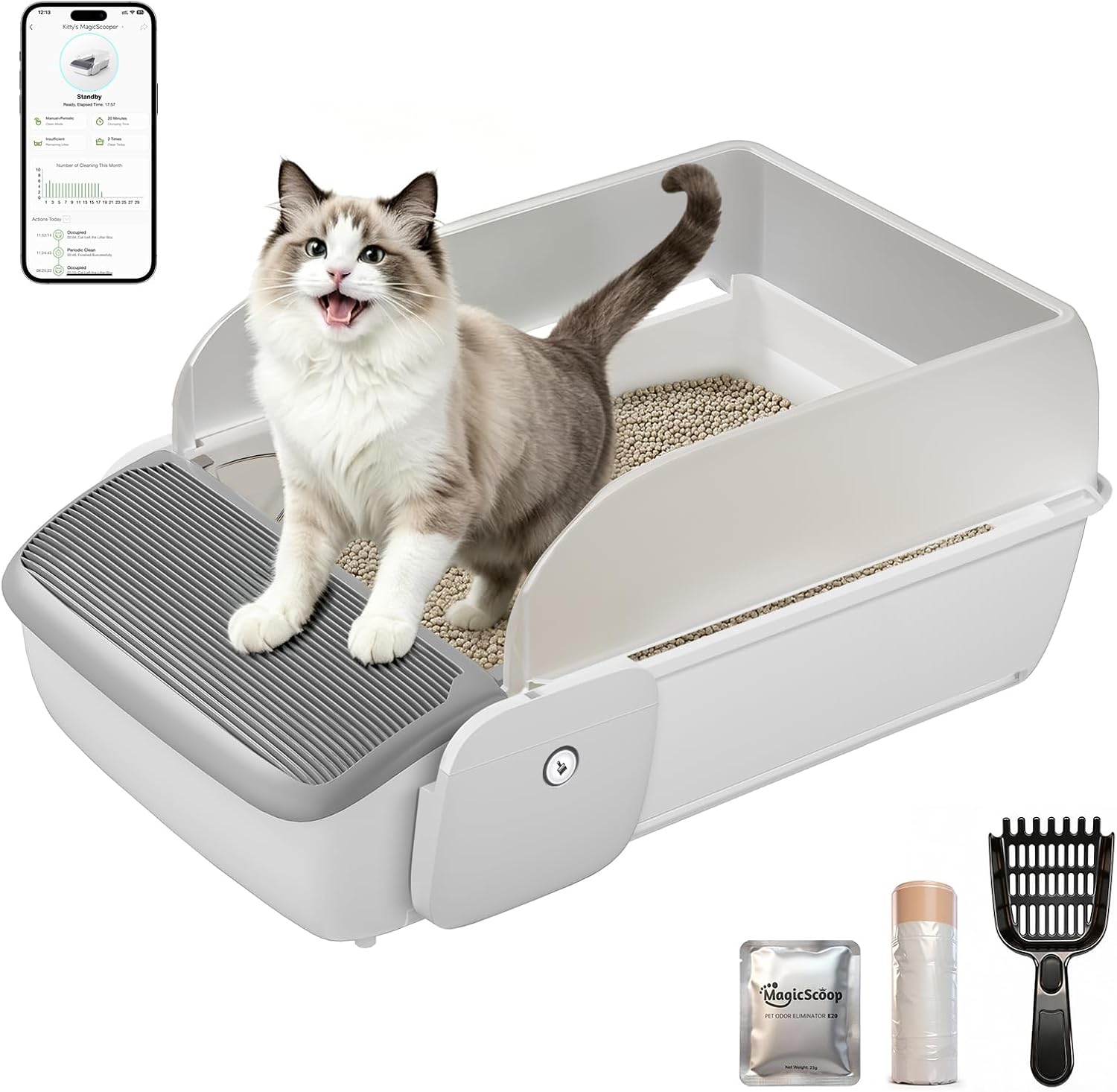
The classic cheap rake box. It uses clumping litter, which sounds great if you don’t want to switch to crystals — the rake moves through the litter and pushes clumps into a front waste tray. In theory, lovely.
Pros
- Lowest upfront price of the true automatic options
- Uses clumping litter instead of requiring a switch to crystals
Cons
- Needs the right litter level and firm clumps to work reliably
- Rake teeth need regular cleaning
- Can miss small bits, make noise, or jam
In real life, these boxes can be picky. I am not 100% sure I would buy one new unless the return policy was easy. Cheap automatic litter boxes fail in boring ways — a cheap rake box just slowly becomes a scoop you plug into the wall.
Best for a small or average-size cat on firm clumping litter, if you don’t mind cleaning the rake and are patient with fussy gadgets. I would skip it for big cats, high-peeing cats, and anyone wanting a true set-it-and-forget-it box — there is no such thing under $100.
Used or Open-Box PetSafe ScoopFree

Rating: 7.5/10
Not glamorous advice, but possibly the smartest route on a tight budget. Check local used listings for older PetSafe ScoopFree models — sometimes people sell them because their cat refused to use them, which is sad for them and useful for you.
Pros
- Potential to get a better model than $100 buys new
- Same known-brand reliability as buying new
Cons
- Requires careful inspection before buying
- Refill availability for older models needs to be confirmed
Before buying, check whether the rake moves smoothly, whether the power cord and waste cover are included, whether the tray is cracked, whether you can still buy refills, and whether it smells deeply baked-in. The smell test is real — plastic holds odor, and if a used box smells bad before litter goes in, don’t bring that curse into your home.
Manual Rolling or Sifting Self-Cleaning Box

Rating: 7.2/10
Not automatic — I know the title says automatic — but it may solve the real problem. A rolling self-cleaning box lets you tilt or roll it so clumps separate into a tray. You still do the motion, but you don’t dig through the whole box with a scoop.
Pros
- No motor, sensor, or plug to worry about
- Cheap and straightforward
- Good option for nervous cats uneasy around moving machines
Cons
- Not truly automatic — you still have to do the rolling or sifting yourself
- May still be too much physical motion for wrist or back pain
Best for people who want less scooping, not a motor, and for cats who’d rather not share a room with anything that beeps or grinds.
The Refill Trap Matters More Than the Sticker Price
This is where cheap automatic litter boxes get sneaky. A $99 box can cost more than a $150 box if it locks you into pricey refills. The PetSafe crystal system is the best example — it can work well, but the trays add up. That does not make it bad. It just means you should do the math before buying.
Say a refill tray costs around $20 to $25. If one tray lasts three weeks for one cat, that might be okay. If it lasts ten days because you have two cats, the cheap box starts feeling a lot less cheap. A clumping-litter box may cost less each month, but if it jams, misses clumps, and needs hand-cleaning, the money saved may not feel worth it.
This is the part most product lists rush through. They show the box price. They don’t show the “I am wiping a rake at 11 p.m.” price.
My simple cost rule: before buying, write down three numbers — box price, monthly litter or tray cost, and replacement waste bag or filter cost. Then ask yourself one blunt question: would I still buy this if it cost me that much every month for one year? If yes, fine. If no, get a normal high-sided box and a good scoop. A well-kept basic box beats a bad robot every time.
Safety: Where I Get Picky
I do not like cheap closed rotating boxes from unknown brands. Some automatic litter boxes have had scary reports tied to poor designs — the biggest worry is a box where the entrance can close during the cleaning cycle. If the sensor fails, that is not a small problem.
For under $100, I would avoid anything that looks like a tiny washing machine with a closing door. I would look for:
- Open access during cleaning
- A known brand
- Clear safety sensor info
- Easy manual shutoff
- A return policy
- Real customer support
Also, do not use auto mode for young kittens. Kittens are small, curious, and deeply committed to bad timing. If the brand says to keep it unplugged for kittens, listen. A regular box is boring, safe, and cheap — your kitten will survive the lack of gadget culture.
Which Cats Should Skip Cheap Automatic Boxes?
Some cats are not good matches for cheap auto boxes, and a fancy product page won’t always say this clearly. Skip the cheap automatic box if your cat is:
- Over 15 pounds and long-bodied
- Very nervous around noise
- A senior cat with stiff hips
- A kitten
- A high pee-er
- Already having litter box problems
That last one matters. People often buy an automatic litter box because their cat is peeing outside the box — I would not start there. A new moving machine can make the problem worse. First, rule out pain, stress, dirty litter, box size, location, and conflict with other cats. Then think about automation.
What About Random Amazon Automatic Litter Boxes Under $100?
Most true robot boxes under $100 make me suspicious. Not because cheap always means bad — some cheap pet products are fine, and a stainless bowl can be cheap and last forever. But a moving litter box is different. It has a motor, sensors, a waste path, and your cat’s trust involved. That is a lot to hang on a mystery product.
I would be extra careful with listings that have no clear brand site, strange review patterns, poor safety-claim wording, product photos shared across many different brands, no warranty details, or a closing chamber design. A low price can feel brave for about five minutes. Then your cat refuses to enter it, or the motor grinds, or you can’t find replacement bags — and suddenly your bargain has become a plastic sculpture of regret.
How to Switch Without Causing a Litter Box Protest
Do not remove the old box on day one — that advice gets repeated because it is right.
Put the new automatic box near the old one. Leave it unplugged for a few days. Let your cat sniff it, step in, and judge it in silence. Add a small scoop of used litter to the new box to signal, “yes, this weird object is also a bathroom.”
Once your cat uses it a few times, run one cleaning cycle while your cat is nearby but not inside. Don’t make a big event out of it — no cheering, no clapping. Just let the box move.
If your cat looks scared, slow down. Some cats need a week. Some need a month. Some never agree. That is not failure. That is cats.
How Often Do You Still Clean It?
Less often than a normal box. Not never.
You still need to empty waste, replace trays or bags, wipe the rake, clean the corners, and check that nothing is stuck. This is where cheap models lose points — they often have more little grooves where waste can sit, and that smell gets rude fast.
I would do a quick check every day for the first two weeks. After that, you’ll know the rhythm. For one cat, the box can often go several days before you touch it. For two cats, don’t expect magic. Poop math is undefeated.
🏆 Editor’s Pick
The PetSafe ScoopFree Crystal Classic is still the one I’d point people toward. It’s not the cheapest option here, and the refill cost needs a real budget line, not an afterthought — but it’s the only pick on this list with the track record to trust near your cat unsupervised. If the refill math doesn’t work for your household, or you have more than one heavy litter box user, a manual rolling box or a good basic high-sided pan will serve you better than gambling on a no-name closed robot just to save a motor’s worth of effort.
Best Picks By Situation
For apartments: I’d still choose the PetSafe ScoopFree Crystal Classic. The odor control matters most in a small space, where one bad litter box can take over the whole place. Place it in a quiet corner with easy access — not beside the washer, dryer, or a loud air purifier, and not trapped behind a door or next to the food bowl. If your bathroom is tiny, measure first; cheap boxes sit lower than big robots but still need room for the tray and rake path.
For multiple cats: Under $100, I don’t love any option for multiple cats. The PetSafe can work for two cats if they’re small, calm, and not heavy users, but refill cost rises and smell shows up sooner. The LitterMaid Multi-Cat sounds like the better fit by name, but names don’t clean litter. For two cats, I’d rather run one automatic box plus one regular backup box with daily checks than expect one cheap auto box to replace all litter boxes in a multi-cat home. Cats like choices, and they also like not being cornered while using the bathroom. Fair.
For odor control: PetSafe wins again — crystal litter handles urine smell better than most cheap clumping setups, and the covered waste trap helps too. But odor control still depends on your cat, food, room airflow, and how long you push a tray before replacing it. Don’t stretch refills too far; once crystal litter is done, it stops feeling fresh and starts smelling like you’re negotiating with science. A small litter mat in front and a trash bag nearby for fast tray changes both help. Skip strong fragrance sprays around the box — many cats hate that, and honestly, so do I. Fake lavender mixed with cat waste is not peace. It is confusion.
If you hate scooping but fear motors: Get a manual rolling or sifting box. No sensor, no app, no motor — for nervous cats, that can be a real win. For people with wrist or back pain, it may still be too much motion, in which case an auto rake box could be the better tradeoff. Real advice has conditions. Annoying, but true.
FAQ
Is there really a good automatic litter box under $100? Yes, but the list is short. The PetSafe ScoopFree Crystal Classic is the most sensible pick when it’s priced under $100. LitterMaid can also fall under that price, but I trust it less because rake boxes can be fussy.
Can I use regular clumping litter in the PetSafe ScoopFree Crystal Classic? No, not in the usual setup — it’s made for crystal litter trays. If you want to use regular clumping litter, look at a rake box made for clumping litter instead, and know that cheap clumping-litter machines can need more cleaning.
Will a cheap automatic litter box smell worse than a normal box? It can, if waste gets stuck or the tray sits too long. A good cheap box can smell better than a dirty regular box. A bad cheap box can smell worse because waste hides in corners and rake parts.
Do I still need a backup litter box? Yes, at least while your cat is learning. For multi-cat homes, I would keep a backup box long term. One machine should not be the only bathroom in the house.
Are cheap automatic litter boxes safe for kittens? I would not run auto mode for kittens. Use a normal litter box until your kitten is older and large enough for the sensors to detect well. Cheap or expensive, moving litter boxes deserve caution.
So, Should You Buy One?
Buy the PetSafe ScoopFree Crystal Classic if you have one small or medium cat, want less scooping, and can live with crystal refill costs.
Try LitterMaid only if upfront price matters most and you’re okay with some tinkering.
Skip no-name closed robot boxes under $100 — I would not gamble there.
And if your cat is picky, senior, huge, anxious, or already avoiding the litter box, spend the money on a better basic setup first. Big open pan. Good litter. Quiet spot. Daily scoop. That is not as fun as buying a robot. It works more often.